

Dreams are the strangest stories we ever tell — written by the sleeping mind, screened behind closed eyes, and half forgotten by breakfast. The Merriam-Webster definition of dream describes a series of thoughts, images, and sensations occurring in the mind during sleep — and the similes for dream in this collection follow those night journeys into sweet rest, surreal worlds, and the hopes we carry into the day.

Writers reach for dream similes because dreams are almost impossible to report plainly. Saying a character dreamed tells nothing; saying her dream was like a staircase climbing into the sky shows its wonder and its sudden end.

Below you will find 45 similes for dream in five groups — sweet and peaceful dreams, strange and surreal dreams, vivid dreams that feel real, daydreams, and dreams as hopes and goals. Each comes with a simple meaning, so you can pick the exact mood you need.
Match the image to the moment: a melting clock for a dream that makes no sense, a seed under winter soil for a hope still waiting. And when the dreamer wakes and you need the quiet around the dream itself, see our similes for sleep as well.
Sweet and Peaceful Dreams
Begin with the dreams nobody wants to leave: soft, safe, and slow. These similes suit lullabies and any character who sleeps the sleep of the untroubled.
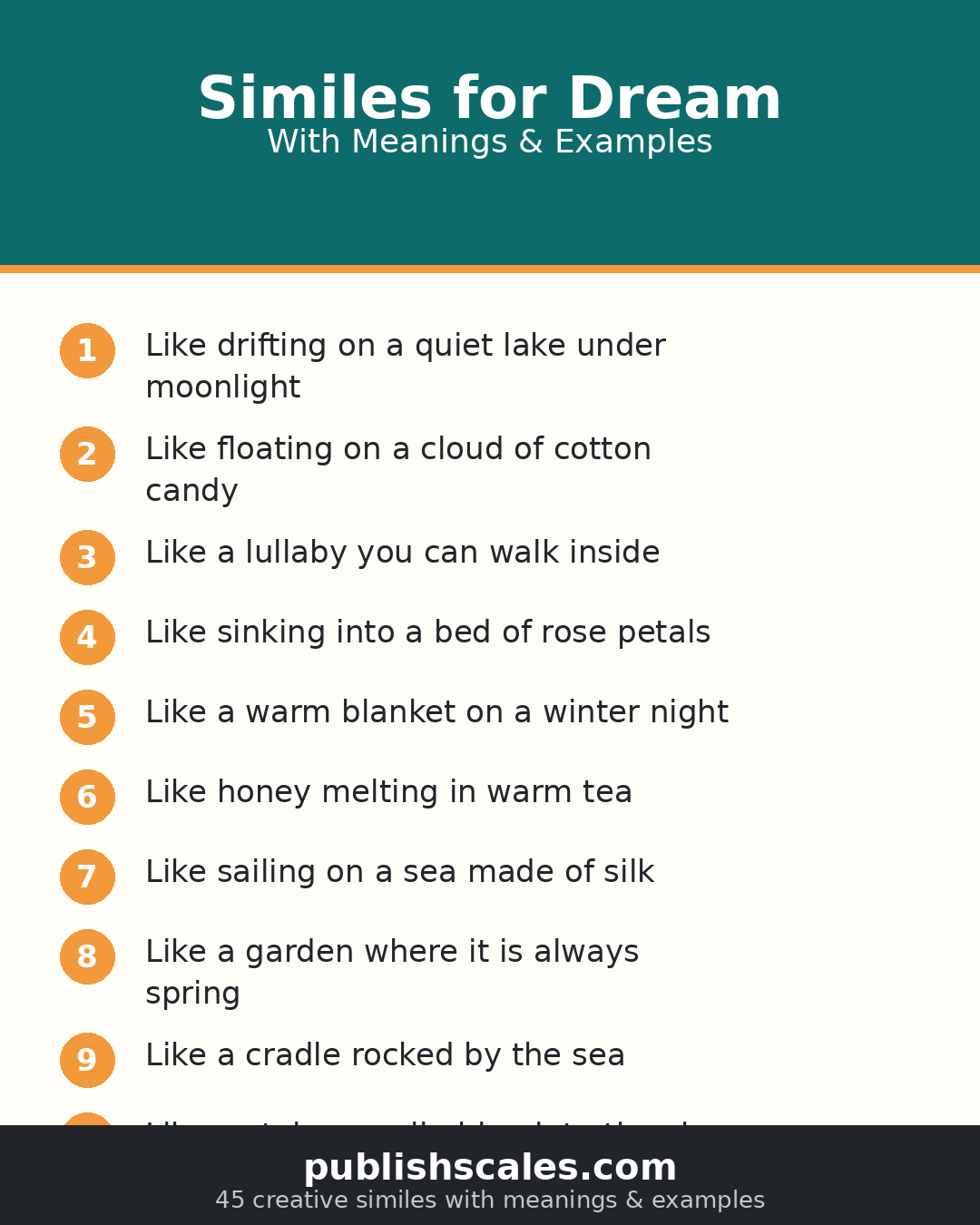
Like drifting on a quiet lake under moonlight
Perfectly calm and unhurried, as if the night itself were holding its breath.
Like floating on a cloud of cotton candy
Soft, sweet, and slightly unreal — a dream so gentle that waking feels like a small loss.
Like a lullaby you can walk inside
A dream that wraps around you like music; everywhere you wander is safe and warm.
Like sinking into a bed of rose petals
Luxurious softness touched with perfume; rest that feels beautiful as well as deep.
Like a warm blanket on a winter night
Simple, complete comfort: the cold locked outside, warmth folded around the sleeper.
Like honey melting in warm tea
Slow, golden, and sweet — worries dissolving until the mind turns clear.
Like sailing on a sea made of silk
Effortless, noiseless movement over a surface that never rocks or threatens.
Like a garden where it is always spring
A dream of unfading colour, where nothing wilts and every path leads somewhere lovely.
Like a cradle rocked by the sea
Rocked gently by something vast and kind: the oldest, safest rhythm of sleep.
Strange and Surreal Dreams
Now for the dreams that ignore every rule, where the sleeping mind rearranges the world: clocks melt, faces swap, and yesterday keeps answering the door.
Like a staircase climbing into the sky to a locked door
Hopes built step by step, then refused an explanation at the top.
Like fish swimming through the air of your living room
The familiar world turned impossible: ordinary creatures in the wrong element, calm as ever.
Like a clock melting over the edge of a table
Time gone soft and useless, the way dream minutes stretch or vanish between blinks.
Like a hallway of doors, every one opening into yesterday
A dream that keeps returning you to the past, whichever future you choose.
Like meeting a stranger who wears your own face
Unsettling yet intimate: the parts of yourself you recognise but do not know.
Like rain falling upward into the clouds
The world’s laws politely reversed, and the dreamer accepts it without question.
Like a train pulling into a station inside your childhood home
Two worlds folded into one: journeys and childhood sharing the same impossible platform.
Like a moon wearing a top hat, bowing as you pass
Courtly nonsense — the dream world treating you as guest of honour at an unexplained ceremony.
Like a library where the books whisper your name
Secrets that seem to know you personally: inviting and eerie in equal measure.
Vivid Dreams That Feel Real
Some dreams do not feel like dreams at all. These describe the ones with weight, texture, and sound — the ones dreamers swear were real until morning.
Like a film in a cinema inside your head
Full colour, dialogue, and drama, watched from a front-row seat you never chose.
Like a second life lived between dusk and dawn
A dream so complete it has its own places and people — a whole biography in one night.
Like a memory of a day you never actually lived
So convincing that the mind files it with real memories and argues with it at breakfast.
Like flying with the wind truly on your face
Flight that convinces every sense: speed, height, and cold air all feel real.
Like a photograph so sharp you can count the leaves
Detail far beyond ordinary dreams, as if the mind had upgraded its eyes.
Like a storm you can smell before it breaks
Weather so real the nose believes it; the dreamer smells rain before it falls.
Like holding a warm cup in hands you can truly feel
Small, solid proof: heat, weight, and texture all reporting that this world is real.
Like a voice so near it stirs the hair on your neck
Sound with breath in it — a dream voice close enough to raise goosebumps.
Like waking inside a room more solid than your own
A dream room so detailed that your own bedroom feels flimsy beside it on waking.
Daydreams
Daydreams are the waking cousins: lighter, voluntary, easily popped. Use them for characters whose eyes are open but whose minds have left the room.
Like a soap bubble drifting over a busy street
Beautiful and weightless, one sharp moment from vanishing above an ordinary day.
Like clouds building castles in a summer sky
Imagination at leisure, raising towers nobody expects to last the afternoon.
Like a kite tugging your thoughts up into the blue
A daydream pulling the mind off the ground, asking only for more string.
Like a film trailer for the life you want to live
Short, shining previews of a hoped-for future, edited to show only the best scenes.
Like a window opening onto somewhere else entirely
The eyes stare at one room while the mind steps into another country, another life.
Like a favourite song playing in the back of your mind
A pleasant loop beneath the day, colouring everything else — half heard, wholly enjoyed.
Like doodles blooming in the margin of a notebook
Small creations growing by themselves while attention is supposed to be elsewhere.
Like a hammock strung between two ordinary hours
A rest for the imagination, slung in the gap between one duty and the next.
Like a postcard from a future you have not visited yet
A bright message from the life ahead — just enough picture to keep you walking towards it.
Dreams as Hopes and Goals
In daylight language, a dream is something we work towards. These similes treat hopes as living things that sleep, guide, burn, and grow.
Like a seed sleeping under the winter soil
A hope that looks dead on the surface but is quietly alive, awaiting its season.
Like a star you steer your ship by
A distant goal that directs every decision and keeps you on course, though you may never touch it.
Like a lighthouse on a coast you have not reached
A goal that warns and welcomes at once, shining from an unreached shore.
Like a map with one road drawn in gold
Among all life’s possible routes, one shining path matters more than every other.
Like a flame cupped against the wind
A fragile ambition that survives only because someone shields it daily from doubt.
Like a mountain summit seen from the valley floor
A goal impossibly far away, yet visible enough to measure every step against.
Like a letter you write to your future self
A dream kept as a promise on paper, addressed to the person you intend to become.
Like a bridge still being built, plank by plank
A hope under construction: not yet crossable, but stronger with every day of work.
Like a key carried for a door not yet found
Faith that the right opening exists somewhere, and the key stays polished until it appears.
Bonus: Build Your Own Dream Simile
The best dream simile is the one only you could write, because nobody else has slept inside your dreams. This activity builds one in four steps, then shows three finished examples.

Step 1 — Name the dream’s mood. Was it sweet, strange, vivid, or hopeful? Pick one family from this page first; peaceful and surreal dreams need completely different pictures.
Step 2 — Steal a picture from waking life. Choose something your reader knows by sense: warm bread, a candle, a kite, a station platform. The picture must be ordinary, even if the dream was not.
Step 3 — Join them with like or as. Put the dream first, the picture second: her dream was like… Then finish the line with a small surprise; surprise is where freshness lives.
Step 4 — Add one true detail. Give the picture a sound, a smell, or a temperature. One honest detail turns a comparison into a scene.
Here are three built with exactly this recipe:
Example 1: Her dream was like a night train crossing snowy fields — silent, unstoppable, lit from within. (Mood: vivid. Picture: a train. Detail: the silence.)
Example 2: His ambition was like a paper boat on a monsoon river — small, brave, and somehow still afloat. (Mood: hopeful. Picture: a paper boat. Detail: the rough water.)
Example 3: The daydream came like a cat through an open window — uninvited, graceful, and impossible to send away. (Mood: daydream. Picture: a cat. Detail: the open window.)
Quick Reference: 10 Similes for Dream at a Glance
Need one fast? This table matches ten of the most useful dream similes to the moments they describe best.
| Simile | What It Describes |
|---|---|
| Like drifting on a quiet lake under moonlight | Deep calm and completely untroubled sleep |
| Like floating on a cloud of cotton candy | A sweet, soft dream full of comfort |
| Like a staircase climbing into the sky to a locked door | A strange dream that refuses to explain itself |
| Like rain falling upward into the clouds | A surreal dream where the world’s rules are reversed |
| Like a second life lived between dusk and dawn | A dream so vivid it feels completely real |
| Like a memory of a day you never actually lived | A vivid dream the mind mistakes for a memory |
| Like clouds building castles in a summer sky | An easy, imaginative daydream |
| Like a postcard from a future you have not visited yet | A daydream about the life you hope for |
| Like a seed sleeping under the winter soil | A hope quietly waiting for its season |
| Like a star you steer your ship by | A goal that guides every choice you make |
How to Use Dream Similes in Writing
First, decide which kind of dream your scene contains. A sleeping dream, a daydream, and an ambition share one word but three different weathers; the simile must match the weather, or readers feel a wrong note they cannot name.
Next, load the image with one sense beyond sight. Dreams are remembered in fragments: a smell of rain, a voice too close, a cup’s weight. A simile carrying sound, touch, or smell feels dreamed, not merely described.
Then place your strongest simile at the border of sleep: falling under, the dream’s strangest second, or the jolt of waking. Borders are where readers lean in, and one exact image there does a paragraph’s work.
Finally, let the dream change the dreamer. A simile earns its place when the character wakes kinder, braver, or more afraid. If the dream changes nothing, cut it; readers can tell.
Common Mistakes to Avoid with Dream Similes
Dream is a generous word, which is exactly why writers spend it carelessly. Watch for these five traps.
Calling every dream a movie
The dream-like-a-movie comparison is the first one everyone reaches for, so readers have seen it too often to feel it. Fix it by naming one unforgettable frame instead: the staircase, the whispering library, the melting clock.
Mixing the two meanings of dream in one passage
A character cannot drift like a soap bubble and steer like a star in one breath: one image means sleep, the other ambition, and together they blur both. Decide which dream you mean and keep every image in that family.
Using peaceful images inside a nightmare
Cotton candy clouds and rose petals cannot carry dread, however dark the sentence around them. Match the picture to the fear: a voice too near, a door that will not stay shut.
Stacking five dream images in one dream sequence
A lake, a library, a train, and a melting clock in ten lines do not deepen the dream — they wake the reader up. Choose the single strangest image and let the rest stay plain.
Forgetting to bring the dreamer back
Writers describe the dream beautifully, then drop it at waking as if it never happened. Always leave a trace: a mood, a decision, or a sentence at breakfast the dream put there.
Frequently Asked Questions
What is a simile for dream?
A simile for dream compares a dream, a daydream, or an ambition to something familiar using like or as. For example, a peaceful dream can be like drifting on a quiet lake under moonlight — calm and safely far from shore.
What is a good simile for a beautiful dream?
One of the most loved is like floating on a cloud of cotton candy, joining softness and sweetness in one picture. For something quieter, like a lullaby you can walk inside works beautifully.
How do I describe a dream that feels real?
Use the senses the dream fooled: weight, warmth, sound, and smell. Like holding a warm cup in hands you can truly feel works because the detail is small, solid, and checkable inside the dream.
What is a good simile for a strange dream?
Pick an ordinary thing behaving impossibly: rain falling upward, fish in living-room air, a staircase to a locked door in the sky. The stranger the behaviour, the more dreamlike it feels.
What is the difference between a simile and a metaphor for dream?
A simile compares with like or as — her dream was like a garden in spring. A metaphor states it directly — her dream was a garden in spring. Similes feel clearer; metaphors, bolder.
Final Thought
A dream lasts minutes and can steer a whole life. Choose the image that matches its true weather — sweet, strange, vivid, or hopeful — and one honest line will do what a page of summary cannot.

The PublishScales Editorial Team researches and writes clear, original guides to similes and figurative language.


