

Every story has a door in it. Someone walks out of a house, a job, a city, or a relationship, and everything changes. Plain words, however, rarely capture that moment. Saying that a character simply went away tells the reader almost nothing. This is where similes for leaving earn their place. A simile compares the departure to something familiar, so readers can feel its speed, its mood, and its weight in a single line. The dictionary keeps the act simple: to leave is to go away from a place or a person, as the Merriam-Webster definition of leave explains. A good simile takes that plain meaning and gives the moment a heartbeat.
Leaving, of course, is not quite the same as saying goodbye. Goodbye is the farewell itself, the words spoken at the door; leaving is the going, the turning away and the road that follows. If you need comparisons for the farewell moment, our similes for goodbye collection covers it warmly. Below, in contrast, you will find forty-five leaving similes grouped by scene and mood, from quiet escapes at home to bold new beginnings. Each one comes with a plain meaning and an example sentence, so you can lift it straight into your own writing.
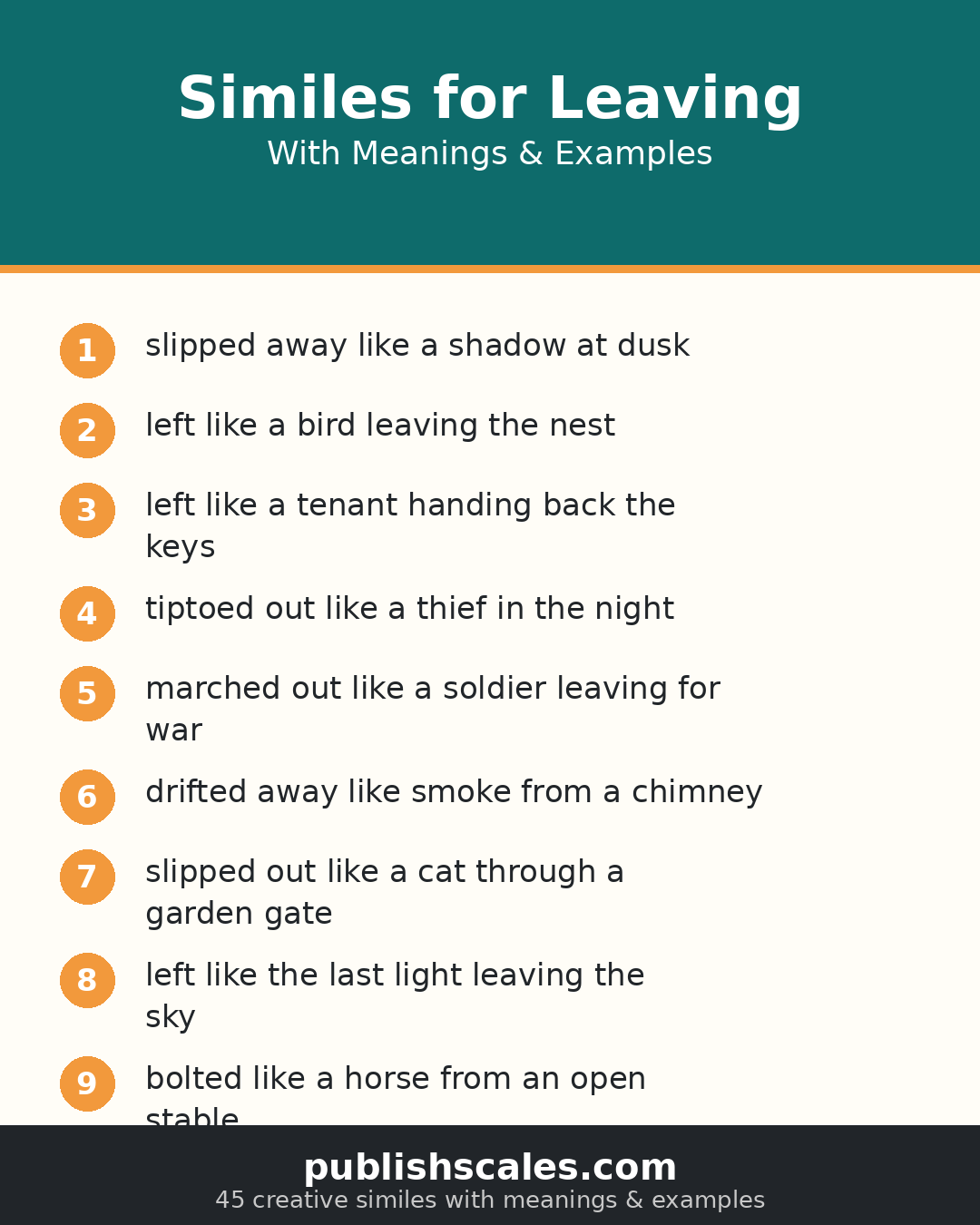
Leaving Home
Home is the hardest place to leave, because every corner holds a memory. Indeed, the front door has witnessed more emotion than any other part of the house. These similes capture the quiet, brave, and sometimes secret ways people slip out of the place they know best.
- slipped away like a shadow at dusk
Meaning: quietly and unnoticed, without any fuss or farewell scene.
Example: Meanwhile, while the family argued in the kitchen, Zara slipped away like a shadow at dusk. - left like a bird leaving the nest
Meaning: stepping out into independence for the first time, nervously but bravely.
Example: On her first morning at university, Ayesha left like a bird leaving the nest, suitcase in hand and heart pounding. - left like a tenant handing back the keys
Meaning: finally and formally, with nothing left to come back for.
Example: After twenty years in the old house, Mr. Alvarez finally left like a tenant handing back the keys. - tiptoed out like a thief in the night
Meaning: secretly, hoping nobody would notice or try to stop them.
Example: In fact, Hamza was so afraid of tears that he tiptoed out like a thief in the night and caught the early train. - marched out like a soldier leaving for war
Meaning: bravely and with a heavy sense of duty, knowing the parting may be long.
Example: With his bag on his shoulder, Daniel marched out like a soldier leaving for war; indeed, nobody tried to stop him. - drifted away like smoke from a chimney
Meaning: gradually, almost without anyone marking the exact moment.
Example: One by one, the cousins moved abroad, and each drifted away like smoke from a chimney. - slipped out like a cat through a garden gate
Meaning: silently and gracefully, along a familiar escape route.
Example: When the visitors arrived, little Omar, meanwhile, slipped out like a cat through a garden gate. - left like the last light leaving the sky
Meaning: slowly and sadly, as a warm chapter fades away.
Example: Grandmother left the family home like the last light leaving the sky, looking back at every room. - bolted like a horse from an open stable
Meaning: eagerly and suddenly, the moment freedom appeared.
Example: Finally, when the last bell rang, the twins bolted like a horse from an open stable.
Walking Away
Some departures happen mid-scene, right in front of other people. In such moments, body language speaks first: shoulders turn, steps quicken, and a turned back becomes the final word. The similes below, therefore, focus on the walk itself, whether it is proud, graceful, or impossible to stop.
- walked away like a king leaving a throne
Meaning: with pride and dignity, refusing to beg or look back.
Example: Above all, Nadia valued her pride, so she walked away like a king leaving a throne. - turned away like a page being turned
Meaning: decisively, closing one chapter and starting another.
Example: After all, there was nothing left to say, so she turned away like a page being turned. - strode off like a storm leaving a harbour
Meaning: powerfully and noisily, leaving disturbance behind.
Example: Furious at the decision, the coach, in fact, strode off like a storm leaving a harbour, slamming the gate behind him. - walked off like a dancer leaving the stage
Meaning: gracefully, well aware that every eye is watching.
Example: With a small bow to the crowd, Elena walked off like a dancer leaving the stage. - wandered off like a cloud crossing the moon
Meaning: slowly and dreamily, without a clear destination.
Example: After dinner, Grandpa wandered off like a cloud crossing the moon, lost in old memories. - marched away like an army in retreat
Meaning: in an orderly but defeated way, saving strength for another day.
Example: Outnumbered in the debate, the students, as a result, marched away like an army in retreat. - slipped away like water through fingers
Meaning: impossible to hold on to, however hard someone tries.
Example: Bilal, of course, slipped away like water through fingers before the farewell dinner even began. - left like a lighthouse keeper at dawn
Meaning: quietly, the duty done, with no ceremony at all.
Example: When the long night shift finally ended, Tomas left like a lighthouse keeper at dawn. - strode away like a giant through a doorway
Meaning: too big for the place, having outgrown it completely.
Example: The small office could not hold her ambition, so Priya strode away like a giant through a doorway.

Sudden Departures
Not every exit is planned over long weeks. Sometimes, in fact, a door slams and a person is simply gone. These comparisons catch the speed and shock of departures that happen within a single heartbeat.
- vanished like a magician in a puff of smoke
Meaning: instantly and mysteriously, leaving everyone puzzled.
Example: Hassan, in fact, had vanished like a magician in a puff of smoke before anyone noticed his empty chair. - bolted like a startled deer
Meaning: in sudden panic, without thinking or packing.
Example: At the sound of the alarm, the fox, of course, bolted like a startled deer for the trees. - disappeared like a bubble popping in air
Meaning: in a single instant, leaving nothing behind.
Example: The chance to say a proper farewell disappeared like a bubble popping in air. - fled like a spark from a fire
Meaning: quickly and brightly, darting beyond reach.
Example: Caught whispering in the exam hall, the boy fled like a spark from a fire; indeed, he was gone before the teacher turned around. - shot out like a cork from a bottle
Meaning: suddenly, and with long pent-up force.
Example: When the gates opened, the crowd shot out like a cork from a bottle; as a result, the square emptied in seconds. - melted away like snow in spring sunshine
Meaning: gradually but completely, until nothing remains.
Example: By noon, the guests had melted away like snow in spring sunshine. - slipped off like a guest escaping a dull party
Meaning: politely but eagerly, at the very first chance.
Example: Yusuf, meanwhile, slipped off like a guest escaping a dull party, smiling all the way to the door. - rushed off like a train leaving the station
Meaning: promptly and unstoppably, fixed to a strict schedule.
Example: At five sharp, Mariam rushed off like a train leaving the station, coat half on and bag swinging. - darted out like a mouse from a trap
Meaning: with desperate speed, escaping danger by seconds.
Example: The moment the manager turned away, the intern darted out like a mouse from a trap.
Leaving a Place Behind
Places hold us in different ways: a street, a harbour, a village where everyone knows our name. Leaving them, as a result, often feels like losing a part of ourselves. The similes in this group borrow their pictures from nature and travel, where everything is always moving on.
- left the city like a river leaves the mountains
Meaning: naturally and permanently, flowing toward a wider life.
Example: Kenji graduated and, therefore, left the city like a river leaves the mountains, heading for the coast. - faded like a postcard left in the sun
Meaning: slowly losing colour and importance in the memory.
Example: Over the years, the old neighbourhood faded like a postcard left in the sun. - closed the door like the last page of a book
Meaning: finally and completely, with a clear sense of an ending.
Example: Selling the shop after forty years, Mr. Okafor closed the door like the last page of a book. - left like autumn leaves leaving the trees
Meaning: in a natural season of change, one by one.
Example: That September, of course, the students left like autumn leaves leaving the trees, each to a different city. - walked out like the tide going out
Meaning: steadily and irresistibly, revealing what was hidden beneath.
Example: The festival crowd finally walked out like the tide going out, leaving the square silent. - left the village like a song ending on the radio
Meaning: gently, with an echo that lingers afterwards.
Example: When the last bus pulled away, she left the village like a song ending on the radio. - disappeared like a ship over the horizon
Meaning: gradually shrinking from sight until only memory remains.
Example: The ferry finally disappeared like a ship over the horizon, carrying Tomas to his new life. - shook the dust off like a traveller leaving a desert town
Meaning: completely, refusing to carry the place along.
Example: After the betrayal, Ingrid, in contrast, shook the dust off like a traveller leaving a desert town and never wrote again. - left the harbour like a ship with full sails
Meaning: confidently and in full view, bound for adventure.
Example: On a bright June morning, the ferry left the harbour like a ship with full sails.

Moving On and New Beginnings
Finally, some leavings are really beginnings in disguise. The sadness is real, of course, but so is the pull of the new road ahead. These last similes carry hope: seeds, rivers, sunlight, and wings, all heading somewhere better.
- left like a butterfly leaving the cocoon
Meaning: transformed, and ready for an entirely new life.
Example: After two quiet years of study, Sana finally left like a butterfly leaving the cocoon. - walked out like a seed leaving the pod
Meaning: small for now, but full of future growth.
Example: With one bag and big plans, Leo walked out like a seed leaving the pod. - moved on like a river finding a new course
Meaning: adapting and flowing forward after a blockage.
Example: After the factory closed, the whole town, as a result, moved on like a river finding a new course. - stepped out like a traveller at a new border
Meaning: alert and excited, entering unknown territory.
Example: On her first day abroad, Mei stepped out like a traveller at a new border, map in hand. - left the past like a snake shedding its skin
Meaning: discarding an old self completely and naturally.
Example: After all those wasted years, Marcus left the past like a snake shedding its skin. - left like the sun leaving the night
Meaning: bringing hope and warmth after a dark period.
Example: After months of grief, Amina began to smile again; she had left like the sun leaving the night. - set off like a bird on its first migration
Meaning: instinctively, trusting the long journey ahead.
Example: With no job waiting and no map, Diego set off like a bird on its first migration. - walked away like a gardener leaving a planted field
Meaning: content that the work is done and growth will follow.
Example: Mrs. Chen, indeed, walked away like a gardener leaving a planted field, smiling at what would grow without her. - departed like a letter leaving the postbox
Meaning: sent out into the world, its story now in other hands.
Example: Watching her son board the plane, Fatima, indeed, felt he had departed like a letter leaving the postbox, sealed and beyond her reach.
Quick Reference: 10 Leaving Similes at a Glance
| Simile | Best For |
|---|---|
| slipped away like a shadow at dusk | Quiet, unnoticed exits |
| left like a bird leaving the nest | First steps into independence |
| left like a tenant handing back the keys | Final, formal departures from a home |
| tiptoed out like a thief in the night | Secret departures |
| marched out like a soldier leaving for war | Brave, duty-bound farewells |
| drifted away like smoke from a chimney | Slow, gradual drifting away |
| slipped out like a cat through a garden gate | Silent escapes |
| left like the last light leaving the sky | Sad, slow farewells |
| bolted like a horse from an open stable | Eager rushes to freedom |
| walked away like a king leaving a throne | Proud, dignified exits |
How to Use Leaving Similes in Writing
Start with the reason for the leaving, because the reason chooses the picture. A character escaping danger bolts like a startled deer, while a character retiring in peace walks away like a gardener leaving a planted field. The action looks similar, but the feelings are worlds apart. Next, match the speed of the simile to the speed of the scene. Sudden exits need sparks, corks, and popping bubbles; slow farewells, in contrast, suit drifting smoke, fading postcards, and the outgoing tide. When the pace of the image matches the pace of the moment, readers feel the departure instead of merely reading about it.
Use one strong simile at the doorway moment and let it do the heavy work. Above all, resist explaining the leaving twice, once with a simile and again with a plain sentence saying the same thing. Instead, trust the picture and move on with the story. In addition, think about who stays behind, because a leaving simile often says as much about the watchers as about the one who goes. Finally, read your sentence aloud. A good leaving simile should carry a sense of motion in its rhythm; if it sits still on the tongue, choose a livelier image.
Common Mistakes to Avoid with Leaving Similes
1. Confusing Leaving with Goodbye
Writers often decorate the exit itself with farewell language, or fill a farewell speech with walking-away images. In other words, they mix up the words spoken at the door with the act of going through it. Decide which moment your scene actually shows. If characters are speaking, use goodbye comparisons; if someone is turning away, use a leaving simile instead.
2. Choosing a Simile with the Wrong Speed
A panicked escape described as drifting smoke feels wrong, because smoke is slow and the moment is fast. As a result, readers sense the clash even if they cannot name it. Match the tempo honestly: sparks and startled deer for panic, tides and fading light for slow, heavy exits.
3. Mixing Two Departures in One Simile
Sentences like “he left like a bird flying off a sinking ship at dawn” stack three pictures on top of each other. Each image fights the others, and consequently none of them lands. In short, keep one clear picture per simile, and save the spare images for later scenes.
4. Forgetting Who Is Watching
A secret exit and a public walkout are different events, even when the same person leaves the same room. Similarly, a departure watched by a crowd needs a simile about dignity or shame, while one nobody sees needs a simile about silence. Choose the image that fits the audience inside the scene, not only the person leaving.
5. Using the Same Exit Again and Again
If every character in a story slips away like a shadow, the phrase soon stops painting anything at all. Readers start skimming, and the departures lose their emotional punch. After all, real leavings differ: some slam, some tiptoe, and some sail away in full view. Therefore, build a small stock of varied leaving similes and rotate them deliberately.
Frequently Asked Questions
What is a simile for leaving?
A simile for leaving compares a departure using like or as, such as “slipped away like a shadow at dusk.” It borrows the speed, mood, or manner of something familiar, so readers can picture exactly how a person goes. In short, it turns a plain exit into a small scene of its own.
What is a good simile for leaving home?
“Left like a bird leaving the nest” is a favourite, because it holds both the nerves and the courage of a first independence. For a sadder tone, meanwhile, “left like the last light leaving the sky” paints a slow and tender goodbye to a home.
What is the difference between leaving similes and goodbye similes?
Goodbye similes describe the farewell: the words, the waves, and the tears at the door. Leaving similes, in contrast, describe the going itself: the turning away, the walk, and the road afterwards. A scene may need one or the other, and sometimes it needs both in turn.
How can I create my own leaving simile?
First, name the strongest quality of the departure: its speed, its silence, its pride, or its sadness. Then think of something famous for that quality, a startled deer, a shadow, a ship with full sails, and join the two with like or as. Finally, read the sentence aloud and check that the picture appears instantly.
Which simile describes a sudden departure?
“Bolted like a startled deer” is the classic choice for panic, because the image is all instinct and speed. “Shot out like a cork from a bottle” adds pent-up energy, while “vanished like a magician in a puff of smoke” suits a mysterious exit. Each one, indeed, freezes the shock of the moment.
Can I use leaving similes in essays and speeches?
Yes, leaving similes work beautifully in farewell speeches, memoirs, and reflective essays, where a single image can carry real emotion. Use them sparingly, however, one at the emotional peak rather than in every paragraph. In formal reports, plain and direct language is usually the better choice.
Final Thought
Every leaving, after all, is a small story: a door, a pause, and a road that was not there a moment before. The right simile lets you tell that story in a single line, whether your character tiptoes out at midnight or sails away in full view. Choose the picture that matches the feeling, use it once and well, and your readers will hear the door close long after the page has turned.

The PublishScales Editorial Team researches and writes clear, original guides to similes and figurative language.


