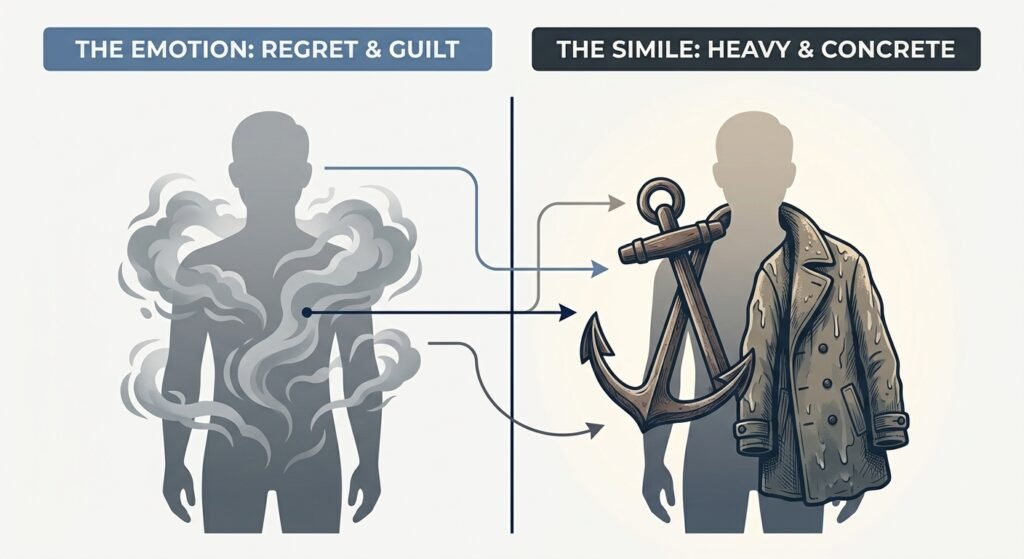
Regret can feel like a stone in your chest, a shadow that follows you, or a door that closes just as you reach for it. These similes for regret help describe the sadness, guilt, disappointment, and longing that come from wishing you had made a different choice. Each comparison includes a meaning and an example sentence, so you can find the right expression for a poem, story, essay, or personal reflection.
What Is a Simile for Regret?
A simile for regret compares the feeling of wishing you had acted differently to something familiar, using words such as like or as. For example, “His regret followed him like a shadow” compares regret to something that stays close wherever a person goes.
A good regret simile communicates more than sadness. It can suggest a missed opportunity, a painful memory, guilt over a mistake, or the lingering feeling that something cannot be changed.
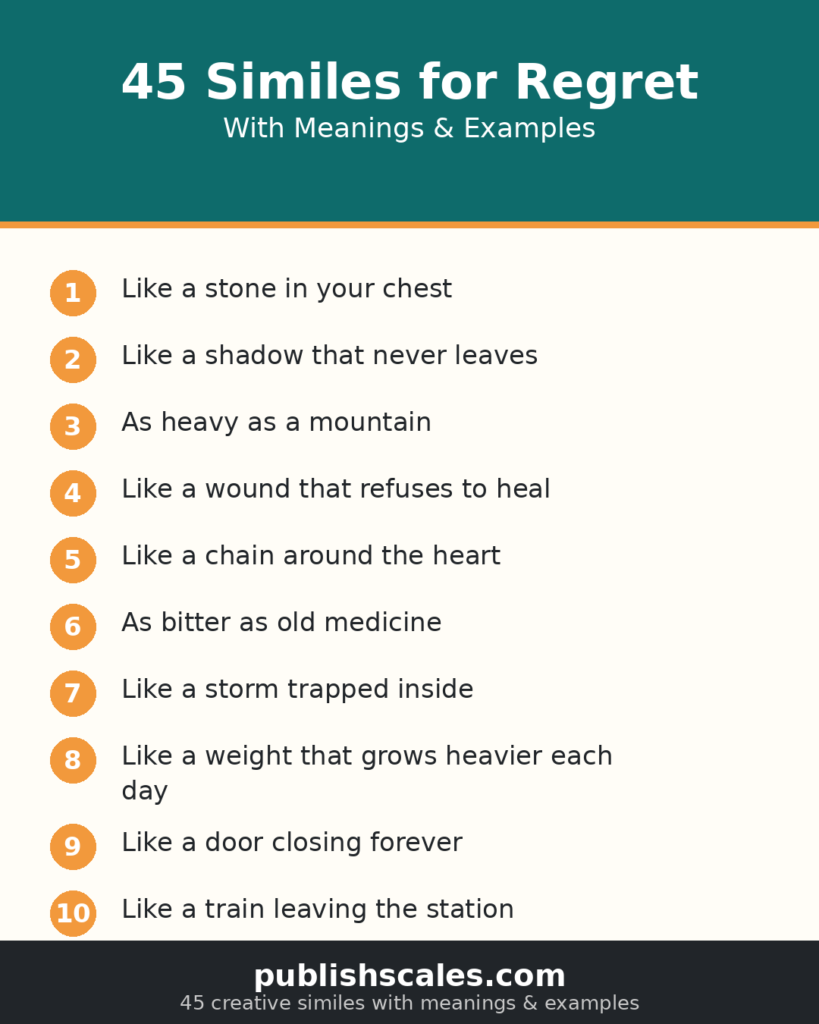
45 Similes for Regret With Meanings and Examples

1. Similes That Describe Deep Regret
These comparisons express regret that feels heavy, persistent, or difficult to escape.
1. Like a stone in your chest
Meaning: A heavy emotional burden caused by regret.
Example: After realizing how badly he had hurt his friend, guilt sat in his chest like a stone.
2. Like a shadow that never leaves
Meaning: Regret that follows someone wherever they go.
Example: The memory of her final argument with her sister followed her like a shadow that never left.
3. As heavy as a mountain
Meaning: Extremely difficult to carry emotionally.
Example: His regret felt as heavy as a mountain after he turned down the opportunity of a lifetime.
4. Like a wound that refuses to heal
Meaning: Regret that continues to hurt long after an event.
Example: Her decision to walk away from her closest friend remained like a wound that refused to heal.
5. Like a chain around the heart
Meaning: Regret that makes someone feel emotionally trapped.
Example: The words he never apologized for became like a chain around his heart.
6. As bitter as old medicine
Meaning: A painful feeling that is difficult to accept.
Example: Accepting that she had wasted years on the wrong goal was as bitter as old medicine.
7. Like a storm trapped inside
Meaning: Intense regret mixed with conflicting emotions.
Example: He smiled at the reunion, but inside, his regret raged like a storm trapped within him.
8. Like a weight that grows heavier each day
Meaning: Regret that becomes more difficult to bear over time.
Example: Every unanswered message made his regret feel like a weight that grew heavier each day.
2. Similes for Missed Opportunities
Use these comparisons when someone wishes they had taken a chance, spoken up, or made a different decision.
9. Like a door closing forever
Meaning: A lost opportunity that may never return.
Example: Watching the scholarship deadline pass felt like a door closing forever.
10. Like a train leaving the station
Meaning: An opportunity that has passed beyond someone’s reach.
Example: When she finally decided to apply, the chance had gone like a train leaving the station.
11. Like reaching for a star just out of reach
Meaning: Longing for something that now seems impossible to obtain.
Example: His dream of joining the team felt like reaching for a star just out of reach.
12. Like a bird that has flown away
Meaning: Something valuable that is gone and cannot easily be recovered.
Example: Their friendship was like a bird that had flown away after years of silence.
13. Like watching the last light fade
Meaning: The painful realization that a chance is disappearing.
Example: She watched her final opportunity to reconcile with him fade like the last light of sunset.
14. Like an unopened letter returned too late
Meaning: A message, feeling, or opportunity that was never acted upon in time.
Example: His apology felt like an unopened letter returned too late after she moved away.
15. Like arriving after the curtain falls
Meaning: Realizing what mattered only after the opportunity has ended.
Example: He understood how much the performance meant to his daughter like someone arriving after the curtain falls.
16. Like a key to a door that no longer exists
Meaning: Wishing you had made a different choice when the situation has already changed.
Example: Her carefully planned explanation felt like a key to a door that no longer existed.
3. Similes for Guilt and Wrong Decisions
These similes work well when regret comes from an action, a hurtful comment, or a decision that caused harm.
17. Like a stain that will not wash away
Meaning: Guilt that remains despite attempts to move on.
Example: His dishonest words stayed in his memory like a stain that would not wash away.
18. As sharp as broken glass
Meaning: A painful realization about a mistake.
Example: The truth about her careless decision cut through her thoughts as sharply as broken glass.
19. Like a bell that keeps ringing
Meaning: A mistake that repeatedly returns to someone’s thoughts.
Example: His cruel remark echoed in his mind like a bell that kept ringing.
20. Like walking barefoot over stones
Meaning: Moving through life while carrying emotional pain.
Example: Trying to rebuild their friendship felt like walking barefoot over stones.
21. Like carrying a secret in a locked box
Meaning: Keeping guilt hidden and struggling with it privately.
Example: She carried her regret like a secret in a locked box, afraid to admit what she had done.
22. As uncomfortable as an ill-fitting shoe
Meaning: A persistent feeling that something is wrong.
Example: His excuse felt as uncomfortable as an ill-fitting shoe because he knew he had not told the truth.
23. Like swallowing a bitter pill
Meaning: Accepting an unpleasant truth about your own choices.
Example: Admitting that he had been unfair to his colleague was like swallowing a bitter pill.
24. Like a mirror showing every flaw
Meaning: Regret that forces someone to face their mistakes honestly.
Example: The failed project became like a mirror showing every flaw in her planning.
4. Similes for Lingering Memories
These comparisons are useful when regret returns through old photographs, familiar places, conversations, or memories.
25. Like an echo in an empty room
Meaning: A memory that repeatedly returns when everything is quiet.
Example: Their final conversation lingered in his mind like an echo in an empty room.
26. Like an old photograph that has faded
Meaning: A memory of something meaningful that can no longer be experienced in the same way.
Example: Her childhood summers felt like an old photograph that had slowly faded.
27. Like rain tapping against a window
Meaning: A gentle but persistent feeling of sadness.
Example: Regret returned to her thoughts like rain tapping against a window on a quiet night.
28. Like a song you cannot forget
Meaning: A memory that continues to replay in the mind.
Example: The promise he had broken stayed with him like a song he could not forget.
29. Like smoke lingering after a fire
Meaning: Emotional pain that remains after the original event has ended.
Example: Even after they reconciled, a trace of regret lingered like smoke after a fire.
30. Like footsteps in fresh snow
Meaning: The lasting evidence of choices made in the past.
Example: Her decisions remained in the family history like footsteps in fresh snow.
31. Like an unfinished sentence
Meaning: Regret about something left unsaid or incomplete.
Example: The conversation they never finished hung between them like an unfinished sentence.
32. Like a clock ticking in an empty house
Meaning: A quiet, persistent awareness of time that cannot be recovered.
Example: He thought about the years he had wasted, his regret ticking inside him like a clock in an empty house.
5. Similes for Gentle Sadness and Longing
Not every form of regret is overwhelming. These comparisons describe quieter feelings about the past.
33. Like a fading sunset
Meaning: Sadness about something beautiful that has ended.
Example: She remembered their final summer together like a fading sunset.
34. As quiet as falling snow
Meaning: A subdued, private feeling of regret.
Example: His regret was as quiet as falling snow; he rarely spoke about the choice he wished he could change.
35. Like a leaf drifting downstream
Meaning: Feeling carried away from a past opportunity or a different possible future.
Example: He watched his old ambitions drift away like a leaf floating downstream.
36. Like a candle burning low
Meaning: A feeling that slowly diminishes but has not completely disappeared.
Example: Her regret remained like a candle burning low long after the disagreement ended.
37. Like a distant train whistle
Meaning: A faint reminder of a past decision or a life that might have been.
Example: Every visit to his hometown brought back the old dream like a distant train whistle.
38. Like an empty chair at the table
Meaning: Regret connected to someone’s absence or a relationship that has changed.
Example: After their friendship ended, every holiday dinner reminded him of his loss like an empty chair at the table.
39. Like a wave returning to shore
Meaning: Regret that comes back even after someone believes they have moved on.
Example: Just when she thought she had accepted the past, her regret returned like a wave to the shore.
6. Creative Similes for Regret in Stories and Poems
These more imaginative comparisons can help writers communicate regret through vivid images.
40. Like a letter written in disappearing ink
Meaning: A chance to express something important that is slowly being lost.
Example: His unspoken apology felt like a letter written in disappearing ink.
41. Like a garden left without rain
Meaning: Regret over something meaningful that was neglected.
Example: Their friendship withered like a garden left without rain while both waited for the other to call.
42. Like a bridge burned behind you
Meaning: Regret over a decision that damaged a relationship or removed a path forward.
Example: After their argument, he realized that his angry words had left him like a traveler facing a burned bridge.
43. Like a book with its final page missing
Meaning: Frustration about an ending that never brought closure.
Example: Their sudden separation left her memories like a book with its final page missing.
44. Like a candle lit in daylight
Meaning: An attempt to fix something after the moment when it could have made a difference.
Example: His late apology seemed like a candle lit in daylight; the damage had already been done.
45. Like footprints washed away by the tide
Meaning: The painful realization that a moment or opportunity cannot be preserved.
Example: He wished he had spent more time with his grandfather before those precious days disappeared like footprints washed away by the tide.
Quick-Reference Table: Choosing the Right Simile for Regret
| Simile | Main Feeling | Best Used For |
| Like a stone in your chest | Heavy sadness | Deep personal regret |
| Like a shadow that never leaves | Persistent guilt | Character descriptions |
| Like a door closing forever | Lost opportunity | Missed chances |
| Like a stain that will not wash away | Guilt | Mistakes and wrongdoing |
| Like an echo in an empty room | Lingering memories | Stories and reflective writing |
| Like a fading sunset | Gentle sadness | Poetry and personal essays |
| Like an unfinished sentence | Lack of closure | Unspoken words |
| Like a garden left without rain | Neglect | Damaged relationships |
| Like a wave returning to shore | Recurring regret | Emotional narratives |
| Like a book with its final page missing | Unresolved feelings | Stories and poems |
How to Use Similes for Regret in Writing
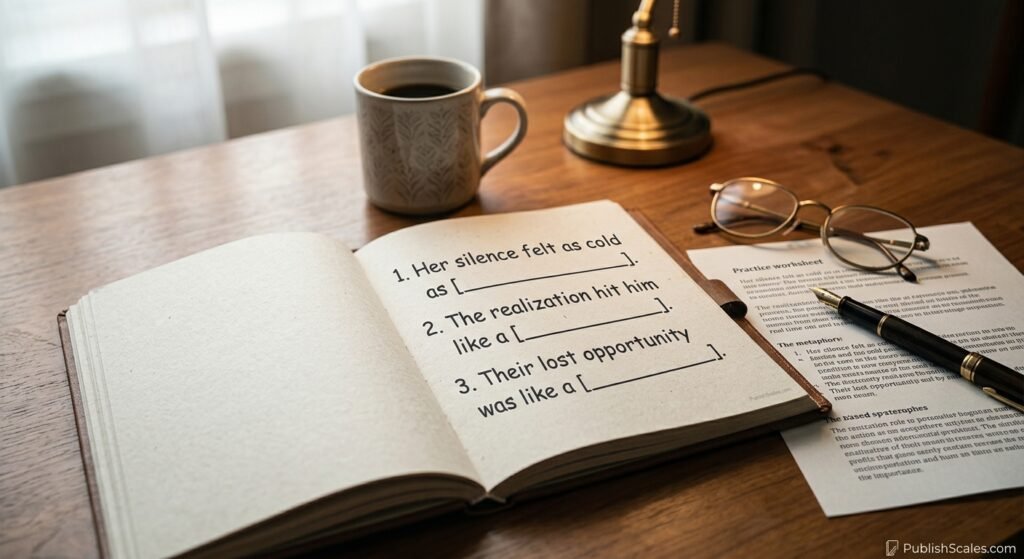
The best simile depends on the kind of regret you want to express. A comparison that works in a poem may sound too dramatic in an ordinary conversation.
1. Match the Simile to the Emotion
Choose an image that reflects the character’s actual feelings.
- Deep guilt: “His regret was like a stain that would not wash away.”
- Missed opportunity: “The chance disappeared like a train leaving the station.”
- Quiet sadness: “Her memories returned like rain tapping against a window.”
- Lack of closure: “Their last conversation felt like an unfinished sentence.”
2. Show Regret Instead of Naming It
Rather than writing, “She deeply regretted her decision,” use a comparison that lets readers feel the emotion.
Plain sentence: He regretted not calling his father.
More descriptive sentence: The missed call stayed in his mind like an unfinished sentence, growing more painful with every passing day.
The second sentence gives the reader an image and hints at the character’s emotional struggle.
3. Avoid Mixing Too Many Comparisons
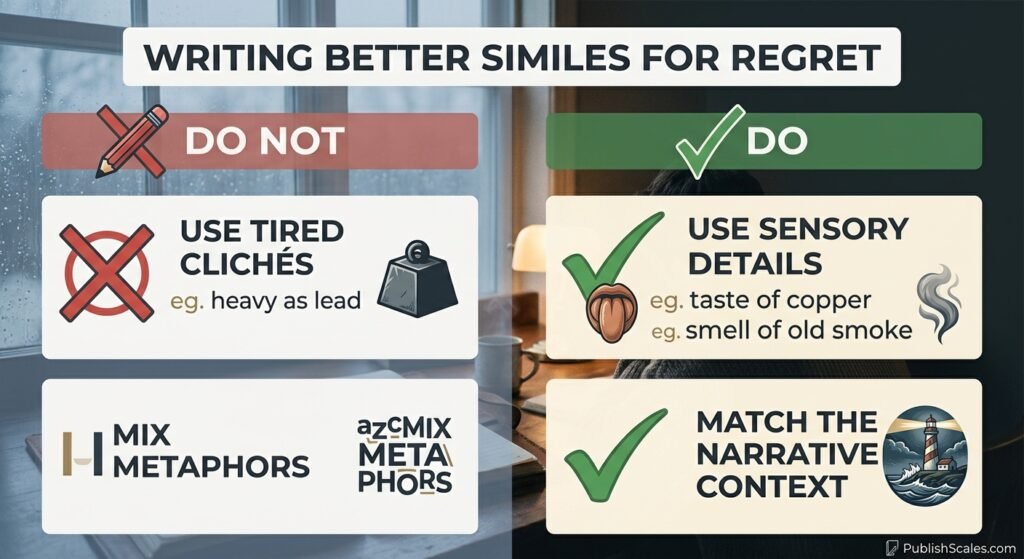
One strong simile often works better than several competing images.
Overloaded: His regret was a storm, a mountain, a chain, and a burning fire inside his heart.
Improved: His regret sat on his shoulders like a heavy stone.
The improved version gives readers one clear image to remember.
4. Use “Like” and “As” Naturally
Similes often use like to compare two things directly.
Example: “Her regret followed her like a shadow.”
The word as can compare qualities.
Example: “His remorse was as heavy as a winter sky.”
Choose the structure that sounds natural in the sentence rather than forcing a particular word.
5. Consider the Character and Setting
A sailor might describe regret as a ship missed at the harbor, while a gardener might compare it to a neglected plant. Context-specific images make descriptions feel more original and believable.
Frequently Asked Questions
1. What is a good simile for regret?
“Regret followed him like a shadow” is a strong, easy-to-understand simile. It suggests that a person cannot easily escape memories of a past decision. For deeper emotional pain, “regret sat like a stone in her chest” communicates a heavy burden.
2. What is a powerful simile for regret?
“Regret was like a wound that refused to heal” is powerful because it compares emotional pain to a physical injury that remains unresolved. It works well when describing a mistake or loss that continues to affect a character long after the event.
3. What is a simile for regretting a missed opportunity?
“The opportunity disappeared like a train leaving the station” expresses the feeling of being too late. It works particularly well when a character realizes that a chance has passed and cannot easily be recovered.
4. How do you describe regret in a poem?
Use images that suggest weight, distance, fading light, echoes, or unfinished things. For example, “My regret was like a fading sunset” conveys sadness about something that has ended. A poem can use a quiet comparison for subtle emotion or a stronger image for intense guilt.
5. What is an easy simile for regret for students?
“Regret is like a shadow that follows you” is an easy simile for students because it uses a familiar image to explain a difficult emotion. It can help students describe how a past mistake continues to affect someone’s thoughts.
6. Are regret and remorse the same?
Regret means wishing something had happened differently or that you had made another choice. Remorse usually suggests deeper guilt about doing something wrong, especially when another person has been hurt. Both emotions can be described with similes, but remorse often places more emphasis on responsibility and guilt.
7. Can I create my own simile for regret?
Yes. Think about what regret feels like, then compare it to something readers can picture. Ask yourself whether the feeling is heavy, persistent, sharp, quiet, or connected to a missed chance. For example, you could write, “My regret was like a message I never sent.” The comparison should fit the situation and sound natural.
Final Thought
The best similes for regret turn an abstract emotion into an image readers can understand. A heavy stone can suggest guilt, a closing door can represent a missed opportunity, and an unfinished sentence can capture words left unsaid.
Choose a comparison that matches the intensity of the feeling and the situation you are describing. For more original writing, connect the image to the character’s surroundings or experiences instead of relying on familiar expressions alone. Learning effective descriptive writing techniques can help you create vivid, meaningful comparisons. A clear, well-chosen simile can make regret feel more personal, vivid, and memorable. When you are ready to move beyond regret, explore these similes for a fresh start and find hopeful language for new beginnings.
Regret usually starts as a problem — our similes for problems capture both.
Cruel words often leave the deepest regret — our similes for cruel.
Regret often follows dishonesty, so our similes for lying are a natural next read for describing lies and liars.
Regret is a heavy teacher, but it teaches honestly. If these similes help you name that feeling — in a story, a letter, or a quiet moment of reflection — then the weight has already begun to lift, one honest word at a time. And when regret deepens into heartbreak itself, our similes for heartbreak carry that heavier feeling.

The PublishScales Editorial Team researches and writes clear, original guides to similes and figurative language.