

Everyone knows the feeling of hearing a story that does not quite add up. The Merriam-Webster definition of lying is simple — making a false statement with the intent to deceive — but writers need more than a definition; they need similes for lying — pictures that show the lie in action.

A good lying simile shows instead of telling: something hidden in the grass, something sweet on the surface and rotten underneath, or something tall and impressive that is about to collapse. The image lets your reader feel the dishonesty before anyone says the word “lie.”

Here are 45 similes for lying in five groups — sneaky lies, big obvious lies, sweet-talking lies, lies that grow, and the moment of getting caught — and every simile comes with a plain meaning.
Use the sneaky ones for villains and mysteries, the growing ones for stories about consequences, and the caught-in-the-act ones for the satisfying moment when the truth finally wins.
Lies often end in regret — see our similes for regret.
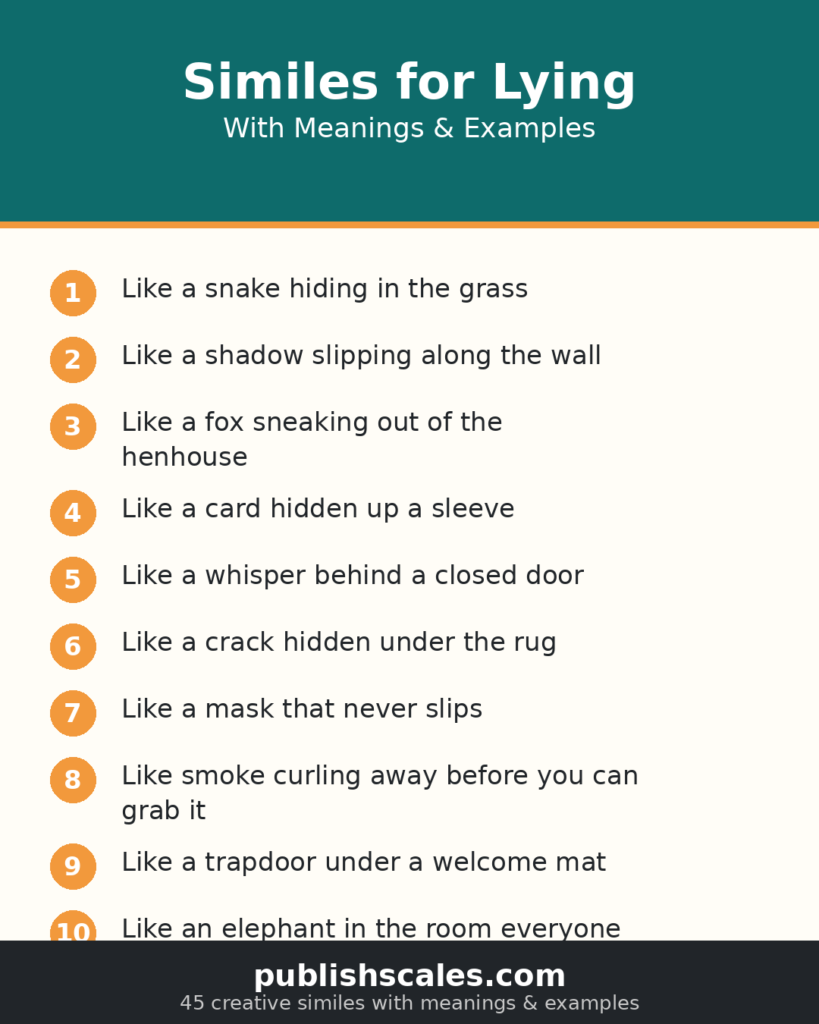
Sneaky and Hidden Lies
These similes describe lies that are carefully concealed — the kind designed never to be noticed at all.
Like a snake hiding in the grass
A lie (or liar) concealed and waiting, dangerous precisely because you cannot see it.
Like a shadow slipping along the wall
A lie that moves quietly and hopes nobody turns on the light.

Like a fox sneaking out of the henhouse
A liar escaping quietly after doing the damage, looking innocent.
Like a card hidden up a sleeve
A lie prepared in advance, ready to be played at the perfect moment.
Like a whisper behind a closed door
A lie shared secretly, meant only for certain ears.
Like a crack hidden under the rug
A problem deliberately covered up instead of fixed — the lie of pretending all is well.
Like a mask that never slips
A liar who maintains the false face perfectly, in every situation.
Like smoke curling away before you can grab it
A lie so vague and slippery that nobody can ever pin it down.
Like a trapdoor under a welcome mat
Friendliness on the surface hiding a nasty surprise underneath.
Big and Obvious Lies
Some lies fool nobody. These similes are comic and cutting — perfect for calling out a whopper.
Like an elephant in the room everyone pretends not to see
An enormous lie that everybody knows about but nobody mentions.
Like a clown claiming to be a king
A claim so absurd that the costume gives it away instantly.
Like a paper crown in the rain
A grand false claim that falls apart the moment it meets reality.
Like a fish story that grows with every telling
An exaggeration that gets bigger each time the liar repeats it.
Like a balloon waiting to burst
An inflated lie stretched so thin that one small question will pop it.
Like a tower built on sand
An impressive-sounding story with no truth underneath to hold it up.
Like paint peeling off a rotten wall
A false surface that is visibly coming away to show the truth beneath.
Like a drum beaten too loudly to sound true
A story protested so hard that the noise itself creates suspicion.
Like the sun trying to hide behind a finger
A denial so hopeless that everyone can see straight through it.
Sweet-Talking Lies
The most dangerous lies arrive smiling. These similes describe flattery and sugar-coated deceit.
Like honey poured over bitter medicine
Sweet words used to make an unpleasant truth — or a false one — easier to swallow.
Like sugar sprinkled on a sour lemon
Kind-sounding words that cannot change the sour reality underneath.
Like a sweet wrapper around an empty box
Beautiful promises with nothing inside them at all.
Like perfume sprayed on garbage
Pleasant talk used to cover something rotten.
Like a smile painted on a mask
Friendliness that is not felt, only performed.
Like silk wrapped around a stone
Soft, smooth words hiding something hard and hurtful.
Like a bedtime story told to hide the truth
A comforting tale invented to keep someone calm and in the dark.
Like candy with a bitter center
A compliment or promise that turns unpleasant once you get inside it.
Like butter spread smoothly over burnt toast
Charm used to cover a mistake that everyone can still taste.
Lies That Grow
One small lie rarely travels alone. These similes trace how a falsehood spreads and swells out of control.
Like a snowball rolling downhill
A lie that picks up size and speed with every person who repeats it.
Like weeds spreading through a garden
Falsehoods multiplying quietly until they choke out the truth.
Like a fire fed by the wind
A lie growing faster because gossip and panic keep feeding it.
Like ripples spreading across a pond
A single false statement reaching further and further from its source.
Like a rumor with wings
A lie that travels impossibly fast from mouth to mouth.
Like ivy creeping over a whole wall
A small deception slowly covering and hiding the entire truth.
Like a small leak sinking a great ship
One tiny lie eventually destroying something large and valuable — like trust.
Like a seed that grows into a thorny tree
A little lie planted today that becomes a big, painful problem later.
Like echoes bouncing from wall to wall
A lie repeated so often that it starts to sound like the truth.
Getting Caught Lying
Every liar dreads this moment. These similes capture the exact second the story falls apart.
Like a spider tangled in its own web
A liar trapped by the complicated story they themselves invented.
Like a fish caught in its own net
Hoist by your own trap — caught by the very scheme you set.
Like a burglar frozen in a flashlight beam
A liar stopped dead, exposed, with nowhere left to hide.
Like a puppet whose strings snap
A rehearsed liar suddenly losing control of the performance.

Like a house of cards in a sudden breeze
An elaborate lie collapsing all at once at the slightest challenge.
Like an actor who forgets his lines
A liar who stalls and stumbles when the invented story runs out.
Like glass cracking under pressure
A false story beginning to break apart under hard questions.
Like a knot pulled tighter the more you tug
Each new excuse making the liar’s situation worse instead of better.
Like a boomerang coming back to strike
A lie returning to hit the person who threw it.
Quick Reference: Similes for Lying at a Glance
These ten are the sharpest of the collection — the ones writers reach for first:
| Simile | Best For |
|---|---|
| Snake in the grass | A hidden lie or a hidden liar, waiting to strike. |
| House of cards | An elaborate story that collapses at a touch. |
| Snowball | A lie that grows with every retelling. |
| Honeyed words | Sweet talk with false intent. |
| Paper crown | A grand claim that reality dissolves. |
| Smoke | A lie too slippery to pin down. |
| Spider’s own web | Caught in a trap of your own making. |
| Balloon | An inflated story ready to burst. |
| Fish story | An exaggeration that grows each time. |
| Bitter candy | Sweet outside, false inside. |
How to Use Lying Similes in Writing
In stories, let the simile do the accusing. Writing “He lied” is flat; writing “His story was like a house of cards in a sudden breeze” shows the reader a liar whose invention is collapsing in real time. Match the simile to the lie’s size: a smoke or shadow simile for a subtle deception, an elephant or tower for a giant one.
For essays about honesty and moral writing, the “lies that grow” group is gold — the snowball, the leak, and the seed show consequences without preaching. Place one early (the seed) and echo it late (the thorny tree) to give your essay a satisfying arc from small lie to big damage.
Common Mistakes to Avoid with Lying Similes
Calling every exaggeration a lie
A fish story told for laughs is not the same as deception. If the intent to deceive is missing, choose a gentler simile or a different word entirely.
Mixing up your animal meanings
Snakes suggest hidden danger and foxes suggest cleverness. Using both for the same liar in one paragraph blurs the picture you are painting.
Using cruel similes in friendly writing
“Like a snake” is an attack. In a light school essay or a children’s story, prefer the comic images — the paper crown or the bursting balloon.
Making lies sound glamorous
Sweet-talking similes can accidentally make the liar look smooth and admirable. Add a consequence image — the bitter center — so the judgement stays clear.
Forgetting the moment of truth
A lying scene without a “caught” simile feels unfinished. Readers wait for the web to tangle its spider; give the story its payoff.
Frequently Asked Questions
What are the best similes for lying?
The strongest are “like a house of cards” for a collapsing story, “like a snake hiding in the grass” for hidden deceit, and “like a snowball rolling downhill” for a lie that keeps growing.
What is a good simile for a liar?
Try: “He was like a spider who eventually tangled himself in his own web.” It describes the liar and predicts his downfall in a single image.
What are some funny similes for lying?
“Like a clown claiming to be a king,” “like the sun trying to hide behind a finger,” and “like a fish story that grows with every telling” all expose a lie with humor instead of anger.
What does “white lie” mean in simile writing?
A white lie is a small, harmless falsehood told to spare feelings. Gentle similes fit it best — like a bedtime story told to hide a sad truth — rather than snakes and traps.
How do I describe a lie growing in a story?
Use the snowball image: start the lie small in chapter one, let each retelling add size, and by the climax it is an avalanche the liar can no longer outrun.
Can I use lying similes in a school essay?
Yes — essays about honesty, peer pressure, and social media rumors all benefit from them. The growing-lies group (snowball, weeds, leak) is especially effective for showing consequences.
Final Thought
A lie is a story told against reality, and reality always wins in the end — the cards fall, the balloon bursts, and the web catches its own spider. Choose the simile that matches your lie, and your reader will not just be told someone is dishonest; they will watch the truth arrive.

The PublishScales Editorial Team researches and writes clear, original guides to similes and figurative language.


