
Personality is the first thing readers notice about a character, often before they learn a single fact. A shy shopkeeper, a fearless captain, and a teasing best friend all walk onto the page with different weather around them. However, plain labels like friendly, brave, or rude rarely make that weather real. This is where similes for personality earn their place. A simile compares a trait to something familiar, so readers can feel a person’s warmth, courage, or sharpness in one quick picture. The dictionary keeps the idea simple: personality is the combination of qualities that makes each person distinct, as the Merriam-Webster definition of personality explains. A good simile takes that plain definition and gives it a face.
Below you will find forty-five personality similes grouped by type of character. Some, for example, celebrate warm and friendly hearts, while others capture bold leaders, quiet thinkers, and sparkling jokers. A few, in contrast, describe the strong and difficult people every story needs. If warmth is the trait you need most, our similes for a kind person collection is the perfect place to wander next. Pick the images that fit your character, and let every introduction do its work in a single line.
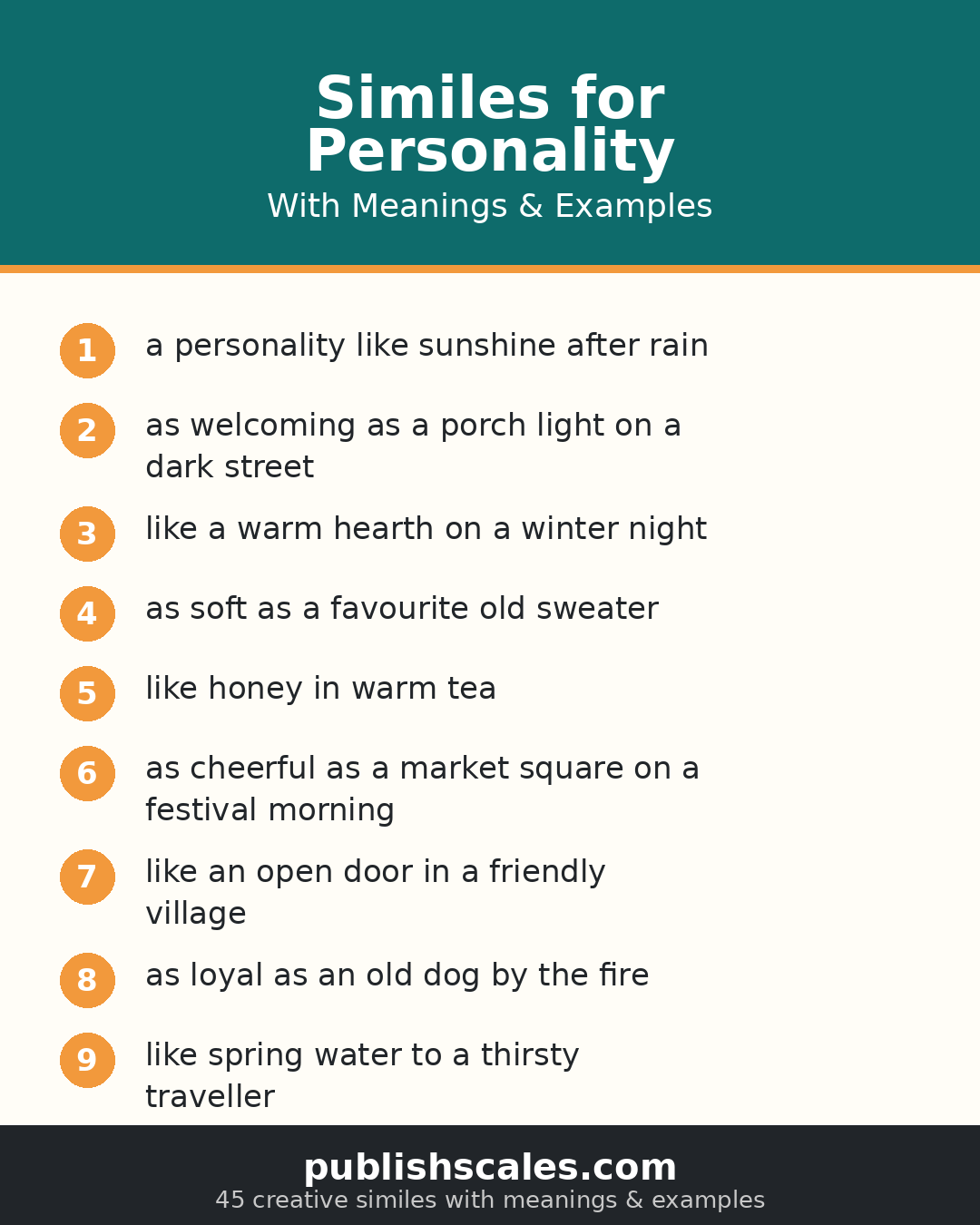
Warm and Friendly Personalities
Some personalities make a room feel warmer the moment they enter it. Indeed, these comparisons suit the friends, grandparents, and neighbours whose kindness everyone remembers first.
- a personality like sunshine after rain
Meaning: warmth that lifts the mood of everyone nearby after hard times.
Example: In fact, after the tough week at the office, Sara arrived with a personality like sunshine after rain, and the whole team relaxed. - as welcoming as a porch light on a dark street
Meaning: friendly in a way that makes strangers feel safe and wanted.
Example: Of course, new students always found Mr. Alvarez first, because he was as welcoming as a porch light on a dark street. - like a warm hearth on a winter night
Meaning: a comforting presence that people naturally gather around.
Example: In fact, Grandma Rose was like a warm hearth on a winter night, and every neighbour drifted toward her kitchen. - as soft as a favourite old sweater
Meaning: easy, comforting, and never sharp or cold with people.
Example: Indeed, Tom’s manner was as soft as a favourite old sweater, so even bad news sounded bearable from him. - like honey in warm tea
Meaning: sweet and soothing, calming everyone nearby.
Example: Her voice, in fact, was like honey in warm tea, and the angry customers slowly settled down. - as cheerful as a market square on a festival morning
Meaning: openly joyful and generous with good humour.
Example: Meanwhile, Uncle Dev was as cheerful as a market square on a festival morning, greeting every passer-by by name. - like an open door in a friendly village
Meaning: approachable, so anyone can come and talk freely.
Example: As a manager, Priya was like an open door in a friendly village, and no question ever felt too small. - as loyal as an old dog by the fire
Meaning: devoted and steady in friendship, in good times and bad.
Example: Through every failure, Ben, in fact, stayed as loyal as an old dog by the fire, never once drifting away. - like spring water to a thirsty traveller
Meaning: refreshing kindness that arrives exactly when it is needed.
Example: After months of loneliness, her friendship was, in short, like spring water to a thirsty traveller.
Bold and Confident Personalities
Other personalities fill a room before they say a word. These similes borrow the confidence of lions, captains, and banners, so your leaders and heroes can stand tall on the page.
- like a lion walking into its own valley
Meaning: quietly sure of belonging and unafraid of judgement.
Example: When Ayesha entered the boardroom, she moved like a lion walking into its own valley. - as bold as a banner in a high wind
Meaning: impossible to ignore and proud to be seen.
Example: Indeed, his opinions were as bold as a banner in a high wind, and nobody ever wondered where he stood. - like a captain who has crossed the ocean before
Meaning: experienced confidence that steadies everyone around.
Example: In a crisis, Marta, however, was like a captain who has crossed the ocean before, and panic simply left the room. - as fearless as a firefighter at the door
Meaning: brave in the exact moment when others hesitate.
Example: Indeed, the young doctor was as fearless as a firefighter at the door, speaking up whenever a patient was ignored. - like a mountain that never argues with storms
Meaning: unshaken by criticism, pressure, or insults.
Example: The old judge, meanwhile, was like a mountain that never argues with storms, and insults simply broke against him and vanished. - as direct as an arrow to its target
Meaning: honest and straight, with no hidden corners.
Example: In short, Farah’s answers were as direct as an arrow to its target, so meetings with her were short and clear. - like a drumbeat leading a parade
Meaning: a natural leader whose energy sets the pace for others.
Example: At the charity walk, Coach Dan was, in fact, like a drumbeat leading a parade, and everyone fell into step behind him. - as proud as a peacock in full feather
Meaning: confident to the point of happily showing off.
Example: After the promotion, Leo, of course, walked as proud as a peacock in full feather through the whole office. - like a lighthouse that never doubts its light
Meaning: steady self-belief that also guides other people.
Example: In contrast, the quiet founder was like a lighthouse that never doubts its light, certain of her direction in every storm.

Calm and Quiet Personalities
Meanwhile, not every strong character is loud. These quiet comparisons fit the patient, thoughtful people whose calm steadies everyone around them.
- like a still lake at dawn
Meaning: peaceful, reflective, and very hard to disturb.
Example: Brother Thomas was, in fact, like a still lake at dawn, and arguments seemed to settle just by reaching him. - as patient as a gardener waiting for spring
Meaning: willing to let people and plans grow in their own time.
Example: For instance, with her students, Mrs. Chen was as patient as a gardener waiting for spring, never forcing a single bloom. - like a deep river that runs silently
Meaning: quiet on the surface, strong and thoughtful underneath.
Example: Omar said little in meetings; however, he was like a deep river that runs silently, and his rare words carried weight. - as steady as a candle in a windless room
Meaning: calm and reliable, without flickers of panic.
Example: During the blackout, Nurse Amy, meanwhile, stayed as steady as a candle in a windless room, checking each patient twice. - like snow falling on a sleeping village
Meaning: a gentle quietness that softens the whole atmosphere.
Example: Her presence, indeed, was like snow falling on a sleeping village, and even the loud children lowered their voices. - as unhurried as an old turtle on a sunny bank
Meaning: never rushed and never flustered by other people’s panic.
Example: Similarly, Grandpa Joe stayed as unhurried as an old turtle on a sunny bank while the whole family panicked around him. - like a library at closing time
Meaning: thoughtful, hushed, and full of hidden depth.
Example: The professor was, in short, like a library at closing time, quiet at first glance and endless once you stepped inside. - as gentle as evening light through curtains
Meaning: soft-spoken kindness that never overwhelms anyone.
Example: His advice came, after all, as gentle as evening light through curtains, easy to accept and easy to remember. - like a cat watching from the windowsill
Meaning: observant and content to stay out of the noise.
Example: At parties, Nina, meanwhile, was like a cat watching from the windowsill, missing nothing and needing none of the spotlight.
Bright and Playful Personalities
Some people seem to carry their own sunshine and a pocketful of jokes. In fact, these playful similes suit the jokers, dreamers, and bright spirits who keep every scene awake.
- like a box of fireworks waiting for dark
Meaning: full of surprises and barely contained fun.
Example: Cousin Max was like a box of fireworks waiting for dark, and every family dinner eventually sparkled. - as bubbly as soda in a shaken bottle
Meaning: fizzy with laughter, energy, and high spirits.
Example: The new intern was, in fact, as bubbly as soda in a shaken bottle, and Monday mornings grew noticeably louder. - like a puppy that has found a ball
Meaning: enthusiastic about small joys and always eager to play.
Example: In fact, Sam approached every project like a puppy that has found a ball, tail wagging before the work even began. - as mischievous as a monkey at a fruit stall
Meaning: playful and cheeky, always testing the rules.
Example: Little Zara, meanwhile, was as mischievous as a monkey at a fruit stall, hiding spoons and grinning at the chaos. - like sunshine through a prism
Meaning: able to turn ordinary moments into colour and delight.
Example: Her humour, indeed, was like sunshine through a prism, and dull bus rides became small celebrations. - as light-hearted as a kite on a spring breeze
Meaning: carefree and cheerful, floating above small worries.
Example: Even in exam week, Ravi, of course, stayed as light-hearted as a kite on a spring breeze, to the envy of his friends. - like a jukebox that only plays happy songs
Meaning: reliably cheerful company, whatever the day brings.
Example: Whatever the news, Aunt Flo was, in short, like a jukebox that only plays happy songs, and people left her house humming. - as curious as a child in a new garden
Meaning: full of playful wonder, always asking and exploring.
Example: The young scientist was, for instance, as curious as a child in a new garden, opening every cupboard in the laboratory. - like confetti at a wedding
Meaning: bright, scattered joy that lands on everyone nearby.
Example: When she laughed, it spread like confetti at a wedding, brightening strangers three tables away.

Strong and Difficult Personalities
Finally, real stories also need friction. These comparisons describe stubborn, prickly, and difficult personalities honestly, without turning them into cartoons.
- like a cactus in polite company
Meaning: prickly and hard to approach, even when no harm is meant.
Example: The new editor, in fact, was like a cactus in polite company, and juniors learned to ask questions from a safe distance. - as stubborn as a mule at a closed gate
Meaning: immovable once a decision has been made.
Example: Once Grandpa set a rule, he was, after all, as stubborn as a mule at a closed gate, and no argument could shift him. - like a winter wind through a cracked door
Meaning: cold and cutting, felt by everyone nearby.
Example: Her criticism arrived, indeed, like a winter wind through a cracked door, small in words and freezing in effect. - as prickly as a hedgehog in a crowd
Meaning: defensive and quick to bristle at the smallest touch.
Example: After the demotion, however, Karl grew as prickly as a hedgehog in a crowd, snapping at the kindest questions. - like a locked gate with the key in sight
Meaning: distant and withholding, even when help is possible.
Example: In meetings, the director was, in fact, like a locked gate with the key in sight, listening to everything and offering nothing. - as sharp as a razor wrapped in silk
Meaning: polite words with a cutting intent hidden beneath.
Example: His compliments, however, were as sharp as a razor wrapped in silk, and colleagues learned to check each one twice. - like a storm that complains about the rain
Meaning: negative and difficult, blaming others for moods they create themselves.
Example: Mr. Doyle was, indeed, like a storm that complains about the rain, blaming the office mood that he himself had created. - as changeable as April weather
Meaning: moods that shift quickly and keep everyone guessing.
Example: Ms. Park, meanwhile, was as changeable as April weather; praise at nine could become a scolding by ten. - like a porcupine at a hug party
Meaning: so guarded that closeness feels almost impossible.
Example: At reunions, Uncle Ray, in contrast, remained like a porcupine at a hug party, arms folded while cousins circled hopefully.
Quick Reference: 10 Personality Similes at a Glance
| Simile | Best For |
|---|---|
| a personality like sunshine after rain | Lifting a room after hard times |
| as welcoming as a porch light on a dark street | Making newcomers feel safe |
| like a warm hearth on a winter night | A comforting family presence |
| as soft as a favourite old sweater | Gentle, easy-going friends |
| like honey in warm tea | Soothing, calming people |
| as cheerful as a market square on a festival morning | Open joy and generosity |
| like an open door in a friendly village | Approachable leaders and teachers |
| as loyal as an old dog by the fire | Steadfast friendship |
| like spring water to a thirsty traveller | Kindness that arrives in need |
| like a lion walking into its own valley | Quiet, natural confidence |
How to Use Personality Similes in Writing
Start with the trait your character shows most often, not the trait you merely claim for them. A leader who listens calmly may suit a still lake better than a lion. Therefore, watch what your character does in the scene, then choose the picture that matches the action. In the same way, match the simile to the moment: a warm hearth belongs in a homecoming, while a drumbeat belongs at the head of a march. When the image fits both the person and the scene, readers believe it at once.
Use one strong personality simile when a character first appears, and let behaviour prove it afterwards. Too many comparisons in one introduction, in contrast, leave the reader with a crowd instead of a person. In addition, give different characters different image families, so the playful friend never sounds like the calm grandmother. Finally, read the sentence aloud. A personality simile should sound like the person it describes: warm and round for kindness, short and hard for a prickly temper.
Common Mistakes to Avoid with Personality Similes
1. Labelling Instead of Picturing
Writers often announce a trait and then move on, as in saying she was confident or he was kind. As a result, readers learn a fact but feel nothing at all. Fix it by replacing the label with a picture: a confident heroine walks in like a lion entering its own valley, and the trait becomes visible at once.
2. Mixing Two Clashing Pictures
Sentences that call a man as calm as a lake and as bold as a lion ask readers to hold two opposite weathers at once. Each image cancels the other. Consequently, the character feels blurry rather than complex. Keep one clear picture per trait, and save the second trait for a later scene.
3. Giving Every Character the Same Favourite Simile
When the teacher, the villain, and the grandmother are all described like sunshine, the comparison stops meaning anything. Readers also stop telling the characters apart. Instead, build a small set of image families, such as weather for one character, animals for another, and the sea for a third, and keep each family consistent.
4. Choosing Images Readers Cannot Picture
A simile works only when the picture arrives instantly. Obscure hobbies, private jokes, and rare objects leave most readers blank. In particular, favour widely shared images such as lions, lakes, storms, and warm kitchens, or add a few words of context so an unusual image explains itself.
5. Freezing a Personality That Should Change
Characters grow, soften, and sometimes harden across a story. If the frightened boy is still as timid as a mouse in the final chapter, the simile quietly denies his whole journey. Therefore, let your comparisons evolve with the person: the mouse of chapter one can become the quiet, steady river of the last page.
Frequently Asked Questions
What is a simile for personality?
A simile for personality compares a character trait to something familiar using like or as, such as a personality like sunshine after rain. It borrows the qualities of the picture, such as warmth, strength, calm, or sharpness, so readers can feel the trait instead of just reading its name. In short, it turns an abstract label into a living picture.
What is a good simile for a kind personality?
Like a warm hearth on a winter night is a favourite, because everyone understands the comfort of gathering near a fire. As welcoming as a porch light on a dark street works beautifully for someone who makes strangers feel safe. Both images are warm, familiar, and easy to picture at once.
How do I describe a strong personality with a simile?
Decide which kind of strength you mean first. For confidence, try like a lion walking into its own valley; for stubbornness, try as stubborn as a mule at a closed gate. After all, strength in writing is clearest when the picture matches the exact flavour of the trait.
Can one character have more than one personality simile?
Yes, and most real people need more than one. A heroine can be a still lake with strangers and a box of fireworks with her children. However, introduce the pictures one at a time, in different scenes, so each trait gets its own moment to land.
What is the difference between a personality simile and a metaphor?
A simile compares with like or as: he was as patient as a gardener. A metaphor states the thing outright: he was a gardener with people, patient with every slow bloom. Similes are gentler and clearer for young readers; metaphors are bolder and more poetic.
How many personality similes should I use in one story?
One strong simile per character introduction is a reliable rule. After that, let actions and dialogue carry the trait, and add a fresh comparison only when the character changes or faces a big moment. In general, a few well-placed pictures beat a page crowded with them.
Final Thought
Personality is what readers carry with them after the plot is forgotten. The right simile gives that personality a shape, a temperature, and a sound in a single line. Whether your character warms a room like a hearth or prickles like a cactus, this collection holds a comparison that fits. Choose the picture that matches the person, use it once and well, and your characters will walk off the page and stay with your readers.

The PublishScales Editorial Team researches and writes clear, original guides to similes and figurative language.