

A simile is a short, fun way to compare two things using the words like or as. When we say a runner is as fast as a cheetah, we do not mean the runner grows spots and a tail — we mean the runner is very, very fast, and the picture pops into your head at once. The Merriam-Webster definition of simile calls it a figure of speech that compares two different things, and it is one of the first writing tools children ever meet. This collection of similes for grade 2 learners keeps every comparison simple, safe, and easy to say out loud: animals, food, weather, school, and home — the things seven-year-olds already know and love.
Every simile below comes with a plain meaning that a teacher can read aloud and one short example sentence, so children can copy the pattern and then build their own. The groups move from the animal world to the lunchbox, from the sky to the classroom, and end with the warm feelings of family life. None of them needs a dictionary, a grown-up to explain the picture, or any words beyond a young reader’s day.
Teachers can read one group a day, parents can play with them at homework time, and young writers can drop them straight into stories about pets, picnics, and rainy days. If your class is ready to take the next step, our similes for words collection shows how single words can grow into comparisons of their own.
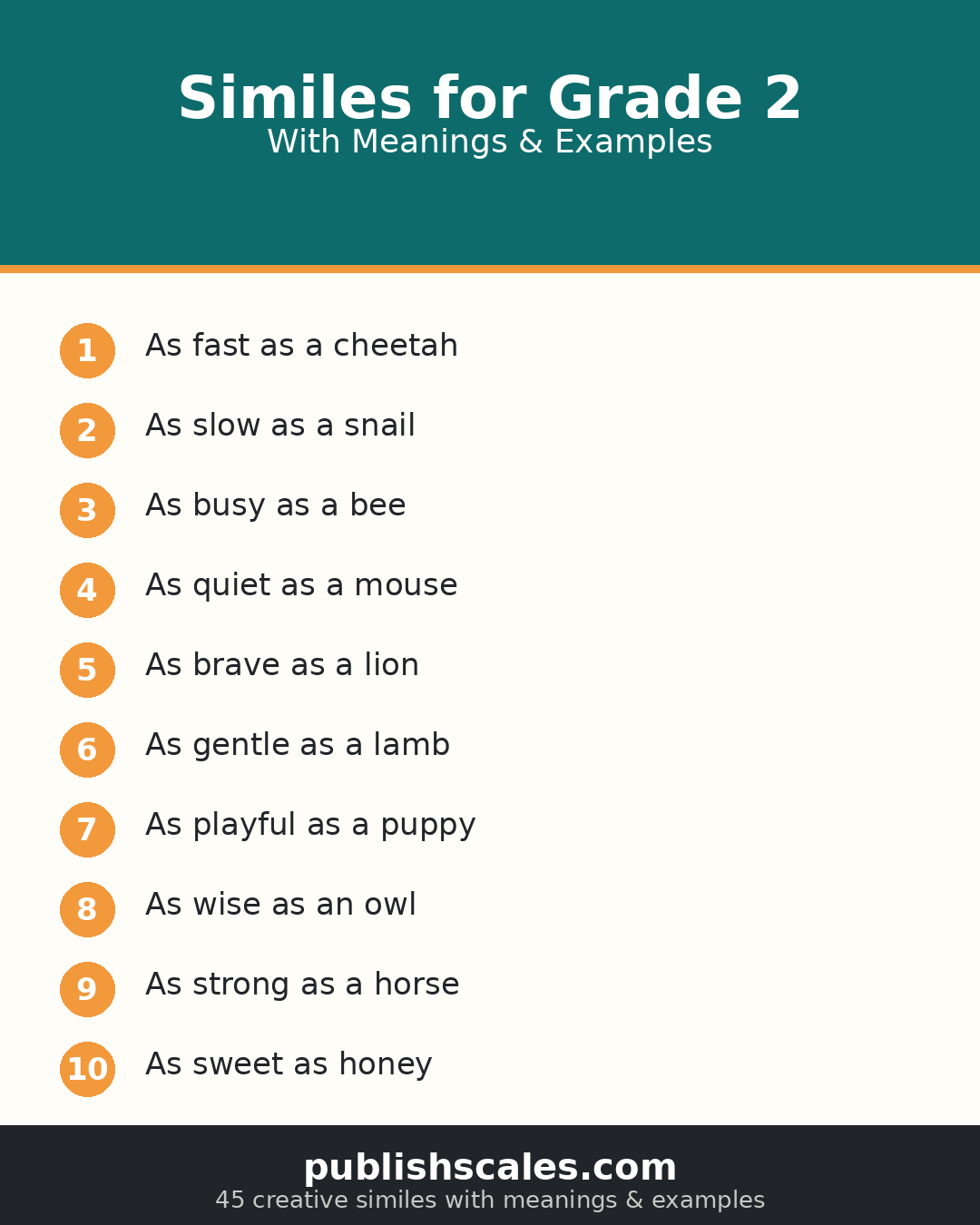
Animals
Animals are the easiest place to start, because every child already knows what a cheetah, a snail, and a mouse are like. Each animal below is famous for one thing — speed, slowness, quiet, or courage — and that one famous thing is exactly what the simile borrows.
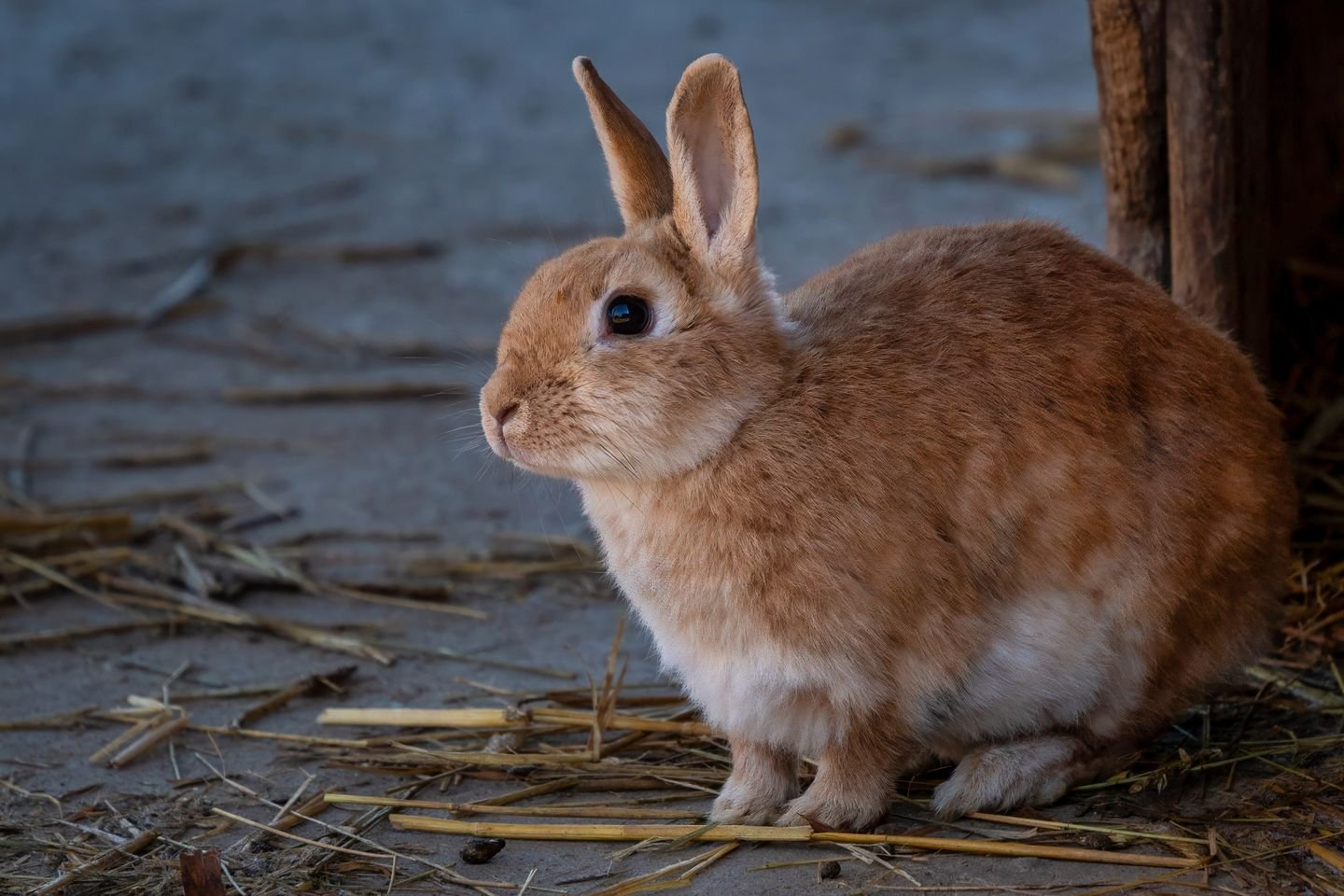
As fast as a cheetah
Meaning: The fastest of all. A cheetah runs quicker than any other animal on land.
Example: Ben raced to the gate as fast as a cheetah.
As slow as a snail
Meaning: Moving very, very slowly, one tiny step at a time.
Example: The long line at the fair moved as slow as a snail.
As busy as a bee
Meaning: Working hard and moving about without stopping.
Example: Mia was as busy as a bee, tidying every corner of her desk.
As quiet as a mouse
Meaning: Making almost no sound at all.
Example: During the test, our class was as quiet as a mouse.
As brave as a lion
Meaning: Not scared, even when something is hard or new.
Example: Sara stood up to read her poem, as brave as a lion.
As gentle as a lamb
Meaning: Soft, kind, and careful with small or weak things.
Example: He held the baby chick as gentle as a lamb.
As playful as a puppy
Meaning: Full of fun, jumps, and happy energy.
Example: The twins rolled in the grass, as playful as a puppy with a new ball.
As wise as an owl
Meaning: Very smart, and knowing the answers to many questions.
Example: Grandpa, as wise as an owl, knew why the moon changes shape.
As strong as a horse
Meaning: Able to lift and carry heavy things without getting tired.
Example: Dad carried the whole box of books, as strong as a horse.
Yummy Food
Food similes taste as good as they sound. Children meet honey, lemons, pancakes, and jam every week, so the pictures are already in their minds — sweet, sour, flat, and sticky — ready to describe cakes, colors, pillows, and even homework.
As sweet as honey
Meaning: Very sweet to taste, and sweet in nature too.
Example: The cake my aunt baked was as sweet as honey.
As red as a strawberry
Meaning: A bright, cheerful red color.
Example: After the race, his cheeks were as red as a strawberry.
As soft as a marshmallow
Meaning: Soft and squishy, sinking a little when you press it.
Example: The new pillow felt as soft as a marshmallow.
As round as an orange
Meaning: Shaped like a ball, round on every side.
Example: The full moon hung in the sky, as round as an orange.
As flat as a pancake
Meaning: Very flat, with no bumps or hills at all.
Example: She pressed the paper as flat as a pancake on the desk.
As sour as a lemon
Meaning: So sharp and sour that it makes your face scrunch up.
Example: The candy was as sour as a lemon, and we all made funny faces.
As sticky as jam
Meaning: Sticking to everything it touches.
Example: After breakfast, my fingers were as sticky as jam.
As white as milk
Meaning: A clean, pure white color.
Example: The little kitten was as white as milk.
As easy as pie
Meaning: Something that is very simple to do.
Example: For Tim, the spelling test was as easy as pie.
Weather & Nature
The sky gives children their biggest pictures: sun, thunder, rainbows, and mountains. These similes describe light, sound, color, and size — the things young writers most often want to paint in words when a story goes outdoors.

As bright as the sun
Meaning: Shining with lots and lots of light.
Example: Her smile on prize day was as bright as the sun.
As cold as ice
Meaning: Very, very cold to touch.
Example: The morning wind felt as cold as ice on my nose.
As soft as a cloud
Meaning: Light, fluffy, and gentle, like a pillow in the sky.
Example: The kitten’s bed was as soft as a cloud.
As loud as thunder
Meaning: A huge, booming sound that everyone can hear.
Example: The drum at the parade was as loud as thunder.
As fast as the wind
Meaning: Moving quickly, the way the wind rushes past.
Example: Leo ran down the hill as fast as the wind.
As colorful as a rainbow
Meaning: Full of many bright colors at once.
Example: Her drawing of the garden was as colorful as a rainbow.
As high as a mountain
Meaning: Very tall, reaching far up toward the sky.
Example: Our tower of blocks stood as high as a mountain.
As green as grass
Meaning: A fresh, bright green color.
Example: In spring, the whole park turns as green as grass.
As light as a feather
Meaning: Weighing almost nothing at all.
Example: The empty bag was as light as a feather.
School & Play
School is where grade 2 similes get used the most — in reading lessons, story writing, and show-and-tell. These nine come from the classroom and the playground, so children can practice them on the very same day they learn them.
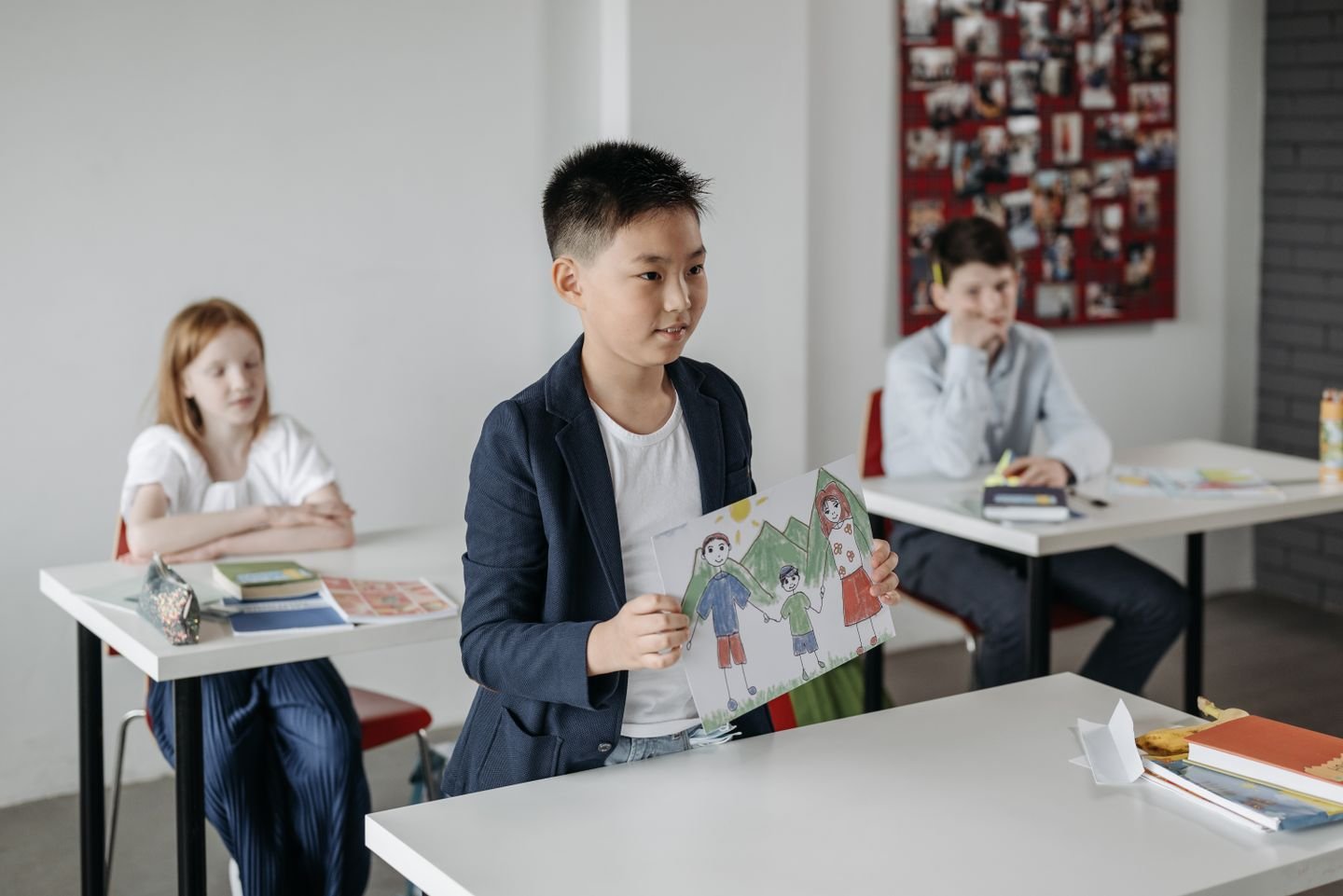
As quiet as a library
Meaning: Silent and still, with no talking at all.
Example: During reading time, our room is as quiet as a library.
As straight as a ruler
Meaning: In a perfect line, with no bends or wiggles.
Example: He drew the road as straight as a ruler.
As neat as a new notebook
Meaning: Clean and tidy, with everything in its place.
Example: Her desk was as neat as a new notebook.
As tall as a bookshelf
Meaning: Reaching high up, taller than the children around it.
Example: By summer, the sunflower grew as tall as a bookshelf.
As still as a statue
Meaning: Not moving at all, not even a wiggle.
Example: In the game of statues, Amy froze as still as a statue.
As bouncy as a ball
Meaning: Springing up again and again, full of bounce.
Example: On the mat, the little gymnast was as bouncy as a ball.
As quick as a flash
Meaning: Happening in a single second, before you can blink.
Example: She solved the puzzle as quick as a flash.
As smart as a teacher
Meaning: Knowing the right answer and how to explain it.
Example: When I finished the hard sum, I felt as smart as a teacher.
As fun as recess
Meaning: Full of play, laughter, and happy noise.
Example: The school picnic was as fun as recess.
Family & Feelings
Feelings can be hard for young writers to explain, so this last group borrows its pictures from home: hugs, lullabies, blanket forts, and birthday songs. These similes help children write about love, comfort, pride, and joy in words their readers can actually feel.
As warm as a hug
Meaning: Full of love and comfort, the way a hug feels.
Example: Grandma’s kitchen always feels as warm as a hug.
As snug as a bug in a rug
Meaning: Warm, cozy, and tucked in tight.
Example: Mia read in bed, as snug as a bug in a rug.
As soft as a lullaby
Meaning: Calm and gentle, making you feel safe and sleepy.
Example: Mom’s voice at bedtime was as soft as a lullaby.
As funny as a clown
Meaning: Silly in a way that makes everyone laugh.
Example: Uncle Joe at the party was as funny as a clown.
As sweet as a goodnight kiss
Meaning: Tender and full of love.
Example: The card she made for Dad was as sweet as a goodnight kiss.
As kind as a best friend
Meaning: Caring, sharing, and always ready to help.
Example: Zara shares her crayons every day, as kind as a best friend.
As proud as a peacock
Meaning: Feeling very pleased, and wanting everyone to notice.
Example: Dad walked to the stage door, as proud as a peacock, after my dance.
As cozy as a blanket fort
Meaning: Warm and safe in a small, happy hiding place.
Example: The reading corner was as cozy as a blanket fort.
As cheerful as a birthday song
Meaning: Bright, happy, and full of celebration.
Example: She sang while she worked, as cheerful as a birthday song.
Bonus Game: Finish the Simile
Here is a game that teachers and parents can play right away. Read the first half of each simile out loud and let the children shout out the missing word — then check the answer column together. Every answer comes from the groups above, so the game works as a quick test of the whole lesson, a warm-up before story writing, or a five-minute filler that still teaches. For a harder round, cover the answers and ask a child to invent a different ending that still makes sense: as fast as a racing car works just as well as as fast as a cheetah, and inventing endings is where real writing begins.
| Finish the Simile | Answer | It Describes |
|---|---|---|
| As fast as a ____ | cheetah | speed |
| As slow as a ____ | snail | slowness |
| As quiet as a ____ | mouse | silence |
| As brave as a ____ | lion | courage |
| As sweet as ____ | honey | sweetness |
| As flat as a ____ | pancake | flatness |
| As cold as ____ | ice | cold |
| As bright as the ____ | sun | light |
| As snug as a bug in a ____ | rug | coziness |
| As soft as a ____ | cloud | softness |
Once children can finish these ten, let them swap the answers around and laugh at the silly results — as slow as a cheetah, as quiet as thunder — because explaining why the silly ones are wrong teaches the meanings faster than any worksheet.
How to Use Grade 2 Similes in Writing
For young writers, one simile is enough to make a plain sentence shine. “The cat slept” is a fine sentence, but “The cat slept, as snug as a bug in a rug” shows the reader a picture. Teach children the simple pattern — a plain sentence first, then one comparison added at the end — and let them upgrade one sentence a day in their journals. Keeping a personal list of favorite similes at the back of the notebook gives shy writers a toolbox to open whenever a story feels flat.
In the classroom, similes love games. Try a simile of the day on the whiteboard each morning, a finish-the-simile round using the bonus table above, or a drawing lesson where each child illustrates one comparison and a partner has to guess it. Acting works too: the class freezes as still as a statue, tiptoes as quiet as a mouse, and roars as brave as a lion — and the words stick, because their bodies remember them. When marking writing, praise the simile that fits its picture, not just any simile at all.
Similes at Home and in Stories
At home, parents can keep it light and woven into the day. Read storybooks together and hunt for the words like and as; point out real comparisons at the table (this soup is as warm as sunshine) and in the garden (that snail really is as slow as a snail). At homework time, ask for just one simile in each story or diary entry rather than many, and read it aloud together — hearing the picture is how a child learns whether it works. Never correct a wobbly first try into discouragement; celebrate the attempt, then improve the picture together.
In story writing, similes do their best work at the biggest moments: the hero’s courage (as brave as a lion), the storm’s arrival (as loud as thunder), the happy ending (as warm as a hug). One well-chosen comparison at the turning point of a story is worth five scattered anywhere. Remind young authors that the reader needs to see the story, not the whole toolbox — so one simile in a paragraph is a kind limit that keeps their writing clear, bright, and easy to read.
Common Mistakes to Avoid with Grade 2 Similes
Young learners make the same handful of simile mistakes, and each one is easy to fix once a teacher or parent knows what to look for.
Forgetting the words like or as
A simile must carry its joining word. “The runner was a cheetah” is not a simile — it is a pretend fact, and young readers take it literally. The fix is a quick check before writing: find like or as in the sentence. If it is missing, add it, and the comparison turns clear at once — the runner was as fast as a cheetah.
Comparing a thing to itself
“As red as red” and “as big as a big thing” say nothing at all, because the picture never leaves the word it started from. A simile works by borrowing a picture from a different thing. The fix: after the word as, name something famous for that quality — as red as a strawberry, as big as a bus.
Choosing something nobody knows
A simile only works if the reader has actually met the second thing. “As fast as a zonka-monster” may sound funny, but since nobody knows how fast that is, the picture fails and the reader is lost. The fix for young writers is simple: pick animals, foods, and weather that the whole class knows — exactly like the groups in this collection.
Picking a picture that fights the feeling
“As quiet as thunder” for a sleeping baby mixes a gentle moment with a crashing sound, and the reader ends up confused instead of calm. Before keeping a simile, ask one question: does the picture feel the same as the moment? Quiet moments want mice, clouds, and lullabies; loud moments can have the thunder.
Stuffing in too many similes at once
“He ran as fast as a cheetah, as quick as the wind, like a rocket, like a racing car” is four pictures fighting in one sentence, and the reader ends up seeing none of them clearly. Young writers often add more because they are excited, so set a friendly rule: one simile per sentence, and let the next sentence be plain.
Frequently Asked Questions
What is a simile in simple words?
A simile compares two things using the words like or as, to build a picture in the reader’s mind. “As busy as a bee” tells us someone works very hard, by borrowing the picture of a bee. If a sentence compares two things without like or as, it is not a simile.
What is the difference between a simile and a metaphor?
A simile keeps its joining word, while a metaphor drops it and speaks as if one thing simply is the other thing. “She is as brave as a lion” is a simile; “she is a lion in a fight” is a metaphor. For grade 2 learners, the joining word is the clue they can always check.
Why do writers use similes?
Because a picture is faster and stronger than a plain description. “Very cold” is easy to forget, but “as cold as ice” lets the reader feel the cold on their own fingers. Similes help young readers understand what they read, and they help young writers make their stories bright, funny, and clear.
Can children make up their own similes?
Yes — and they should. The recipe is easy: pick a quality (fast, soft, happy), think of a thing that is famous for it (a cheetah, a cloud, a birthday song), and join them with like or as. A simile a child invents — like “as bouncy as my little brother on the bed” — is often the one the whole class remembers.
Which similes should grade 2 students learn first?
The animal group is the best starting point: as fast as a cheetah, as slow as a snail, as quiet as a mouse, and as brave as a lion. Children already know these animals from stories and picture books, so the pictures are ready-made — and success with four easy ones builds the confidence to try food, weather, and feelings next.
How can teachers and parents practice similes without worksheets?
Play with them. Finish-the-simile games at breakfast, simile hunts in storybooks, drawing each other’s comparisons, and freezing in statue games all teach the same skill while feeling like play. Five playful minutes a day will settle similes into a child’s writing faster than a page of exercises done once a month.
Final Thought
A simile is often the first piece of real writing magic a child ever performs: two ordinary things, joined by one small word, suddenly making a picture nobody has seen before. Start with cheetahs and pancakes, play the games, forgive the wobbly first tries — and by the time these young writers reach the next grade, their stories will already be shining, as bright as the sun.

The PublishScales Editorial Team researches and writes clear, original guides to similes and figurative language.


