

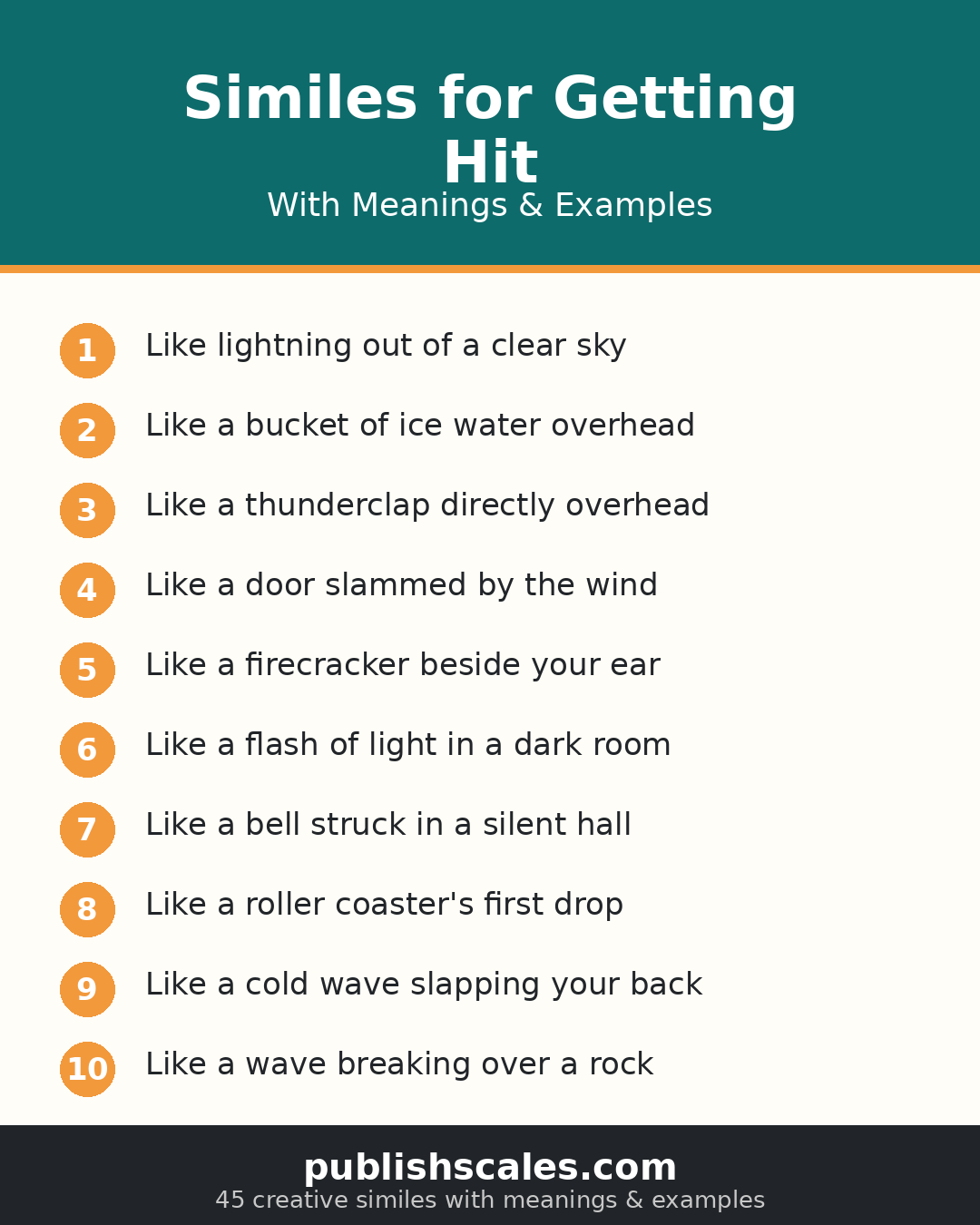
Some moments arrive without knocking. A ball you never saw coming, a wave bigger than it looked, a piece of news that lands before you can brace for it — being hit is one of the oldest shocks the body knows. The Merriam-Webster definition of hit is plain enough: to strike something forcefully with a hand, a tool, or a weapon. But on the page, a hit is never just contact — it is surprise, force, and the strange ringing quiet that follows. The similes for getting hit in this collection give writers all three.
Writers reach for these comparisons because a plain sentence like “he was hit hard” tells the reader almost nothing. Say instead that the blow landed like a wave breaking over a rock, and the reader feels the weight, hears the crash, and understands the helplessness in a single line. A good impact simile does the work of a whole paragraph of description.
Below you will find 45 similes for getting hit in five groups — sudden shock, force and weight, falls and crashes, sting and ache, and the dazed, shaken moments afterward. Every simile comes with a simple meaning and an example sentence, so you can pick the exact force your scene needs, from a playful bump in a schoolyard story to the heavy blow that changes a novel’s hero.
Match the simile to the moment: lightning for the shock nobody saw coming, deep water for the ache that lingers, and a shaken snow globe for the daze that follows. And when the hit comes from temper rather than weather, our similes for an angry person complete the scene.
Sudden Shock
The first family is the instant itself: the half-second when the world changes without warning and the body understands before the mind does.
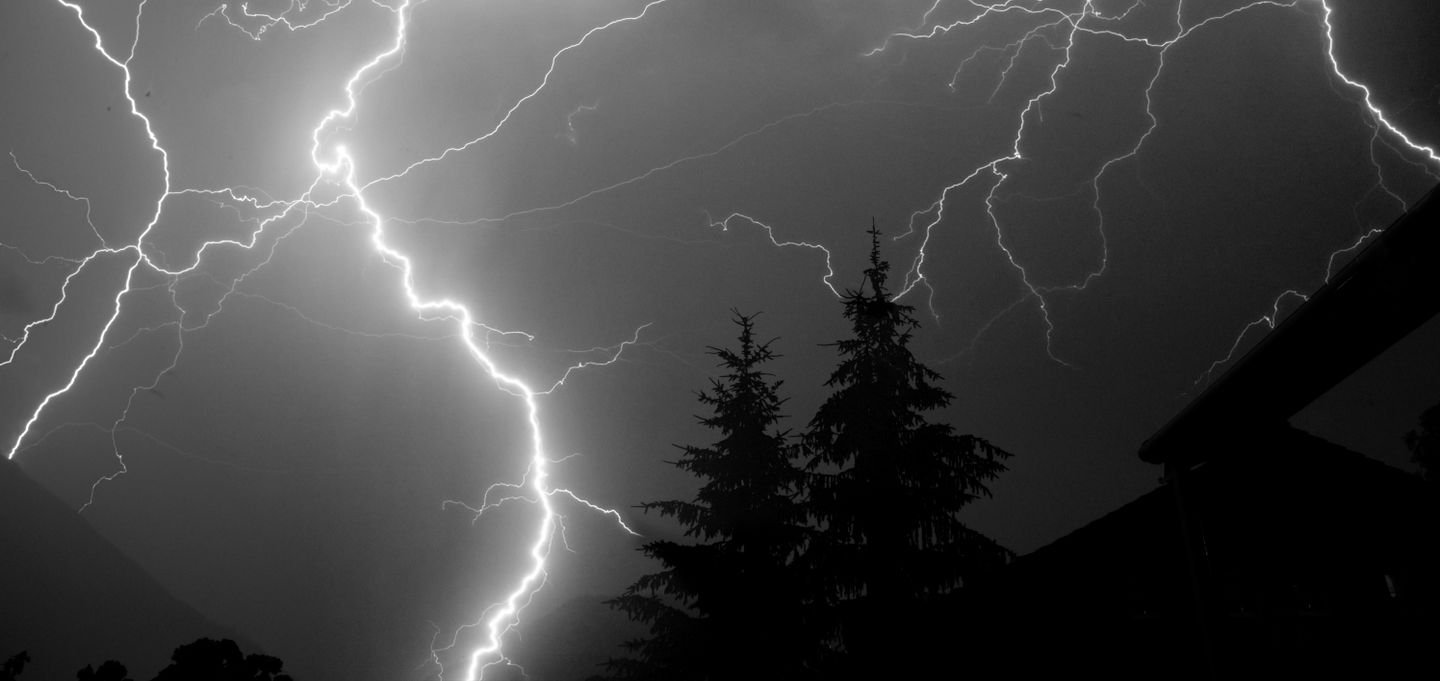
Like a lightning bolt out of a clear sky
Meaning: A shock that arrives with no warning at all, out of an ordinary, peaceful moment.
Example: “The phone call hit her like a lightning bolt out of a clear sky, and she sat down slowly where she stood.”
Like a bucket of ice water over the head
Meaning: A sudden, total shock that wakes every nerve at once and leaves you gasping.
Example: “His resignation landed on the whole office like a bucket of ice water over the head.”
Like a thunderclap directly overhead
Meaning: A blow of sound and surprise so close that it seems to shake the ground under you.
Example: “The verdict struck the courtroom like a thunderclap directly overhead — one crack, and then complete silence.”
Like a door slammed by the wind
Meaning: A sharp, startling impact that makes everyone nearby jump, brief but impossible to ignore.
Example: “Her answer hit him like a door slammed by the wind; he actually flinched.”
Like a firecracker beside your ear
Meaning: A small impact with an outsized shock, the kind that leaves your ears ringing and your heart racing.
Example: “The balloon popped right behind the goalkeeper, and it hit him like a firecracker beside his ear.”
Like a flash of light in a dark room
Meaning: A blinding instant of shock that wipes the picture in front of you clean for a moment.
Example: “The headline hit his eyes like a flash of light in a dark room, and for a second he could not read at all.”
Like a bell struck once in a silent hall
Meaning: A single clean shock that rings through you long after the moment itself has passed.
Example: “One sentence from the doctor struck him like a bell in a silent hall, and it rang in him all day.”
Like the first drop of a roller coaster
Meaning: The stomach-dropping instant when you realize the fall has already begun and cannot be stopped.
Example: “Seeing the empty shelf where the trophy had stood hit her like the first drop of a roller coaster.”
Like a cold wave slapping you from behind
Meaning: A shock that catches you unprepared, from the one direction you were not watching.
Example: “The betrayal hit him like a cold wave slapping him from behind on a calm, sunny beach.”
Force & Weight
For blows with real mass behind them: water, stone, and everything heavy that the world can drop on a person.

Like a wave breaking over a rock
Meaning: A force so much bigger than you that resisting is not really an option; you can only endure it.
Example: “The tackle hit him like a wave breaking over a rock, and the crowd heard the breath leave him.”
Like a sack of wet cement on your shoulders
Meaning: A heavy, dropping weight that lands all at once and nearly folds you under it.
Example: “The debt letter hit him like a sack of wet cement dropped on his shoulders from a height.”
Like a freight train that forgot to stop
Meaning: The classic image of unstoppable momentum — too much mass and speed for anything in its path.
Example: “The rugby forward came through the line like a freight train that forgot to stop, and the hit echoed off the stands.”
Like a battering ram meeting a castle gate
Meaning: A deliberate, full-force impact meant to break through something strong — and succeeding.
Example: “The gust hit the old barn door like a battering ram meeting a castle gate, and the hinges gave up at once.”
Like a boulder rolling off a shelf
Meaning: A crushing weight released suddenly, all the worse because it was quiet and still a moment before.
Example: “The shelf gave way, and the largest stone came down like a boulder rolling off a shelf onto the workbench.”
Like a hammer coming down on an anvil
Meaning: A hard, ringing, perfectly landed blow, the kind that sends a shock up through everything connected to it.
Example: “The champion’s final punch landed like a hammer coming down on an anvil — clean, final, and loud.”
Like a whole ocean leaning on you
Meaning: Not one blow but a vast, pressing force, the weight of far more than any single pair of hands.
Example: “Under the collapsed wave, the swimmer felt the hit like a whole ocean leaning on him at once.”
Like a falling piano in an old cartoon
Meaning: Absurd, exaggerated heaviness — a comic image for a blow so large it stops being frightening and starts being funny.
Example: “The stage prop landed behind him like a falling piano in an old cartoon, and the audience howled instead of gasped.”
Like a runaway cart rolling downhill
Meaning: A gathering, graceless force that everyone can see coming and nobody manages to stop in time.
Example: “He slipped on the icy slope and hit the fence like a runaway cart rolling downhill — slowly, then all at once.”
Falls & Crashes
Sometimes the hit is only the beginning; the real poetry is in the going down. These similes describe bodies, plans, and structures collapsing.
Like a tree coming down in the forest
Meaning: A slow, majestic topple that gathers speed and ends with a crash nobody in earshot can miss.
Example: “The exhausted giant of a goalkeeper went over like a tree coming down in the forest, and the stadium shook.”
Like a marionette whose strings were cut
Meaning: A sudden, complete collapse, as if whatever was holding the person up simply let go all at once.
Example: “When the cramp struck, the dancer folded like a marionette whose strings were cut, mid-step and mid-smile.”
Like a stack of plates sliding off a counter
Meaning: A noisy, clattering collapse that seems to happen in pieces and all at the same time.
Example: “Tripping on the rug, he went down like a stack of plates sliding off a counter, arms everywhere at once.”
Like a house of cards in a sudden gust
Meaning: Something delicate and carefully balanced destroyed completely by one passing force.
Example: “All her careful plans for the weekend fell like a house of cards in a sudden gust when the car refused to start.”
Like a bicycle meeting a patch of ice
Meaning: A sudden loss of all grip and dignity — one second upright and confident, the next on the ground.
Example: “His confident stride ended like a bicycle meeting a patch of ice, both feet arguing with the pavement.”
Like a chandelier giving up on the ceiling
Meaning: A grand, glittering collapse from a great height, beautiful and disastrous in the same second.
Example: “The chandelier in the ballroom scene falls like a chandelier giving up on the ceiling — sparkling all the way down.”
Like dominoes deciding all at once
Meaning: One knock that triggers a whole row of falls, each one knocking down the next.
Example: “The skiers at the top of the slope went over like dominoes deciding all at once, to the crowd’s delighted horror.”
Like a shelf of books in an earthquake
Meaning: A heavy, tumbling crash of many solid things arriving together, impossible to dodge.
Example: “The boxes in the storeroom came down on him like a shelf of books in an earthquake — thud after thud after thud.”
Like a snowman meeting the spring sun
Meaning: A slow, sad, slightly comic collapse — not a crash but a gradual surrender to the ground.
Example: “After the long hike back, he sank into the grass like a snowman meeting the spring sun, melting by degrees.”
Sting & Ache
Not every hit is huge. The small ones have their own literature: sharp, personal, and remembered long after the big blows are forgotten.
Like a wasp sting on a summer afternoon
Meaning: A small, sharp, furious pain that arrives out of nowhere and demands your whole attention.
Example: “The insult hit her like a wasp sting on a summer afternoon — tiny, sudden, and impossible to think past.”
Like a snapped rubber band on the wrist
Meaning: A quick, stinging smack: minor, precise, and somehow more annoying than a bigger blow.
Example: “Her criticism landed like a snapped rubber band on the wrist, and he rubbed the spot all through lunch.”
Like stubbing your toe on the bed frame at midnight
Meaning: A pain so pure and familiar that everyone reading winces in sympathy before the sentence even ends.
Example: “The memory hit him at 3 a.m. like stubbing your toe on the bed frame at midnight — sharp, stupid, and wide awake now.”
Like a splinter working its way deeper
Meaning: A small hurt that refuses to leave, growing more noticeable the longer it stays with you.
Example: “The doubt got in like a splinter working its way deeper every time he reread the email.”
Like nettles brushed with bare legs
Meaning: A hundred tiny stings at once, the kind of pain that makes you hop, curse, and laugh at yourself together.
Example: “The mosquito bites from the camping trip rose up like nettles brushed with bare legs the moment the train got warm.”
Like a toothache arriving at midnight
Meaning: A deep, throbbing ache that picks the worst possible hour and settles in to stay.
Example: “Grief, some nights, is like a toothache arriving at midnight — dull, deep, and impossible to sleep through.”
Like a sunburn discovered under a strap
Meaning: A tenderness you only find when something ordinary presses on it — a hidden ache revealed by accident.
Example: “His old failure still sat there like a sunburn discovered under a strap, fine until anything touched it.”
Like a bee that found the one open window
Meaning: A sting that feels personally aimed, as if the whole wide world had other targets and chose you anyway.
Example: “Of all the comments that day, one hit her like a bee that found the one open window — straight to the softest place.”
Like a bruise blooming in slow colors
Meaning: An ache that develops gradually and changes as it deepens, proof of a hit that keeps unfolding after it lands.
Example: “The shame of it spread through her week like a bruise blooming in slow colors, darker every day.”
Dazed & Shaken
The final family is the aftermath: the ringing, wobbling minute when the world has not quite come back into focus yet.
Like a bell still humming after the blow
Meaning: Stunned and resonant, carrying the vibration of the hit long after the moment itself is over.
Example: “He stood in the doorway like a bell still humming after the blow, one hand on the frame to steady himself.”
Like a snow globe just shaken hard
Meaning: Thoughts whirling in every direction, pretty and confused, needing time to settle back into place.
Example: “For a full minute after the announcement, her mind was like a snow globe just shaken hard — everything up in the air.”
Like a radio stuck between two stations
Meaning: A head full of static and half-sentences, unable to tune in to any single clear thought.
Example: “Concussed by the long fall and the longer day, his thoughts crackled like a radio stuck between two stations.”
Like a spinning top beginning to wobble
Meaning: Still upright, still moving, but clearly on the way down — balance quietly leaving the body.
Example: “She crossed the stage like a spinning top beginning to wobble, smiling bravely and looking for a chair.”
Like a goldfish after the bowl was tapped
Meaning: Startled into wide-eyed circling, darting around a small world that suddenly feels dangerous.
Example: “The interns scattered like goldfish after the bowl was tapped the moment the director walked in early.”
Like waking in a room you do not recognize
Meaning: A deep disorientation, the few lost seconds in which nothing around you has a name or a place.
Example: “After the fall from the ladder, he blinked at his own garden like a man waking in a room he did not recognize.”
Like a compass needle after the magnet moved
Meaning: Spinning, trembling, and pointing everywhere except true — a sense of direction temporarily knocked loose.
Example: “Her whole sense of the future swung like a compass needle after the magnet moved, settling nowhere.”
Like the world seen through rippling water
Meaning: Vision and judgment both unsteady, with every familiar shape bending slightly out of true.
Example: “Through tears and exhaustion, the station platform looked like the world seen through rippling water.”
Like a kite after the string snaps
Meaning: Suddenly untethered and drifting, carried by whatever wind is passing, with no one holding the other end.
Example: “When the last plan fell through, he drifted through the week like a kite after the string snaps — up, down, and nowhere chosen.”
Quick Reference: Similes for Getting Hit at a Glance
These ten land hardest — the essential getting-hit toolkit for any writer:
| Simile | Best For |
|---|---|
| Lightning bolt | A shock with no warning at all. |
| Ice water | Total, gasping, whole-body surprise. |
| Wave over a rock | Force far too big to resist. |
| Freight train | Unstoppable momentum in sports scenes. |
| Cut marionette | A sudden, complete collapse. |
| Wasp sting | Small, sharp, personal pain. |
| Stubbed toe | The pain every reader has felt. |
| Shaken snow globe | Whirling, unsettled thoughts. |
| Humming bell | A hit that keeps ringing afterward. |
| Snapped kite string | Drifting, untethered disorientation. |
How to Use Getting Hit Similes in Writing
In fiction, think of an impact in three beats: the shock, the force, and the daze. Most beginners write only the middle beat. A scene that opens with the lightning bolt, lands with the wave breaking over the rock, and lingers with the shaken snow globe feels complete, because it follows the same order the body experiences a real hit. You do not need all three beats every time, but choosing the beat your scene actually needs — surprise, weight, or aftermath — will sharpen every sentence.
In sports writing, match the simile to the sport’s own physics. Water and weather serve surfing, sailing, and stormy match reports; trains, hammers, and battering rams belong to boxing and rugby; the comic family — falling pianos, stubbed toes, sliding plates — belongs in light columns and school stories, where the reader is meant to laugh with the fallen hero rather than fear for him. One well-matched image per scene is worth five generic ones.
In essays and classroom writing, these similes are safest and strongest when the “hit” is figurative: news, grief, criticism, failure. Saying an exam result hit like a bucket of ice water tells the reader exactly how the moment felt without a single claim about physical harm. Keep the imagery literary, keep real people out of the line of fire, and the figure of speech will do honest work for you.
Common Mistakes to Avoid with Getting Hit Similes
Reaching for the nearest cliché
“Hit like a ton of bricks” is the first simile everyone thinks of, which is exactly why readers feel nothing when it arrives. It fails because it is a habit, not an observation. The fix: ask what this specific hit felt like — fast or heavy, sharp or dull, shocking or lingering — and pick the image that matches, even if it is a quieter one like the humming bell.
Mixing contradictory images in one sentence
A blow cannot land like lightning and like a slow ocean in the same breath; the reader’s picture tears in two. It fails because each simile asks for a different kind of force. The fix: give each impact one family — shock, weight, fall, sting, or daze — and save the other family for the next scene.
Stacking three similes on one hit
Lightning, then a train, then a wave, all for a single punch, reads as the writer showing off while the character waits to fall down. It fails because it pauses the action at the exact moment the action should speed up. The fix: choose the single strongest image, trust it, and let the next sentence deal with the consequences.
Letting the tone clash with the scene
A falling-piano cartoon image in a scene of real grief mocks the character; a freight train in a gentle children’s story frightens instead of delights. It fails because the simile’s mood fights the story’s mood. The fix: keep a comic image for comic moments and a heavy image for heavy ones, and reread the line aloud to hear the mismatch before your readers do.
Describing the hit but skipping the aftermath
Many drafts land the blow beautifully and then cut straight to the next scene, so the hit feels weightless by the following page. It fails because readers believe consequences, not impacts. The fix: spend one sentence on the daze family — the snow globe, the humming bell, the wobbling top — and the blow will echo through the rest of the chapter.
Frequently Asked Questions
What are the best similes for getting hit?
The strongest all-rounders are “like a lightning bolt out of a clear sky” for shock, “like a wave breaking over a rock” for overwhelming force, and “like a snow globe just shaken hard” for the daze that follows. Together they cover a complete impact in three beats.
What is a good simile for a sudden shock?
“Like a bucket of ice water over the head” is the favorite: instant, total, and understood by every reader. “Like a thunderclap directly overhead” works when you want the shock to feel louder and more dramatic.
How do I describe being hit without sounding violent?
Borrow your images from weather, water, and everyday accidents instead of weapons: waves, wind, ice, and stubbed toes all carry the feeling of a hit without a hint of gore. Figurative hits — news, criticism, surprise — keep school and family writing completely safe.
What simile describes the dazed feeling after a hit?
“Like a bell still humming after the blow” is the classic for stunned ringing, while “like a radio stuck between two stations” suits a head full of static and half-finished thoughts.
What is a funny simile for getting hit?
“Like a falling piano in an old cartoon” and “like stubbing your toe on the bed frame at midnight” raise laughs because the pain is exaggerated, familiar, and clearly survived. Save them for light scenes where the character is embarrassed rather than endangered.
How many similes should one impact scene use?
One per beat, and most scenes need only one beat. Shock, force, and daze are three separate jobs; a single well-chosen image for the job your scene is doing will always beat a pile of comparisons competing for the same punch.
Final Thought
A hit lasts a second, but a good simile makes it ring for pages. Choose the family that matches your moment — the lightning for surprise, the ocean for weight, the snow globe for the daze — and your reader will feel the blow land exactly where you aimed it, every single time.

The PublishScales Editorial Team researches and writes clear, original guides to similes and figurative language.


