Sadness is the quietest emotion to write, and often the hardest to make a reader truly feel. The Merriam-Webster definition of sad describes a feeling of sorrow or unhappiness, but plain words rarely carry the weight of a grey morning, a silent phone, or an empty chair. The similes for feeling sad in this collection give that weight a picture, so your reader does not just understand the sorrow, they stand inside it for a moment.
Writers reach for sad similes because grief and loneliness are hard to explain directly. Saying a character was unhappy tells the reader a fact, but saying her hope burned like a candle in an empty room shows the loneliness, the smallness of the hope, and the dark around it all at once.
Below you will find 45 similes for feeling sad in five groups: rain and grey weather, tears and water, heavy and ark images, alone and empty scenes, and quiet fading moments. Every simile comes with a simple meaning and a short example, so you can match the image to the exact kind of sadness your scene needs. Match the weight to the loss: the tap that drips for a small steady regret, the well with no bottom for a grief that changes alife. And when the sadness is really about being left on your own, see our similes for being alone as well.
Rain & Grey Weather
Sadness often arrives like bad weather: slow, grey, and impossible to ignore. These similes suit characters who feel soaked through by a mood they cannot shake off.

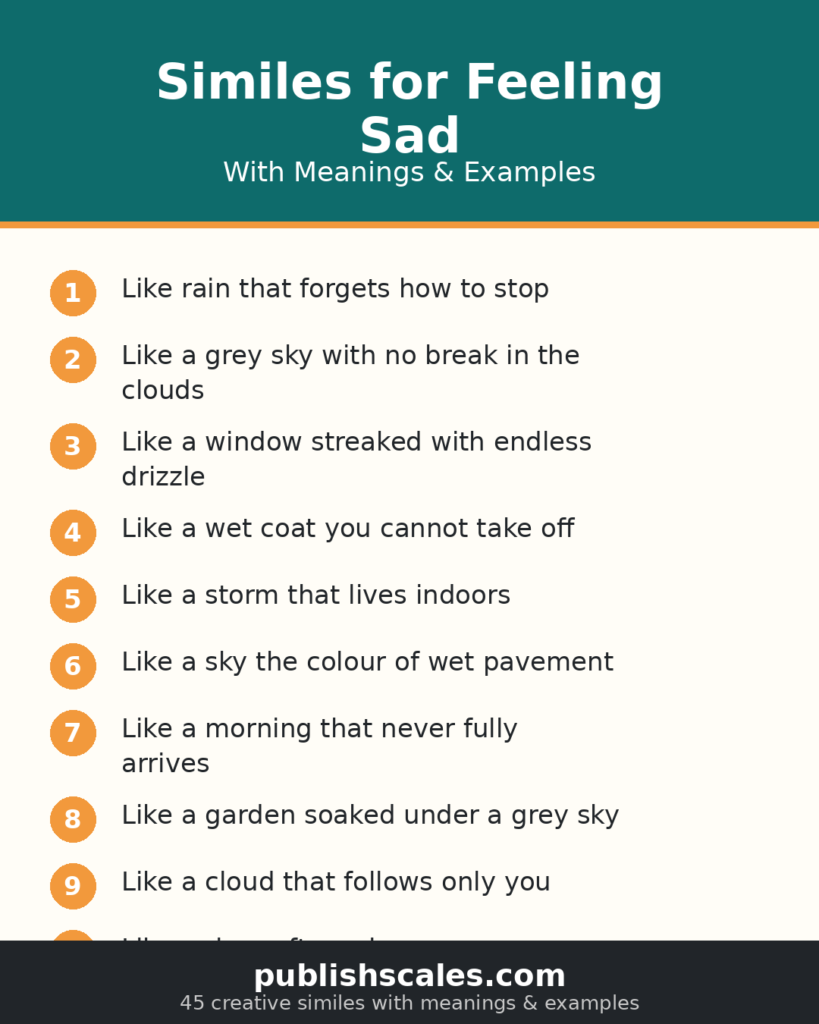
Like rain that forgets how to stop
Meaning: Sadness that keeps falling day after day with no clear end in sight.
Example: For three weeks after the funeral, Maya moved through work like rain that forgets how to stop.
Like a grey sky with no break in the clouds
Meaning: A heavy mood with no sign of hope or relief anywhere in it.
Example: His first winter away from home felt like a grey sky with no break in the clouds.
Like a window streaked with endless drizzle
Meaning: A view of life blurred by constant low level sorrow.
Example: She watched the celebration through tears, like a window streaked with endless drizzle.
Like a wet coat you cannot take off
Meaning: Discomfort and heaviness that follow a person everywhere they go.
Example: Grief clung to him at the party like a wet coat you cannot take off.
Like a storm that lives indoors
Meaning: Turmoil that stays inside a home or a heart instead of passing outside.
Example: After the argument, their kitchen held a storm that lives indoors.
Like a sky the colour of wet pavement
Meaning: A dull flat sadness with no brightness or contrast left in the day.
Example: Monday stretched ahead like a sky the colour of wet pavement.
Like a morning that never fully arrives
Meaning: A day that starts without energy, light, or any sense of beginning.
Example: Depression made each day feel like a morning that never fully arrives.
Like a garden soaked under a grey sky
Meaning: Something once growing and hopeful now flattened by too much sorrow.
Example: Her plans for the year lay like a garden soaked under a grey sky.
Like a cloud that follows only you
Meaning: Personal bad luck and gloom that seem to single out one person.
Example: Wherever Ben went that month, trouble followed like a cloud that follows only you.
Tears & Water
Water gives sadness a shape readers can see: dripping, spilling, rising, and freezing. Use these when emotion is close to the surface and ready to overflow.

Like a river after rain
Meaning: Emotion swollen by recent loss and flowing stronger than usual.
Example: Her eyes were like a river after rain whenever the old song played.
Like a tap that drips all night
Meaning: Small steady sorrow that never quite stops and keeps you awake.
Example: His regret leaked through the quiet house like a tap that drips all night.
Like a cup filled past the brim
Meaning: Feelings held in until one tiny addition makes them spill over.
Example: One kind word filled her like a cup filled past the brim, and she cried.
Like speaking underwater
Meaning: Words muffled by tears, distance, or the effort of holding emotion back.
Example: Trying to explain, he sounded like speaking underwater.
Like a tide coming in grain by grain
Meaning: Sadness arriving slowly and quietly until it covers everything.
Example: Loneliness crept over the village like a tide coming in grain by grain.
Like windows in a rainstorm
Meaning: Cheeks and eyes streaming so that the world beyond looks blurred.
Example: Her cheeks ran like windows in a rainstorm during the goodbye.
Like a well with no bottom
Meaning: Grief so deep that comfort and questions seem to fall forever.
Example: The loss opened in him like a well with no bottom.
Like a dam holding back a flood
Meaning: A brave face barely containing a huge amount of pain behind it.
Example: He smiled through the ceremony like a dam holding back a flood.
Like a boat quietly taking on water
Meaning: A person sinking slowly while appearing calm on the surface.
Example: No one noticed she was like a boat quietly taking on water until she stopped calling.
Heavy & Dark
Some sadness is not wet but weighty. These images use darkness, lead, fog, and winter to show how heavy a heart can feel inside an ordinary day.
Like carrying a bag of wet sand
Meaning: Exhausting sadness that makes every simple task feel twice as hard.
Example: Getting dressed that morning was like carrying a bag of wet sand uphill.
Like a room with the curtains drawn at noon
Meaning: A life shut away from light even when the world outside is bright.
Example: His mind stayed like a room with the curtains drawn at noon.
Like a coat made of lead
Meaning: A burden worn on the body that slows every step and breath.
Example: Shame settled on her shoulders like a coat made of lead.
Like a stone sinking in a pocket
Meaning: A secret sorrow carried everywhere, pulling quietly downward.
Example: The diagnosis sat in his thoughts like a stone sinking in a pocket.
Like a night with no stars and no moon
Meaning: Complete darkness with no small point of hope to steer by.
Example: After she left, his future looked like a night with no stars and no moon.
Like walking through thick fog alone
Meaning: Confusion and sorrow combined, with no clear path and no company.
Example: Returning to school felt like walking through thick fog alone.
Like a house with all the lights off
Meaning: A person present in body but dark and empty inside.
Example: He sat among friends like a house with all the lights off.
Like a shadow that sits down beside you
Meaning: Sadness as a quiet companion that stays close all day long.
Example: Grief followed her to breakfast like a shadow that sits down beside you.
Like a winter evening that starts at breakfast
Meaning: A day that feels dark and ending before it has even begun.
Example: Unemployment turned weeks into a winter evening that starts at breakfast.
Alone & Empty
Emptiness has its own pictures: chairs, rooms, stations, and tables waiting for people who are not coming. These similes work best for loneliness and missing someone specific.

Like an empty chair at a crowded table
Meaning: Absence felt most strongly in the middle of company and noise.
Example: At the wedding, Dad was missed like an empty chair at a crowded table.
Like a house after everyone has moved out
Meaning: A place or heart emptied of the life that once filled it.
Example: Her apartment after the divorce felt like a house after everyone has moved out.
Like a phone that never lights up
Meaning: Waiting for contact that does not come, hour after silent hour.
Example: He kept glancing down like a phone that never lights up was his whole life.
Like a room echoing after the music stops
Meaning: The hollow feeling left when joy ends suddenly and completely.
Example: Graduation night ended like a room echoing after the music stops.
Like a bench in a park in winter
Meaning: Being left exposed, cold, and unchosen while seasons move on.
Example: Forgotten by the team, he sat like a bench in a park in winter.
Like a letter written but never sent
Meaning: Feelings fully formed but never received by the person they were for.
Example: Her apology remained like a letter written but never sent.
Like a table set for two with one plate empty
Meaning: Hope prepared for someone who does not arrive to share it.
Example: He cooked anyway, like a table set for two with one plate empty.
Like a train station after the last train leaves
Meaning: A moment missed for good, leaving only silence and empty tracks.
Example: Midnight found her like a train station after the last train leaves.
Like a birthday cake with no one to share it
Meaning: Joy that turns sad because there is nobody present to receive it.
Example: Success abroad tasted like a birthday cake with no one to share it.
Quiet & Fading
The quietest sadness does not shout or spill. It dims, trails off, and loses colour. Save these for endings, goodbyes, and characters who are slipping away gently.
Like a song fading on a dying radio
Meaning: Happiness or connection weakening until it is barely audible.
Example: Their friendship ended like a song fading on a dying radio.
Like a candle burning low in an empty room
Meaning: A small light of hope using up its last strength alone.
Example: Her optimism burned like a candle burning low in an empty room.
Like a photograph slowly losing its colour
Meaning: A memory or love fading gradually until only outlines remain.
Example: Childhood summers returned like a photograph slowly losing its colour.
Like a whisper lost in a large hall
Meaning: A feeling or plea too quiet to reach anyone who could help.
Example: His request for help fell like a whisper lost in a large hall.
Like a flower closing before evening
Meaning: Something tender shutting itself away earlier than it should.
Example: After the criticism, she folded like a flower closing before evening.
Like a sunset that gives up early
Meaning: A day or a hope ending before its natural time has come.
Example: Their reunion dimmed like a sunset that gives up early.
Like a voice trailing off mid sentence
Meaning: Emotion too large or painful to finish saying out loud.
Example: He began to apologise, then stopped like a voice trailing off mid sentence.
Like a footprint washed away by the tide
Meaning: Proof that someone was here, erased gently and completely.
Example: Her time at the school vanished like a footprint washed away by the tide.
Like a light at the end of a long hallway going out
Meaning: The last distant hope disappearing and leaving the way dark.
Example: When the letter came, it was like a light at the end of a long hallway going out.
Quick Reference: 10 Similes for Feeling Sad at a Glance
Need one fast? This table matches ten of the most useful similes for feeling sad to the situations they describe best, from everyday disappointment to deep grief.
| Simile | What It Describes |
|---|---|
| Like rain that forgets how to stop | Sadness that lasts for days or weeks |
| Like a grey sky with no break in the clouds | A mood with no sign of hope |
| Like a tap that drips all night | Small steady regret that keeps returning |
| Like a dam holding back a flood | Pain hidden behind a brave face |
| Like a coat made of lead | Exhausting heaviness in ordinary tasks |
| Like a night with no stars and no moon | Complete loss of direction and hope |
| Like an empty chair at a crowded table | Missing someone in the middle of company |
| Like a phone that never lights up | Waiting for contact that never comes |
| Like a photograph slowly losing its colour | A memory or love fading over time |
| Like a light at the end of a long hallway going out | The last hope disappearing |
How to Use Similes for Feeling Sad in Writing
First, decide how large the sadness is. A missed bus, a lost friendship, and a death in the family should never share the same image. Small sorrows suit the dripping tap, the wet pavement sky, and the footprint in the tide. Large sorrows need the well, the lead coat, and the night with no moon. When the size of the simile matches the size of the loss, readers trust the scene instantly.
Next, place the simile where the feeling changes. Sadness in a story is rarely constant: it deepens at a doorway, a message that never arrives, or a name spoken by accident. Put your strongest image at that turning point rather than in the opening line, and let plainer sentences carry the reader towards it. One well placed simile will do more than five scattered through a page.
Then, let the body and the room agree with the image. If a character feels like a house with all the lights off, show the unopened curtains, the untouched cup, and the chair nobody sits in. Details that echo the simile make it feel observed rather than decorated, and they give other characters something real to notice and respond to.
Finally, know when to leave sadness plain. In letters, reports, and school essays, a single clear simile near the beginning sets the tone, and the rest can stay simple and honest. Sadness written plainly after one strong image often sounds more sincere than sadness dressed in comparisons from start to finish.
Common Mistakes to Avoid with Similes for Feeling Sad
Sadness invites exaggeration, which is exactly why it needs care. Watch for these five traps, and use the fix that follows each one.
Using a huge simile for a tiny disappointment
Calling a delayed train a night with no stars makes the writing sound comic, because the image promises a grief the scene never delivers. It fails by breaking trust: readers stop believing your big moments later. Fix it by scaling down: a dripping tap or a grey morning carries a small letdown honestly.
Stacking sad images in every sentence
Rain, tears, fog, and darkness in one paragraph do not multiply the feeling, they cancel each other out, because the reader cannot settle on one picture. Choose the single strongest image for the scene, give it room to work, and cut the rest without mercy.
Reaching for the same rain cliche every time
Sadness like rain is the first image every writer finds, so on its own it says very little. It fails through familiarity. Fix it by adding one specific detail: rain that forgets how to stop, rain on a window in a quiet kitchen, or rain that follows only one character through the story.
Mixing a hopeful image with a hopeless scene
A candle can mean fading hope, but pairing it with sunshine and spring in the same passage confuses the emotional direction. Readers feel the clash even when they cannot name it. Decide whether the scene allows hope or not, then keep every image on the same side of that line.
Describing sadness but forgetting the person
A grey sky alone is weather, not feeling. A simile fails when no one is standing under it. Always anchor the image to a character: who carries the lead coat, who watches the phone, who sits beside the empty chair. The person turns a pretty comparison into an emotion.
Frequently Asked Questions About Similes for Feeling Sad
What are similes for feeling sad?
A simile for feeling sad compares sorrow to a familiar picture using like or as. For example, grief can be like a well with no bottom, which shows a sadness so deep that comfort seems to fall forever without landing.
What is a good simile for deep sadness?
One of the strongest is like a night with no stars and no moon, because it removes every small point of light a person might steer by. For a heavier physical feeling, like a coat made of lead shows how grief slows every ordinary task.
How do I describe sadness without using the word sad?
Give the reader one image and one detail. Show a character like a house with all the lights off, then add the unopened curtains or the untouched meal. Readers will name the emotion themselves, and a feeling they discover always lands harder than one they are told.
What is a simile for crying?
Tears suit water images: eyes like a river after rain for a flood of crying, or a tap that drips all night for tears that keep returning quietly. Cheeks like windows in a rainstorm works beautifully for a face streaming in the open.
Can sad similes be used in school writing?
Yes, and teachers welcome similes for feeling sad when they are precise. Choose one clear image, explain what it shows, and keep the rest of the paragraph plain. A single simile like an empty chair at a crowded table is vivid, appropriate, and easy for any reader to understand.
What is the difference between a simile and a metaphor for sadness?
A simile compares with like or as: her sadness was like a grey sky. A metaphor states the thing directly: her sadness was a grey sky. Similes feel clearer and gentler, which suits younger writers, while metaphors feel bolder and more poetic in stories and poems.
Similes for Feeling Sad: A Final Thought
Sadness does not need to shout to be heard. The best similes for feeling sad work quietly: a dripping tap, an empty chair, a light going out at the end of a hallway. Choose the image that matches the true size of the loss, place it where the feeling turns, and trust your reader to feel the rest. Written with that care, even the greyest page can hold a whole heart. That is the quiet power of similes for feeling sad. When the feeling is less sadness than a generally dark outlook, our similes for negative describe that frame of mind.

The PublishScales Editorial Team researches and writes clear, original guides to similes and figurative language.