

Similes for comparisons help explain an idea by connecting it to something familiar. You might describe a brave person as “as bold as a lion,” a busy place as “like a beehive,” or a difficult task as “like climbing a mountain.” Each comparison gives readers a clearer picture.

What Are Similes?
Meaning: Feeling extremely happy, excited, or carefree.
Why it works: The image suggests being so delighted that ordinary physical limits seem to disappear.
Example: After getting her dream job, Nina felt like she was walking on air.
Meaning: Moving steadily toward a destination.
Why it works: A river follows a continuing course toward its outlet.
Example: The crowd moved like a river flowing to the sea toward the stadium gates.
Best for: Crowds, journeys, and continuous movement.
Everyday Similes for Common Comparisons
1. As Brave as a Lion
Meaning: Extremely courageous.
Why it works: Lions are universally seen as symbols of courage.
Example: “The firefighter was as brave as a lion.”
Best for: Courage, heroism, and facing fears.
2. Like a Fish Out of Water
Meaning: Feeling awkward or out of place.
Why it works: A fish cannot survive outside water, just as people struggle in unfamiliar settings.
Example: “At the formal gala, he felt like a fish out of water.”
Best for: New environments, discomfort, and unfamiliar situations.
3. As Busy as a Bee
Meaning: Working hard with constant activity.
Why it works: Bees are famously tireless workers.
Example: “She was as busy as a bee before the wedding.”
Best for: Hard work, packed schedules, and productivity.
4. Like Night and Day
Meaning: Completely different from each other.
Why it works: Night and day are the ultimate opposites.
Example: “The twins are like night and day.”
Best for: Contrasts, opposites, and comparisons.
5. As Cold as Ice
Meaning: Emotionally distant or literally freezing.
Why it works: Ice is the universal symbol of coldness.
Example: “His stare was as cold as ice.”
Best for: Cold weather and unfriendly behavior.
6. Like a Bull in a China Shop
Meaning: Clumsy and reckless in a delicate situation.
Why it works: The image of a huge animal among fragile dishes is instantly funny.
Example: “He handled the negotiations like a bull in a china shop.”
Best for: Clumsiness and delicate situations.
7. As Happy as a Clam
Meaning: Perfectly content.
Why it works: The rhyme makes it memorable, and clams seem peacefully settled.
Example: “With the promotion letter in hand, she was as happy as a clam.”
Best for: Contentment and good news.
8. Like a Breath of Fresh Air
Meaning: Something refreshingly new and welcome.
Why it works: Fresh air revives you after stuffiness.
Example: “The new manager was like a breath of fresh air.”
Best for: New beginnings, relief, and positive change.
9. As Strong as an Ox
Meaning: Physically powerful.
Why it works: Oxen are known for pulling heavy loads.
Example: “The wrestler was as strong as an ox.”
Best for: Strength and endurance.
10. Like Two Peas in a Pod
Meaning: Very similar, almost identical.
Why it works: Peas in a pod look exactly alike.
Example: “The sisters are like two peas in a pod.”
Best for: Similarity and close relationships.
11. As Blind as a Bat
Meaning: Unable to see well.
Why it works: Bats navigate by sound, not sight.
Example: “Without his glasses, he was as blind as a bat.”
Best for: Poor vision and missing obvious things.
12. Like a Deer in Headlights
Meaning: Frozen with fear or surprise.
Why it works: The image of a startled deer is vivid and familiar.
Example: “Asked an unexpected question, she froze like a deer in headlights.”
Best for: Surprise, stage fright, and panic.
13. As Smooth as Silk
Meaning: Perfectly smooth or effortless.
Why it works: Silk’s texture is the standard for smoothness.
Example: “His presentation went as smooth as silk.”
Best for: Elegance and flawless performance.
14. Like a Kid in a Candy Store
Meaning: Overjoyed by abundant choices.
Why it works: Every child dreams of unlimited candy.
Example: “In the library, the book lover was like a kid in a candy store.”
Best for: Excitement and abundance.
15. As Tough as Nails
Meaning: Very strong or resilient.
Why it works: Nails are hard, unbreakable metal.
Example: “The old coach was as tough as nails.”
Best for: Resilience and toughness.
16. Like Oil and Water
Meaning: Two things that cannot mix.
Why it works: Oil and water famously separate.
Example: “The two rivals mixed like oil and water.”
Best for: Incompatibility and conflict.
Similes for Character and Personality
17. As Light as a Feather
Meaning: Very lightweight.
Why it works: Feathers barely weigh anything.
Example: “The package was as light as a feather.”
Best for: Weight and gentleness.
18. Like a Moth to a Flame
Meaning: Irresistibly drawn to something dangerous.
Why it works: Moths cannot resist light even though it harms them.
Example: “He was drawn to risky investments like a moth to a flame.”
Best for: Temptation and dangerous attraction.
19. As Old as the Hills
Meaning: Very ancient.
Why it works: Hills have stood for ages.
Example: “That joke is as old as the hills.”
Best for: Age and outdated things.
20. Like a Wolf in Sheep’s Clothing
Meaning: Someone dangerous pretending to be harmless.
Why it works: The disguise hides the predator.
Example: “The charming salesman was like a wolf in sheep’s clothing.”
Best for: Deception and hidden motives.
21. As Sweet as Honey
Meaning: Very kind or pleasant.
Why it works: Honey is nature’s sweetest treat.
Example: “The grandmother was as sweet as honey.”
Best for: Kindness and pleasant personalities.
22. Like a House on Fire
Meaning: Getting along extremely well.
Why it works: The speed and intensity of a blazing fire suggest instant chemistry.
Example: “The new colleagues got along like a house on fire.”
Best for: Fast friendships and chemistry.
23. As Sly as a Fox
Meaning: Clever in a tricky way.
Why it works: Foxes are legendary for cunning.
Example: “The negotiator was as sly as a fox.”
Best for: Cunning and cleverness.
24. As Happy as a Pig in Mud
Meaning: Blissfully content in one’s element.
Why it works: Pigs visibly love wallowing in mud.
Example: “In his workshop, he was as happy as a pig in mud.”
Best for: Contentment and being in one’s element.
25. As White as Snow
Meaning: Pure white.
Why it works: Fresh snow is the brightest white in nature.
Example: “The sheets were as white as snow.”
Best for: Color and purity.
26. As Red as a Rose
Meaning: Deep, vivid red.
Why it works: Red roses are the classic image of the color.
Example: “She blushed as red as a rose.”
Best for: Color, embarrassment, and romance.
27. Like a Dream Come True
Meaning: Something wonderful beyond expectation.
Why it works: Dreams represent our deepest wishes.
Example: “Winning the scholarship was like a dream come true.”
Best for: Wishes fulfilled and happy surprises.
28. As Fit as a Fiddle
Meaning: In excellent health.
Why it works: A well-tuned fiddle plays perfectly.
Example: “After months of training, he was as fit as a fiddle.”
Best for: Health and fitness.
29. Like a Cat on a Hot Tin Roof
Meaning: Restless and agitated.
Why it works: The image of a cat unable to sit still is instantly clear.
Example: “Before the results, she was like a cat on a hot tin roof.”
Best for: Nervousness and restlessness.
30. As Cool as a Cucumber
Meaning: Perfectly calm under pressure.
Why it works: Cucumbers stay cool inside even in heat.
Example: “During the crisis, the pilot stayed as cool as a cucumber.”
Best for: Calmness and composure.
31. Like Peas and Carrots
Meaning: Two things that go perfectly together.
Why it works: The classic pairing belongs side by side.
Example: “The duo went together like peas and carrots.”
Best for: Perfect pairs and teamwork.
32. As Straight as an Arrow
Meaning: Honest and direct.
Why it works: An arrow flies true without bending.
Example: “His answer was as straight as an arrow.”
Best for: Honesty and directness.
33. As Free as a Bird
Meaning: Feeling unrestricted or independent.
Why it works: Birds flying through open skies often symbolize freedom.
Example: After finishing her final assignment, Leah felt as free as a bird.
Best for: Independence, travel, and relief from responsibilities.
34. Like Leaves in the Wind
Meaning: Moving unpredictably or being easily influenced by outside forces.
Why it works: Leaves can change direction whenever the wind shifts.
Example: Without a clear plan, the team’s decisions changed like leaves in the wind.
Best for: Uncertainty, changing circumstances, and unstable decisions.
35. As Quiet as a Mouse
Meaning: Making very little noise.
Why it works: A mouse is often associated with small, quiet movements.
Example: The children stayed as quiet as mice while the baby slept.
Best for: Libraries, sleeping spaces, and scenes requiring silence.
Similes for Everyday Situations and Relationships
36. Like Two Sides of the Same Coin
Meaning: Two things that differ but remain closely connected.
Why it works: Both sides belong to one coin, even though each side looks different.
Example: Freedom and responsibility are like two sides of the same coin.
Best for: Essays, discussions, relationships, and connected ideas.
37. As Easy as Pie
Meaning: Very easy to do.
Why it works: The expression is a familiar informal way to describe something simple.
Example: Once I understood the instructions, the math problem was as easy as pie.
Best for: Everyday conversation, schoolwork, and casual writing.
38. Like a Needle in a Haystack
Meaning: Extremely difficult to find because something is hidden among many other things.
Why it works: A small needle would be hard to locate in a large pile of hay.
Example: Finding the correct document among thousands of files was like looking for a needle in a haystack.
Best for: Searching, research, lost objects, and difficult discoveries.
39. As Clear as Crystal
Meaning: Very easy to understand or see.
Why it works: Clear crystal suggests transparency and visibility.
Example: After the teacher explained the final step, the instructions were as clear as crystal.
Best for: Explanations, directions, arguments, and communication.
40. Like Clockwork
Meaning: Happening smoothly, regularly, and predictably.
Why it works: A working clock follows a consistent pattern.
Example: The morning routine ran like clockwork once everyone knew their responsibilities.
Best for: Routines, well-organized events, and reliable systems.
Creative Similes for Writing and Description
41. As Quiet as Falling Snow
Meaning: Almost completely silent.
Why it works: Falling snow often creates an image of stillness and calm.
Example: The garden was as quiet as falling snow before sunrise.
Best for: Peaceful scenes, poetry, and descriptive writing.
42. Like Fireworks in the Night Sky
Meaning: Bright, exciting, or full of sudden energy.
Why it works: Fireworks fill the sky with color, light, and movement.
Example: Ideas burst through her mind like fireworks in the night sky.
Best for: Excitement, imagination, celebrations, and energetic scenes.
43. As Delicate as a Spider’s Web
Meaning: Extremely fine, fragile, or easily damaged.
Why it works: A spider’s web contains thin strands that can break under pressure.
Example: The artist painted lines as delicate as a spider’s web across the paper.
Best for: Fine details, fragile objects, and artistic descriptions.
44. Like a Puzzle Missing a Piece
Meaning: Incomplete or difficult to understand because something important is absent.
Why it works: A missing piece prevents a puzzle from forming a complete picture.
Example: Without the final chapter, the story felt like a puzzle missing a piece.
Best for: Incomplete information, mysteries, and unfinished plans.
45. As Steady as a Rock
Meaning: Reliable, stable, or emotionally composed.
Why it works: A rock suggests firmness and resistance to movement.
Example: During the emergency, our team leader remained as steady as a rock.
Best for: Dependability, emotional control, and difficult circumstances.
Quick-Reference Table: Choosing the Right Comparison
| Simile | Meaning | Best Used For |
|---|---|---|
| As brave as a lion | Courageous | Personal qualities |
| As busy as a bee | Very active | Work and daily routines |
| Like two peas in a pod | Very similar | Friends and siblings |
| As fast as lightning | Extremely quick | Sports and reactions |
| As light as a feather | Very light | Objects and movement |
| Like climbing a mountain | Difficult | Challenges and goals |
| As free as a bird | Unrestricted | Independence |
| Like a house of cards | Unstable | Plans and arrangements |
| As clear as crystal | Easy to understand | Communication |
| Like a puzzle missing a piece | Incomplete | Stories and explanations |
How to Choose the Best Simile for a Comparison
A useful simile highlights the particular quality you want readers to notice. Before choosing one, consider the following points.

Identify the quality. Decide whether you are describing appearance, speed, strength, emotion, behavior, or difficulty. “As fast as lightning” emphasizes speed, while “as steady as a rock” suggests stability.
Match the tone. Some expressions sound playful, while others create a serious or poetic effect. “As stubborn as a mule” may suit a humorous character description, but a formal essay might benefit from a more precise explanation.
Consider your audience. Familiar comparisons such as “as white as snow” work well for younger students. Creative writers may prefer a less predictable image if it makes the scene more vivid.
Avoid overloading the sentence. One relevant simile often creates a stronger impression than several comparisons placed together. Choose the image that adds the most useful detail.
Compare these sentences:
- Plain: The room was very busy.
- With a simile: The room was like a beehive, with people moving in every direction.
The second sentence gives readers a clearer picture of activity and movement.
Using “Like” and “As” in Similes
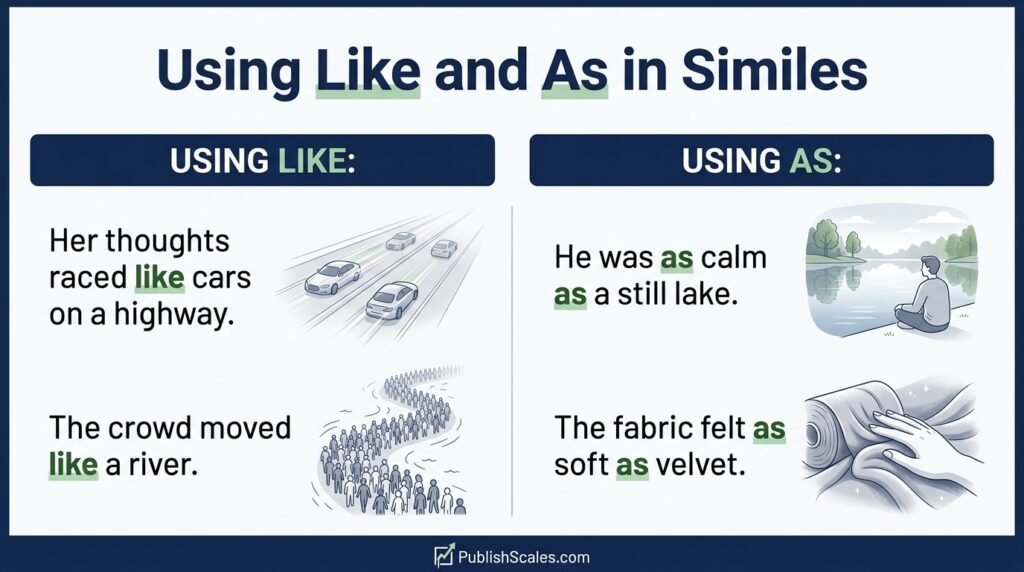
Similes commonly use like or as to connect two different things.
Examples Using “Like”
- Her thoughts raced like cars on a busy highway.
- The new student felt like a fish in water during art class.
- The crowd moved like a river through the station.
Examples Using “As”
- He was as calm as a still lake.
- The fabric felt as soft as velvet.
- The instructions were as clear as crystal.
Both structures can create effective comparisons. Choose the wording that sounds natural and communicates the intended meaning clearly.
Common Mistakes When Using Similes

1. Choosing an inaccurate comparison. A simile should highlight a quality that both things reasonably share. Comparing a quiet room to a roaring waterfall would confuse readers unless the sentence deliberately uses contrast.
2. Mixing unrelated images. A sentence that compares someone to a lion, a river, and a rocket all at once may become difficult to picture. One well-chosen comparison is often enough.
3. Treating a simile as a literal statement. Saying “He is as strong as an ox” emphasizes strength; it does not mean the person has the physical characteristics of an ox.
4. Using clichés without a purpose. Familiar expressions are useful, but repeating several common comparisons in one paragraph can make writing predictable. Add specific details when the context calls for originality.
5. Ignoring the audience. A funny or exaggerated simile may work in a casual story but sound unsuitable in a formal report. Match the comparison to the situation.
Frequently Asked Questions
1. What is a good simile for a comparison?
“As brave as a lion” is a useful simile when comparing someone’s courage with the strength and boldness associated with a lion. Other options include “as busy as a bee” for activity and “as clear as crystal” for easy understanding. The best choice depends on the quality you want to emphasize.
2. What is the difference between a simile and a comparison?
A comparison is a broad way of showing how two things are similar or different. A simile is a specific figure of speech that compares two different things using words such as like or as. For example, “Her voice was as soft as velvet” is a simile because it connects a voice with a familiar texture.
3. What are some simple similes for students?
Students can start with familiar expressions such as “as white as snow,” “as busy as a bee,” “as fast as lightning,” and “as quiet as a mouse.” Each comparison has a clear meaning and is easy to use in a sentence. These examples also help learners understand how figurative language makes descriptions more vivid.
4. How can I create my own simile?
First, identify the quality you want to describe, such as speed, warmth, or nervousness. Next, think of something familiar that shares that quality. Finally, connect the two ideas with like or as. For example, you could describe a rapidly spreading rumor as moving like a spark through dry grass.
5. Can similes improve creative writing?
Yes. A well-chosen simile helps readers imagine an action, feeling, or setting more clearly. “The crowd moved like a river” suggests continuous movement, while “her thoughts burst like fireworks” conveys excitement and energy. Use comparisons that suit the scene instead of adding figurative language to every sentence.
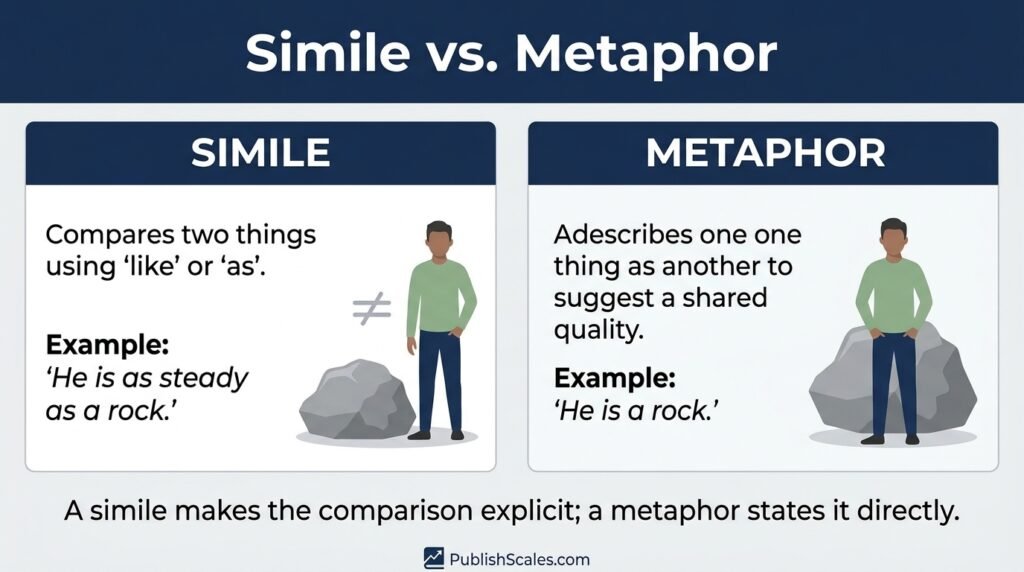
6. Are similes and metaphors the same?
No. Both compare ideas, but they use different structures. A simile makes the comparison explicit with words such as like or as, as in “He is as steady as a rock.” A metaphor states the comparison directly, as in “He is a rock,” to suggest that someone is dependable.
Question 1: Staying Calm
Which simile describes someone who remains calm under pressure?
- As cool as a cucumber — calm and composed
- As slow as a snail — moving very slowly
- As black as coal — very dark in color
Question 2: Similar Appearance
Which expression describes two people who look very similar?
- Like a house of cards — fragile or unstable
- Like two peas in a pod — very similar
- Like a needle in a haystack — difficult to find
Question 3: Being Very Active
Which simile describes someone who is extremely busy?
- As quiet as a mouse — making very little noise
- As busy as a bee — constantly active
- As cold as ice — very cold or emotionally distant
Conclusion
Similes for comparisons make descriptions clearer by connecting unfamiliar ideas with familiar images. Expressions such as “as brave as a lion,” “like a house of cards,” and “as clear as crystal” highlight different qualities, from courage to instability and understanding.
To choose the right simile, identify the feature you want readers to notice and consider the tone of your writing. Familiar expressions work well when their meanings fit the context, while original comparisons can add a fresh perspective. If you want uplifting examples, see our 45 similes for motivation.
With practice, you can use similes to make conversations, school assignments, stories, and poems more vivid. For fresh material, explore our 45 similes for new.
When you need to explain a comparison simply, try our 45 similes for explain.
Teaching young learners? See our Similes for 3rd Graders.
To describe anything well, start with our similes for describe.
Final Thought
Comparison is how the mind understands anything new — it measures the unknown against the familiar. The similes in this collection show how flexible that habit can be, so mix, match, and invent your own; the best comparison is the one only you could have made.

The PublishScales Editorial Team researches and writes clear, original guides to similes and figurative language.


