
Writers reach for similes for teeth whenever a face needs instant character. Dictionaries define teeth as hard structures for biting and chewing, yet stories give them far richer work. After all, similes for candy may sweeten a scene, but a smile can charm, threaten, or terrify instead. Therefore, one well-chosen comparison can carry humour, beauty, or horror at once.
Great teeth similes do three jobs at once in fiction. First, they fix a face in the reader’s mind instantly. Next, they hint at health, wealth, habits, and hidden temperament. Finally, they set the emotional temperature of an entire scene.
This guide collects forty-five similes across five handy categories. You will find beauty, strength, animal wildness, food comedy, and expression. In addition, a comparison table and practical tips follow the lists. Therefore, bookmark the page before your next drafting session begins.
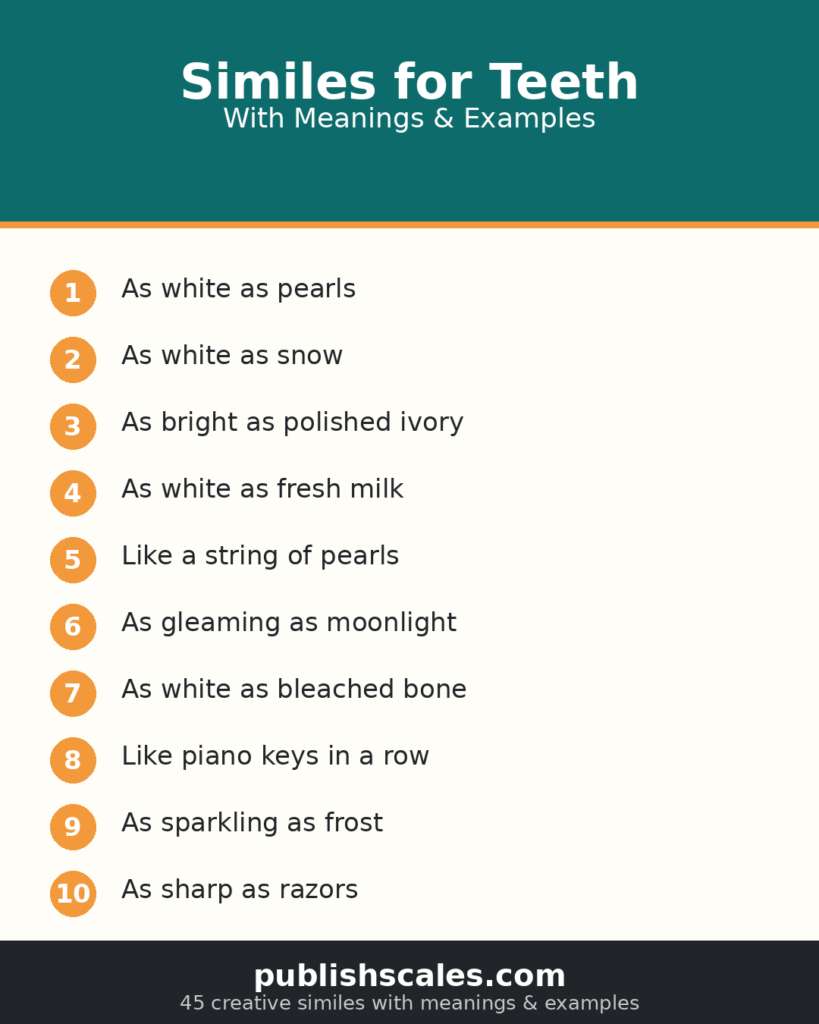
What Do Teeth Show in Writing?
Teeth reveal health before a character says a single word. White, straight teeth suggest youth, money, and careful daily habits. However, stained or missing teeth can signal poverty, age, illness, or hard living. Readers, in short, judge strangers by their smiles instinctively. Even one missing tooth, for example, can tell a whole backstory silently.
Teeth also reveal temperament and hidden danger quite clearly. A gentle smile promises safety, while bared teeth warn of anger or attack. In addition, sharp canines make heroes look wild and villains look hungry. Therefore, one dental detail can set the whole scene’s mood.
Similes for White and Bright Teeth
Bright teeth suggest health, confidence, and careful grooming at a glance.
As white as pearls
Meaning: This classic simile describes teeth that look smooth, white, and evenly shaped. Overall, it suits romantic heroes, heroines, and polished public figures.
Example: When she smiled at the camera, her teeth shone as white as pearls.
As white as snow
Meaning: This simile stresses pure, clean whiteness with no stains at all. Therefore, writers often use it for innocent or youthful characters.
Example: The child’s teeth were as white as snow, untouched by coffee or time.
As bright as polished ivory
Meaning: Ivory gives the whiteness a smooth, expensive shine. In addition, the image hints at wealth, care, and regular attention.
Example: His teeth, as bright as polished ivory, matched his tailored suit perfectly.
As white as fresh milk
Meaning: Milk suggests soft, natural whiteness rather than a bleached shine. As a result, this simile fits children and gentle, wholesome characters.
Example: The toddler grinned, showing baby teeth as white as fresh milk.
Like a string of pearls
Meaning: Here the focus is the neat row, not just the colour. Moreover, the image suggests order, health, and careful grooming.
Example: Her front teeth sat like a string of pearls behind her smile.
As gleaming as moonlight
Meaning: Moonlight adds a soft glow that catches the eye in darkness. Consequently, poets use this simile for mysterious or romantic night scenes.
Example: Her teeth, as gleaming as moonlight, flashed briefly when she laughed.
As white as bleached bone
Meaning: Bone makes the whiteness feel dry, stark, and slightly unsettling. In contrast, this version suits skeletons, villains, and grim descriptions.
Example: The old skull grinned with teeth as white as bleached bone.
Like piano keys in a row
Meaning: Piano keys suggest straight, even teeth with a musical neatness. Meanwhile, the playful image works especially well in light comedy.
Example: He smiled widely, his teeth lined up like piano keys in a row.
As sparkling as frost
Meaning: Frost gives whiteness a crisp, glittering edge. Still, the cold note keeps the beauty slightly distant and untouchable.
Example: Her winter smile was as sparkling as frost on a windowpane.
Similes for Strong and Sharp Teeth
Meanwhile, strong and sharp teeth suggest power, danger, and characters who bite back.
As sharp as razors
Meaning: This simile presents teeth as cutting tools that slice with ease. Therefore, it suits predators, fighters, and threatening villains.
Example: The creature opened its jaws, showing teeth as sharp as razors.
As strong as iron
Meaning: Iron stands for hardness that refuses to bend or break. In addition, the image implies endurance under heavy daily pressure.
Example: Years of chewing tough roots left his teeth as strong as iron.
Like a row of daggers
Meaning: Daggers turn a mouth into a hidden weapons rack. As a result, readers instantly feel danger before anyone speaks.
Example: The dragon’s mouth opened like a row of daggers in the dark.
As sharp as needles
Meaning: Needles suggest many small, pointed teeth rather than long blades. However, the pain they promise feels precise and stinging.
Example: The tiny fish snapped with teeth as sharp as needles.
Like broken glass
Meaning: Broken glass describes jagged, uneven teeth with dangerous edges. In short, it fits monsters, accidents, and sadly neglected mouths.
Example: After the accident, his teeth looked like broken glass in his mouth.
As hard as diamonds
Meaning: Diamonds suggest teeth that nothing can scratch or crush. Moreover, the sparkle adds a touch of pride and glamour.
Example: She bit the olive pit, her teeth as hard as diamonds.
Like a steel trap
Meaning: A steel trap bites fast and refuses to let go. Consequently, this simile suits stubborn guards, dogs, and determined fighters.
Example: Once they closed, his jaws held on like a steel trap.
As pointed as fangs
Meaning: Fangs are long, curved teeth made for piercing flesh. Still, in human descriptions the image hints at cruelty or vampirism.
Example: The vampire smiled, revealing front teeth as pointed as fangs.
As solid as carved stone
Meaning: Stone suggests teeth built to last through age and hardship. Overall, this simile flatters tough, weathered, older characters.
Example: The old farmer’s teeth stayed as solid as carved stone.

Similes for Animal Teeth
Animal comparisons, meanwhile, borrow wild instincts and lend characters a creature’s hunger or charm.
Like a wolf’s fangs
Meaning: Wolf fangs suggest hunger, patience, and strong pack loyalty. Therefore, this simile suits hunters and survivors in wild settings.
Example: The trapper smiled thinly, his teeth showing like a wolf’s fangs.
Like a shark’s teeth
Meaning: Sharks grow row after row of sharp replacement teeth. As a result, the image suggests relentless, almost endless menace.
Example: The villain’s grin, like a shark’s teeth, promised endless trouble ahead.
Like a crocodile’s grin
Meaning: A crocodile shows long teeth even with its mouth closed. In addition, the grin looks calm while hiding real danger.
Example: He waited by the river, grinning like a crocodile, teeth showing.
Like a beaver’s chisels
Meaning: Beavers cut wood with strong, ever-growing front teeth. Meanwhile, the image suits hard workers and cheerful, unstoppable nibblers.
Example: Her front teeth, like a beaver’s chisels, quickly felled the carrot.
Like a rabbit’s front teeth
Meaning: Prominent front teeth give a gentle, comic, slightly shy look. Still, the image can cruelly tease characters in schoolyard scenes.
Example: The boy’s two front teeth, like a rabbit’s, peeked over his lip.
Like a snake’s fangs
Meaning: Snake fangs deliver venom with one quick, silent strike. Consequently, this simile warns readers about poison, betrayal, and hidden malice.
Example: His whisper came with a smile like a snake’s fangs, sweet and deadly.
Like a horse’s teeth
Meaning: Long, square horse teeth suggest age, strength, and plain honesty. In fact, buyers judge horses by teeth, so scrutiny is implied.
Example: Grandfather laughed loudly, showing teeth like a horse’s, big and yellow.
Like a tiger’s canines
Meaning: Tiger canines are long, curved, and built for the kill. Overall, the simile lends royal confidence mixed with real threat.
Example: The queen’s smile showed canines like a tiger’s, beautiful and alarming.
Like a mouse’s nibbling teeth
Meaning: Mouse teeth suggest tiny, quick bites and quiet persistence. Moreover, the image suits timid characters who still get results.
Example: She nibbled the biscuit with tiny bites, like a mouse at midnight.
Similes for Teeth, Food and Eating
Food similes, in addition, turn eating into comedy, greed, or simple daily pleasure.
Grinding like millstones
Meaning: Millstones crush grain slowly between two heavy stones. Therefore, this simile suits tough food and patient, powerful jaws.
Example: He chewed the dry bread slowly, teeth grinding like millstones.
Cracking nuts like a squirrel
Meaning: Squirrels crack hard shells with quick, practised little bites. In addition, the image feels busy, cheerful, and slightly greedy.
Example: Grandma cracked walnuts like a squirrel, teeth working without pause.
Like biting into a crisp apple
Meaning: A crisp apple bite sounds clean, fresh, and deeply satisfying. As a result, writers use it for healthy, youthful eating scenes.
Example: She bit the pear like a crisp apple, juice shining brightly.
As yellow as corn
Meaning: Corn gives stained teeth a natural, harvest-yellow colour. However, the image also hints at age, tobacco, or plain neglect.
Example: His smile showed teeth as yellow as corn in autumn.
Chomping like a hungry goat
Meaning: Goats chew almost anything with cheerful, fearless determination. Meanwhile, the simile creates comedy around bold, undignified eating habits.
Example: The toddler chomped the cardboard box like a hungry goat.
Like a dog gnawing a bone
Meaning: A dog with a bone shows focus that ignores everyone nearby. In short, the simile suits stubborn concentration and simple pleasure.
Example: He gnawed the chicken bone like a dog, ignoring the conversation.
Like sugar cubes in a row
Meaning: Sugar cubes suggest small, white, evenly stacked teeth. Still, the sweetness hides a warning about decay and dentists.
Example: Her baby teeth sat like sugar cubes in a row.
Like a cow chewing cud
Meaning: Cows chew slowly in endless, thoughtful, circling motions. Consequently, the image suits daydreamers and painfully slow eaters at table.
Example: He ate lunch like a cow chewing cud, staring into space.
Like a snapping turtle
Meaning: A snapping turtle strikes quickly and holds on hard. Overall, the simile warns readers about sudden, surprising, final bites.
Example: Her jaws closed on the toffee like a snapping turtle, suddenly final.
Similes for Smiles and Expressions
Finally, smile similes use teeth to light up emotion, charm, or quiet threat.
A smile like sunrise
Meaning: Sunrise suggests warmth spreading slowly across a whole face. Therefore, this simile suits kind characters and hopeful new beginnings.
Example: Her smile rose like sunrise, teeth glowing in the early light.
Grinning like the Cheshire Cat
Meaning: The Cheshire Cat leaves its grin floating in the air. In addition, the image mixes mystery, mischief, and secret knowledge.
Example: He vanished behind the curtain, grinning like the Cheshire Cat still.
As wide as a crescent moon
Meaning: A crescent moon curves upward like a happy mouth. As a result, this simile paints cheerful, slightly dreamy smiles.
Example: The baby beamed, her smile as wide as a crescent moon.
Flashing like lightning
Meaning: Lightning describes a smile that appears suddenly and vanishes fast. However, the flash can charm friends or warn enemies equally.
Example: Across the dark hall, her teeth flashed like lightning once.
Like a jack-o’-lantern grin
Meaning: A carved pumpkin grin looks wide, toothy, and slightly spooky. Meanwhile, it suits Halloween scenes and playful, grinning villains.
Example: The boy grinned like a jack-o’-lantern, teeth glowing orange at dusk.
Like a lighthouse beam
Meaning: A lighthouse beam cuts through darkness and guides people home. In short, this simile suits rescuers, hosts, and welcoming smiles.
Example: Her smile shone like a lighthouse beam across the crowded station.
A grin as sly as a fox
Meaning: A fox’s grin suggests clever plans and hidden tricks. Still, readers enjoy the charm while expecting sudden betrayal.
Example: The salesman smiled, a grin as sly as a fox’s, and waited.
Like a door opening
Meaning: An opening door suggests welcome, honesty, and new opportunity. Moreover, the image flatters generous characters who hide nothing.
Example: His smile opened like a door, showing white teeth and warmth.
Teeth shining like stars
Meaning: Stars give a smile distant sparkle and quiet glamour. Overall, poets favour this image for stage performers and lovers.
Example: On stage, her teeth shone like stars under the lights.
Quick Comparison Table
| Simile | Best For | Tone |
|---|---|---|
| As white as pearls | Romantic heroes and heroines | Romantic |
| As sharp as razors | Villains and monsters | Threatening |
| Like piano keys in a row | Comic characters | Playful |
| Like a steel trap | Stubborn guards and dogs | Tense |
| Like a shark’s teeth | Relentless enemies | Chilling |
| Like a beaver’s chisels | Hard workers | Comic |
| Grinding like millstones | Tough, patient eaters | Rustic |
| As yellow as corn | Stained, older teeth | Blunt |
| Grinning like the Cheshire Cat | Mischief makers | Mysterious |
| A smile like sunrise | Kind, hopeful heroes | Warm |

How to Use Teeth Similes in Writing
Give One Character One Dental Detail
Readers remember one sharp detail far better than five vague ones. Therefore, choose a single dental feature and let it carry the description. For example, a heroine needs only teeth gleaming like moonlight. Her neighbour, meanwhile, might grin with one gold tooth instead. As a result, both faces stay distinct without long, heavy paragraphs.
Match Teeth to Personality
Teeth should quietly agree with the character’s inner nature. A gentle nurse, for instance, suits soft milk-white teeth and small smiles. In contrast, a loan shark deserves hard, stained teeth and a hungry grin. When appearance and personality match, readers believe the character faster. Moreover, small contradictions can deliberately unsettle readers in thrillers.
Choose Smiles or Snarls Deliberately
The same teeth can welcome friends or warn enemies away. Therefore, decide what each smile must do before describing it. A sunrise smile opens a scene with warmth and safety. However, a steel-trap grin closes the same scene with threat. In short, the surrounding verbs decide how readers read the teeth.
Rotate Beyond the Famous Clichés
Pearls and snow appear in thousands of published stories already. Consequently, readers skim them without picturing anything at all. Instead, try fresher images like piano keys, sugar cubes, or frost. You can also twist a classic by adding one specific detail. Overall, one original image beats three borrowed ones every time.
Common Mistakes to Avoid with Teeth Similes
Repeating Pearls in Every Chapter
Many beginners describe every attractive character with the same pearl simile. However, repetition drains the image until readers stop seeing anything. Worse, identical smiles make different characters feel strangely interchangeable. The fix is simple rotation across your cast. For example, give one character moonlight, another frost, and another piano keys instead.
Mixing Beauty and Horror Signals
A romantic hero should not smile with teeth like broken glass. Such clashes confuse readers about whether to swoon or shudder. In addition, mixed signals weaken both the romance and the horror. Therefore, audit each simile against the scene’s intended emotion. Choose beauty for lovers, menace for monsters, and comedy for clowns.
Describing Teeth in Every Scene
Constant dental detail quickly turns vivid writing into a dentist’s report. Readers, moreover, begin counting teeth instead of following the story. One strong mention usually fixes a face for the whole chapter. After that, small reminders work better than full descriptions. In short, introduce the teeth once, then let dialogue carry on.
Forgetting Age and Lifestyle
An eighty-year-old farmer rarely owns a model’s perfect smile. Likewise, a chain-smoking detective with snow-white teeth breaks reader belief instantly. Habits, work, diet, and income all mark real teeth over time. Therefore, match the mouth to the life behind it. As a result, even ugly teeth can make characters feel truly alive.
Using Animal Teeth for Gentle Heroes
Wolf fangs and shark rows promise hunger, attack, and danger. When a kind hero flashes them, readers expect secret villainy instead. Sometimes, of course, that hidden threat is exactly your intention. Otherwise, gentler animals serve kind characters far better. Overall, pick the animal whose reputation matches your character’s heart.

Frequently Asked Questions
What is the most common simile for teeth?
The most common simile is surely “as white as pearls.” Writers have used it for heroes and heroines for centuries. However, its familiarity also makes it the easiest to overlook. It survives because pearls combine whiteness, smoothness, and quiet value.
How do I describe white teeth without using clichés?
Try fresher comparisons like frost, piano keys, or sugar cubes. In addition, one specific detail, like a single chipped edge, restores realism. Specific images, in short, always beat polished general ones.
Which teeth similes suit villains and monsters?
Razors, daggers, and shark rows all promise pain and danger. Meanwhile, bleached bone adds a dry, undead chill for horror scenes. Therefore, combine sharpness with cold colours for maximum menace.
Can teeth similes be funny in a story?
Yes, food and animal images create easy, friendly comedy. A toddler chomping cardboard like a hungry goat delights readers instantly. Moreover, piano-key smiles suit clowns, uncles, and cheerful grandmothers perfectly.
How do writers show bad or rotten teeth?
Broken glass, yellow corn, and gaps like missing fence posts work well. Such images suggest neglect, poverty, illness, or hard living. Still, handle them kindly when describing real, sympathetic characters.
How many teeth similes should one scene use?
One strong simile per scene is usually quite enough. Two different characters, however, may each carry one contrasting image. Overall, restraint keeps every comparison sharp and memorable for readers.
Final Thought
Teeth are small, yet they carry surprising storytelling weight. A single simile can promise beauty, hunger, comedy, or quiet danger. Therefore, choose each comparison as carefully as a character’s name itself. Experiment boldly, but always test the image against your character first.
Start with one honest detail, then match it to personality and mood. In time, your smiles and snarls will feel unmistakably your own. Above all, let every grin reveal something true about its owner.

The PublishScales Editorial Team researches and writes clear, original guides to similes and figurative language.