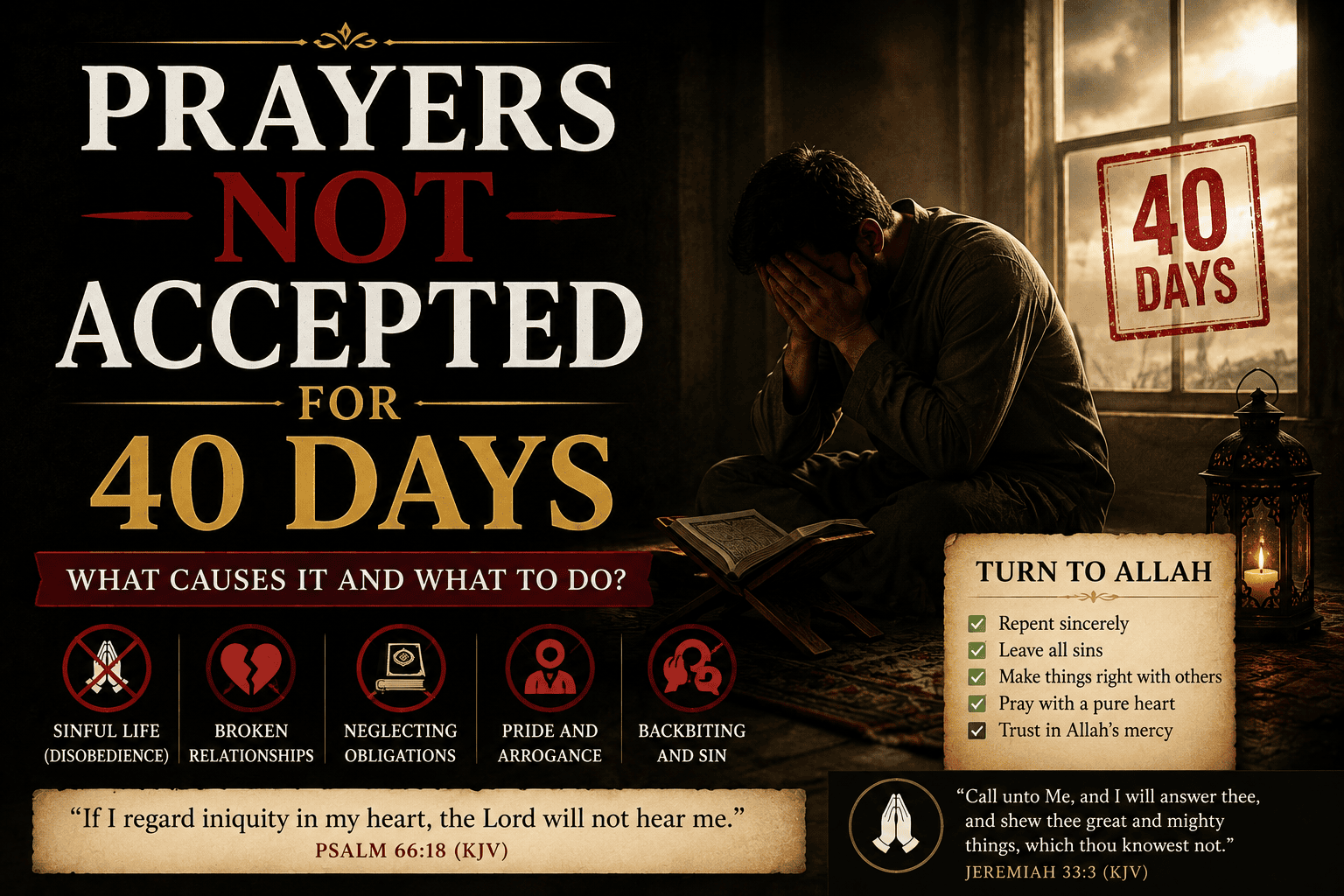
The phrase “prayers not accepted for 40 days” comes from prophetic narrations concerning drinking alcohol or becoming intoxicated. However, this statement is often misunderstood.
It does not mean that a Muslim should stop praying for 40 days, nor does it mean that the person becomes permanently excluded from Allah’s mercy.
Several Islamic sources explain an important distinction between a prayer being valid as an act of worship and receiving its full reward or acceptance.
A person who has committed this sin is still required to pray. Scholars cited by SeekersGuidance and IslamQA explain that the 40-day warning should not be understood as permission to abandon salah.
Most importantly, Islam emphasizes repentance and returning to Allah. The Qur’an says in Surah Az-Zumar 39:53 that believers should not despair of Allah’s mercy and that He is Forgiving and Merciful.
What Does “Prayers Not Accepted for 40 Days” Mean?
The statement refers specifically to narrations about alcohol and intoxicants, rather than establishing a general rule that every sinful action causes prayers to be rejected for exactly 40 days.
Use up and down arrow keys to resize the meta box pane.
Move upMove downShow or hide panel
- SEO
- Readability
- Inclusive language
- Schema
- Social
Optimize your content for discovery or get new content suggestions.Get
A narration attributed to the Prophet Muhammad ﷺ states that whoever drinks wine has their prayer not accepted for forty days, with repentance mentioned as the way back to Allah’s forgiveness.
This teaching is reported in hadith collections including Jami` al-Tirmidhi and is discussed by several Islamic scholars.
The key point is the meaning of “not accepted.”
Islamic scholars commonly distinguish between:
- Validity: Whether the prayer has been performed correctly and fulfills the religious obligation.
- Acceptance and reward: Whether Allah grants the person the reward and acceptance associated with the worship.
For example, a Hanafi explanation from SeekersGuidance states that the prayer remains valid when its required conditions and actions are fulfilled, even though the hadith warns about its acceptance and reward.
Therefore, the statement should never be interpreted as “do not pray for 40 days.”
Does a Person Still Have to Pray During Those 40 Days?
Yes. A Muslim should continue performing the five daily prayers.
Stopping salah because of this warning would create another serious problem. Islamic scholarly explanations specifically emphasize that the 40-day statement does not make prayer unnecessary.
IslamQA explains that the prayers are not considered invalid simply because of the person’s sin, and the individual should not abandon prayer.
This distinction is especially important for someone who feels ashamed or believes they are no longer worthy of praying.
A person should not think:
“I have sinned, so there is no point in praying.”
Instead, the appropriate response is:
“I have sinned, so I should turn back to Allah and continue praying.”
Prayer remains an essential act of worship and a means of maintaining one’s relationship with Allah.
Does This Apply to Every Haram Food or Sin?
No—not according to the specific 40-day prayer narrations.
The 40-day wording is particularly associated with alcohol and intoxication in the relevant prophetic narrations. A 2025 answer from SeekersGuidance specifically addresses the misconception that consuming any unlawful substance or food automatically means that prayers remain unanswered for 40 days.
It explains that the specific 40-day ruling is mentioned in prophetic narrations concerning alcohol and intoxication. This distinction matters because broad statements such as “any haram food means your prayers won’t be accepted for 40 days” can go beyond what the cited hadith establishes.
Other sins may affect a person’s spiritual condition, repentance, and the acceptance of deeds, but they should not automatically be assigned the specific 40-day ruling without reliable evidence.
Why Is Alcohol Prohibited in Islam?
The Qur’an clearly addresses intoxicants.
In Surah Al-Ma’idah 5:90, believers are commanded to avoid intoxicants, along with other practices mentioned in the verse. The following verse also explains that intoxicants can create hostility and distract people from remembering Allah and praying.
This provides important context for understanding why Islamic teachings treat intoxication seriously. The issue is not merely about a particular drink. Rather, the Qur’anic guidance connects intoxicants with spiritual and social harm.
For Muslims seeking to understand the 40-day narration, it is therefore helpful to read the hadith alongside the broader Qur’anic teaching about intoxicants.
What If Someone Sincerely Repents?
There is a strong message of hope in Islamic teachings about repentance.
The Qur’an states in Surah Az-Zumar 39:53:
“Do not despair of the mercy of Allah.”
The following verse calls people to return to their Lord in repentance.
The hadith discussing the 40-day period also mentions repentance. Islamic scholarly explanations therefore emphasize that a person should not view the warning as a permanent spiritual sentence.
A sincere return to Allah can include:
- Stopping the sinful behavior.
- Feeling genuine remorse for the sin.
- Asking Allah for forgiveness.
- Resolving not to return to the sin.
- Continuing the obligatory prayers and other acts of worship.
- Taking practical steps to remain away from the behavior.
Repentance is not about waiting until a particular number of days has passed. It is about genuinely turning back to Allah.
Is a Person Considered Impure for 40 Days?
The 40-day narration should not be understood to mean that the person’s body remains physically impure for 40 days.
This is another common misunderstanding.
The warning concerns the acceptance and reward of prayer, not a rule that the person cannot perform salah, make wudu, enter a mosque, or interact normally with other Muslims for 40 days.
The scholarly distinction between the validity of prayer and its reward is important here. SeekersGuidance explains that “not accepted” in this context does not mean that the prayer is invalid or that the obligation to pray disappears.
Therefore, someone who has sinned should not isolate themselves from worship.
What Should a Muslim Do After Committing This Sin?
The most constructive response is to return to Allah rather than give up.
1. Continue praying
Do not abandon salah. The five daily prayers remain important.
2. Make sincere tawbah
Speak to Allah honestly and ask for forgiveness. Repentance does not require complicated wording.
3. Avoid despair
Feeling regret can lead a person toward repentance, but hopelessness can prevent them from returning to Allah. The Qur’an explicitly warns believers not to despair of Allah’s mercy.
4. Stay away from the sinful behavior
Repentance should involve a genuine effort to leave the wrongdoing behind.
5. Increase good deeds
Prayer, Qur’an recitation, charity, remembrance of Allah, and other righteous actions can help a person rebuild their spiritual discipline.
6. Seek reliable Islamic guidance when necessary
If someone has a specific question about repentance, missed prayers, or a particular circumstance, they can consult a qualified imam or knowledgeable Islamic scholar. Differences between schools of Islamic jurisprudence can affect some detailed rulings.
Does Repentance Make the 40 Days Disappear?
The hadith itself connects repentance with Allah’s forgiveness. However, Muslims should be careful about making claims about exactly how Allah will respond to an individual’s worship.
The safest approach is to understand the teaching as a serious warning against intoxicants combined with an invitation to repent, rather than trying to calculate exactly how many rewards a person will receive after repentance.
Allah’s mercy should encourage repentance, not encourage anyone to treat the sin lightly.
Can You Still Make Dua?
Yes. A person who has sinned should continue turning to Allah through dua, asking for forgiveness, guidance, strength, and righteousness.
The 40-day narration specifically concerns salah, and it should not automatically be transformed into a claim that every personal supplication is rejected for 40 days.
A person should therefore continue making dua while seeking Allah’s forgiveness.
A simple original devotional dua could be:
“O Allah, forgive my mistakes, strengthen my faith, help me leave what displeases You, and guide me toward what is good and pleasing to You. Grant me sincere repentance and help me remain steadfast in prayer.”
This is an original devotional prayer, not a quotation from the Qur’an or a hadith.
What Is the Main Lesson of the 40-Day Hadith?
The teaching contains two important messages that should be held together:
First, the sin is serious. The Qur’an commands believers to avoid intoxicants, and the prophetic warning about 40 days reinforces the seriousness of the matter.
Second, repentance remains open. The Qur’an tells those who have sinned not to despair of Allah’s mercy and calls them to return to Him.
So the correct response is neither to minimize the sin nor to abandon worship.
Instead:
Repent. Keep praying. Ask Allah for forgiveness. Leave the sin behind. And continue seeking His mercy.
Frequently Asked Questions
Are prayers really not accepted for 40 days after drinking alcohol?
Prophetic narrations do state that the prayer of someone who drinks wine or becomes intoxicated is not accepted for forty days. Islamic scholars commonly explain that this does not mean the obligatory prayer becomes invalid or that the person should stop praying.
Should I stop praying for 40 days?
No. A person should continue performing the obligatory prayers. The 40-day warning is not permission to abandon salah.
Does the 40-day rule apply to every haram thing?
Not automatically. The specific prophetic narrations about prayers not being accepted for 40 days concern alcohol and intoxication. They should not be generalized to every sinful action without evidence.
Can Allah forgive someone who committed this sin?
Yes. The Qur’an teaches believers not to despair of Allah’s mercy and calls them to return to Him in repentance.
Can I still make dua after committing the sin?
Yes. A Muslim should continue turning to Allah, asking for forgiveness and guidance. The 40-day narration about salah should not be automatically interpreted as a 40-day ban on every form of dua.
Final Takeaway
The phrase “prayers not accepted for 40 days” refers to a serious Islamic warning associated with alcohol and intoxication. However, it does not mean that a Muslim should stop praying, become physically impure for 40 days, or lose hope in Allah’s mercy.
The Qur’an also clearly addresses intoxicants in Surah Al-Ma’idah 5:90, instructing believers to avoid them and seek a life of righteousness.

The Faith & Tradition Research Team helps develop and organize resources relating to religious traditions represented on Prayerium. Our focus is on researching established practices, terminology, historical context, and traditional prayers while presenting different faith traditions with care and respect.