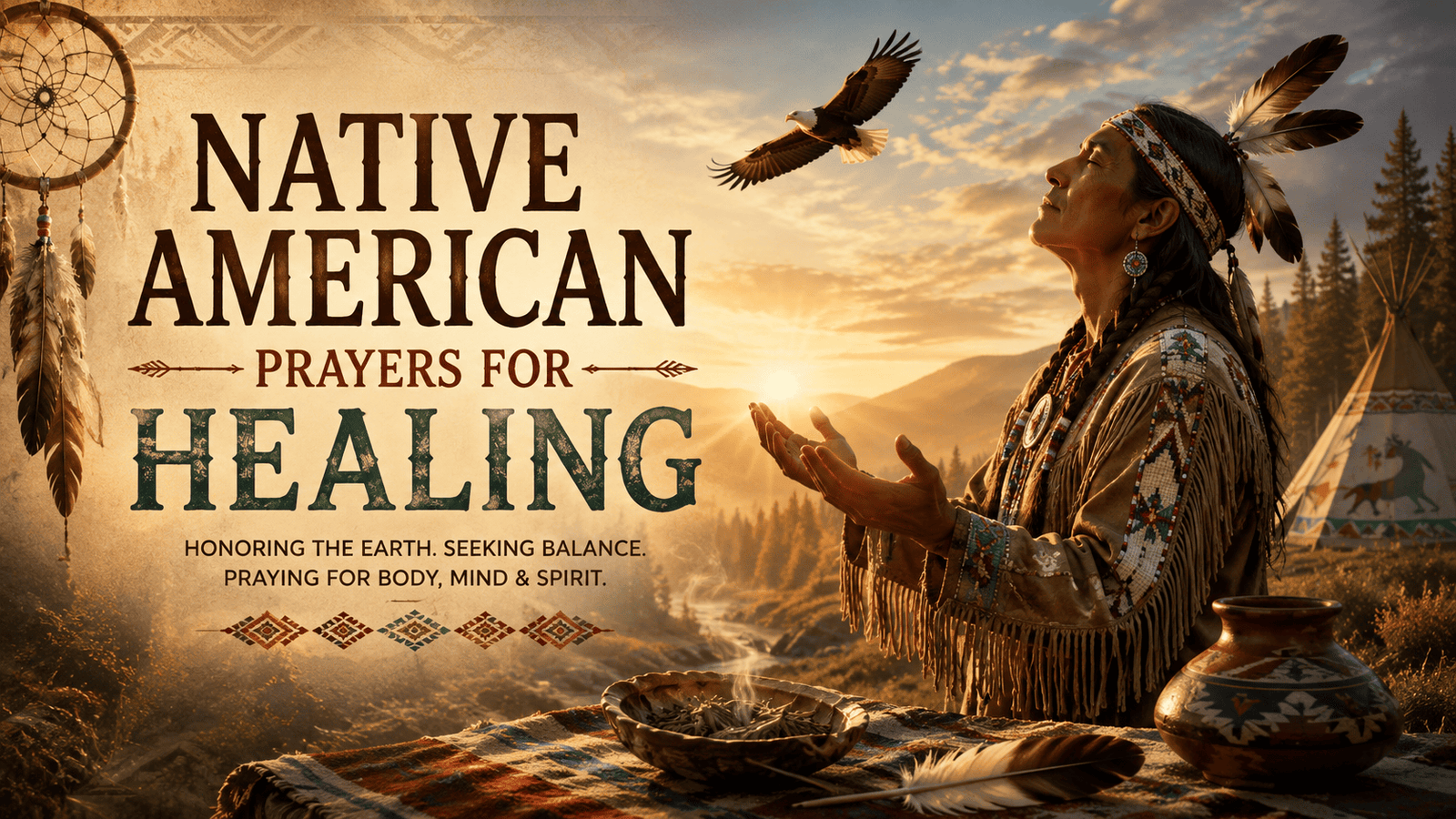
When people search for Native American prayers for healing, they may be looking for words of comfort, spiritual reflection, or a respectful way to connect healing with nature, community, gratitude, and hope.
However, there is an important distinction to make at the beginning: there is no single Native American prayer tradition.
Indigenous peoples in the United States represent many distinct nations, languages, histories, spiritual traditions, and contemporary religious practices. Healing traditions can differ significantly from one community to another.
For that reason, the prayers below are original devotional prayers inspired by broad themes such as gratitude, connection, balance, community, and care for the natural world.
They are not presented as authentic prayers belonging to a particular Native nation, and they should not be treated as substitutes for a tribal ceremony or traditional healing practice.
What Are Native American Healing Prayers?
Native American healing traditions are diverse rather than one unified system. Specific healing practices, ceremonies, and spiritual teachings vary considerably among Tribal communities.
Research on Native American and Alaska Native healing also emphasizes that spirituality and healing can be closely connected with community, cultural continuity, land, and everyday life.
Prayer may be one part of a broader spiritual or healing tradition, but its meaning depends on the particular community and tradition involved.
For example, research on Diné perspectives has described connections among healing, prayer or reverence, traditional teachings, community, and relationships with the land. That does not mean every Native nation shares the same beliefs or practices.
This distinction matters because using a generic “Native American prayer” as though it represents every Indigenous community can unintentionally erase important cultural differences.
10 Original Prayers for Healing
The following prayers are original devotional writings for reflection. They are not traditional Tribal prayers, sacred texts, or translations of Indigenous ceremonial words.
1. A Prayer for Healing and Balance
Creator,
Bring peace to the places within me that feel unsettled. Help me recognize what needs care, what needs patience, and what I need to release.
May I seek balance in my thoughts, relationships, choices, and daily life. Help me listen carefully to the people around me and remain attentive to the world that sustains us.
When I feel discouraged, give me the strength to take the next step. When I feel overwhelmed, remind me that healing can take time.
May I move forward with gratitude, humility, courage, and compassion.
Amen.
2. A Prayer for Strength During Illness
Creator,
Be near to those who are facing illness and uncertainty.
Give them courage for difficult days and patience when recovery does not happen as quickly as hoped. Surround them with people who offer genuine care, encouragement, and practical support.
Help caregivers find strength as they care for someone they love. Give medical professionals wisdom and compassion as they provide treatment.
May every person facing illness find moments of peace, connection, and hope.
Amen.
3. A Prayer of Gratitude for the Natural World
Creator,
Thank You for the earth beneath our feet, the water that sustains life, the air we breathe, and the living world around us.
Help me slow down enough to notice what is often overlooked: the changing sky, the sound of water, the movement of trees, and the quiet of the natural world.
Teach me to approach creation with respect rather than taking it for granted.
May gratitude change the way I live, and may my actions show greater care for the world we share.
Amen.
4. A Prayer for Emotional Healing
Creator,
I bring You the hurt I have difficulty explaining.
Help me face painful emotions with honesty rather than fear. Give me patience with myself when healing feels slow.
Place supportive people in my path and give me wisdom to accept help when I need it. Help me remember that asking for support is not a failure.
Guide my thoughts toward peace, my choices toward wisdom, and my relationships toward kindness.
May I continue healing one day at a time.
Amen.
5. A Prayer for Family and Community
Creator,
Strengthen the bonds between people who care for one another.
Help families speak with patience, listen with respect, and make room for each person’s experience. Bring comfort to communities carrying grief, illness, hardship, or uncertainty.
Teach us that healing does not always happen alone. Help us recognize the value of companionship, shared responsibility, and practical kindness.
May our communities become places where people can find support without shame.
Amen.
6. A Prayer for an Elder or Loved One
Creator,
Watch over the person I love.
Give them comfort when they are tired, strength when they are struggling, and peace when they are afraid.
Help me care for them with patience and respect. Teach me to listen to their stories, value their presence, and appreciate the time we have together.
May our relationship be guided by gratitude, compassion, and understanding.
Amen.
7. A Prayer After a Difficult Time
Creator,
I have come through a difficult season, and I am still finding my way forward.
Help me recognize the strength it took to reach this moment without pretending that everything is already healed.
Give me wisdom to learn from what I have experienced without allowing hardship to define my entire future.
Surround me with people who encourage healthy healing, and help me extend compassion to myself and others.
May each new day bring another opportunity for peace and renewal.
Amen.
8. A Prayer for Healing the Community
Creator,
Bring healing to communities carrying the weight of loss, division, injustice, and hardship.
Help people listen before judging and understand before responding.
Give leaders wisdom, communities courage, and families patience. Help us care for vulnerable people and work toward relationships built on dignity and respect.
May healing include not only individual comfort but also stronger relationships, cultural respect, and responsibility toward one another.
Amen.
9. A Prayer for Hope
Creator,
When hope feels distant, help me find one reason to continue believing that better days are possible.
Give me courage when I cannot see the entire path ahead. Help me focus on what I can do today while accepting that some things take time.
Remind me to notice small moments of kindness, connection, beauty, and peace.
May hope grow quietly within me and become something I can share with others.
Amen.
10. A Prayer for Peace and Renewal
Creator,
Bring calm to my mind and renewal to my spirit.
Help me release what I cannot control while taking responsibility for what I can change.
Guide me toward relationships that support healing and away from choices that deepen harm. Help me respect my own needs while remaining compassionate toward others.
May I walk forward with humility, gratitude, strength, and peace.
Amen.
Important: There Is No Single “Native American Prayer”
One of the most important things to understand about this topic is that Native American is a broad term covering many different Indigenous nations and communities.
The spiritual traditions of the Diné, Lakota, Cherokee, Ojibwe, Haudenosaunee, Pueblo peoples, and many other nations should not automatically be treated as interchangeable. Their histories, languages, ceremonies, teachings, and relationships to spirituality can differ.
Academic and clinical literature specifically warns against treating Native cultures as a single uniform category. Even within an individual nation, beliefs and practices can vary between people and communities.
Therefore, a respectful article should avoid claiming that a particular prayer represents “the Native American tradition” unless it has been accurately attributed to a specific community and source.
Why Cultural Respect Matters
Some Native spiritual practices are sacred and community-specific. They should not simply be copied from a website and presented as generic wellness exercises.
The Native Governance Center’s guidance on cultural appropriation encourages people to ask where a practice comes from, who taught it, whether permission exists to share it outside its original context, and whether the practice is being treated with appropriate respect.
Historical context makes this especially important. The Smithsonian notes that Native peoples faced restrictions and persecution for practicing their traditional religions.In 1978, federal legislation was enacted to protect the freedom of Native peoples to believe, express, and practice their traditional religions.
Respect, therefore, means more than using appropriate words. It means recognizing that Indigenous spiritual traditions belong to living communities rather than treating them as a collection of aesthetic or mystical themes.
Healing, Community, and Connection
A recurring theme in research on Indigenous health and well-being is the importance of relationships.
Traditional healing approaches vary widely, but scholarship describes connections among spiritual life, community, cultural continuity, land, and well-being in some Native communities.
Research involving Diné perspectives, for example, highlights the importance of connection to land and cultural knowledge in approaches to healing and well-being.
That does not mean prayer alone should be expected to resolve illness or emotional suffering.
Instead, a prayer can be one part of a larger process that may include:
- Support from family and community
- Cultural and spiritual connection
- Appropriate medical care
- Mental health support when needed
- Rest and healthy routines
- Time outdoors or connection with meaningful places
- Reflection and gratitude
- Guidance from appropriate Tribal or spiritual leaders
Traditional healing should also not be confused with medical treatment. Specific traditional practices vary, and appropriate care depends on the individual and community.
How to Approach Native-Inspired Prayer Respectfully
If you are not a member of the specific Indigenous community whose tradition you are studying, avoid presenting a newly written prayer as an authentic ceremonial prayer.
Instead:
Learn the specific tradition
If you are interested in a particular nation, start with reliable information about that community rather than searching for a generic “Native American spirituality.”
Use accurate attribution
If a prayer is genuinely traditional, identify the community and reliable source when that information is available.
Don’t invent sacred language
Avoid creating words in an Indigenous language and presenting them as traditional simply because they sound appropriate.
Don’t imitate ceremonies
A written reflection about healing is different from reproducing a sacred ceremony. Some ceremonies and teachings may be restricted or intended for particular community members.
Listen to Indigenous voices
When learning about a specific tradition, prioritize Indigenous-led institutions, Tribal communities, recognized cultural educators, and sources that explain the tradition in its own context.
Can Prayer Replace Medical Treatment?
Prayer and spiritual reflection can be meaningful to people, but they should not be presented as a guaranteed cure for physical or mental illness.
Traditional healing and contemporary healthcare do not have to be treated as mutually exclusive. In some settings, culturally appropriate traditional healing services may be coordinated alongside healthcare. For example, Arizona’s Medicaid program describes traditional healing as a culturally grounded form of care provided through Tribal healers and community-connected services.
If someone is experiencing significant physical or emotional symptoms, appropriate healthcare should not be delayed because of prayer.
Prayer can be a source of comfort, meaning, connection, or hope while someone also receives whatever medical, psychological, or community support is appropriate for their situation.
What Makes a Healing Prayer Meaningful?
A meaningful prayer does not have to be elaborate.
For many people, the most important elements are:
Honesty: Say what you are actually feeling.
Gratitude: Recognize the people, relationships, places, or experiences that have supported you.
Connection: Remember that healing can involve relationships with family, community, and the world around you.
Humility: Avoid assuming that you understand another community’s sacred traditions simply because you have read about them.
Hope: Leave room for healing and renewal without promising a particular outcome.
Action: Let prayer accompany responsible choices and appropriate support rather than replacing them.
A Short Healing Prayer
If you need something brief, you can use this original prayer:
Creator,
Bring peace where there is pain, strength where there is weakness, and compassion where there is loneliness.
Help me care for myself and others with patience. Guide me toward people and choices that support healing.
Teach me gratitude for the life around me and courage for the road ahead.
May I move forward in peace, humility, and hope.
Amen.
Frequently Asked Questions
What are Native American prayers for healing?
The phrase can refer broadly to prayers associated with Indigenous spiritual traditions, but it should not imply that all Native nations share one healing-prayer tradition. Specific prayers, ceremonies, and teachings vary among communities.
Is there one traditional Native American healing prayer?
No. Native American peoples represent many distinct nations and traditions. A prayer belonging to one community should not automatically be described as representative of all Indigenous peoples.
Can I use an original prayer inspired by Native American themes?
You can use a general devotional reflection, but it should not be presented as an authentic Indigenous prayer or ceremony. The prayers in this article are intentionally labeled as original rather than traditional.
What themes are appropriate for a general healing prayer?
Broad themes such as gratitude, compassion, hope, community, balance, care for the natural world, and strength can be used in an original prayer without falsely attributing the wording to a particular Indigenous nation.
Should I use Native American ceremonies for healing?
Sacred ceremonies are connected to particular communities and traditions. Rather than copying a ceremony from a general online description, learn directly from appropriate Indigenous community sources or recognized cultural educators. Traditional healing practices vary considerably among Tribal communities.
Final Reflection
Healing is not a single experience, and Indigenous communities should never be reduced to one spiritual tradition.
If you are searching for Native American prayers for healing, the most respectful approach is to recognize the diversity of Native nations, avoid presenting invented words as traditional prayers, and understand that authentic ceremonies belong within their cultural and community contexts.
When referring to Native communities broadly, use respectful and inclusive terms such as Native American or Indigenous peoples of America.
Because Indigenous communities represent many distinct nations, cultures, languages, and traditions, avoid using a single term to describe all communities or assuming that one tradition represents everyone.
Native American communities represent many distinct nations, cultures, languages, and spiritual traditions. Avoid treating them as a single tradition or assuming that all communities share the same beliefs or practices.
For more context on the diversity of Native cultures and traditions, explore educational resources from the Smithsonian Institution’s Native Knowledge 360° and other reputable cultural and educational organizations.
The original prayers in this article offer a general space for reflection on healing, gratitude, community, nature, courage, and hope. They are not replacements for specific Indigenous traditions, and they do not promise a particular spiritual or medical outcome.

The Faith & Tradition Research Team helps develop and organize resources relating to religious traditions represented on Prayerium. Our focus is on researching established practices, terminology, historical context, and traditional prayers while presenting different faith traditions with care and respect.