
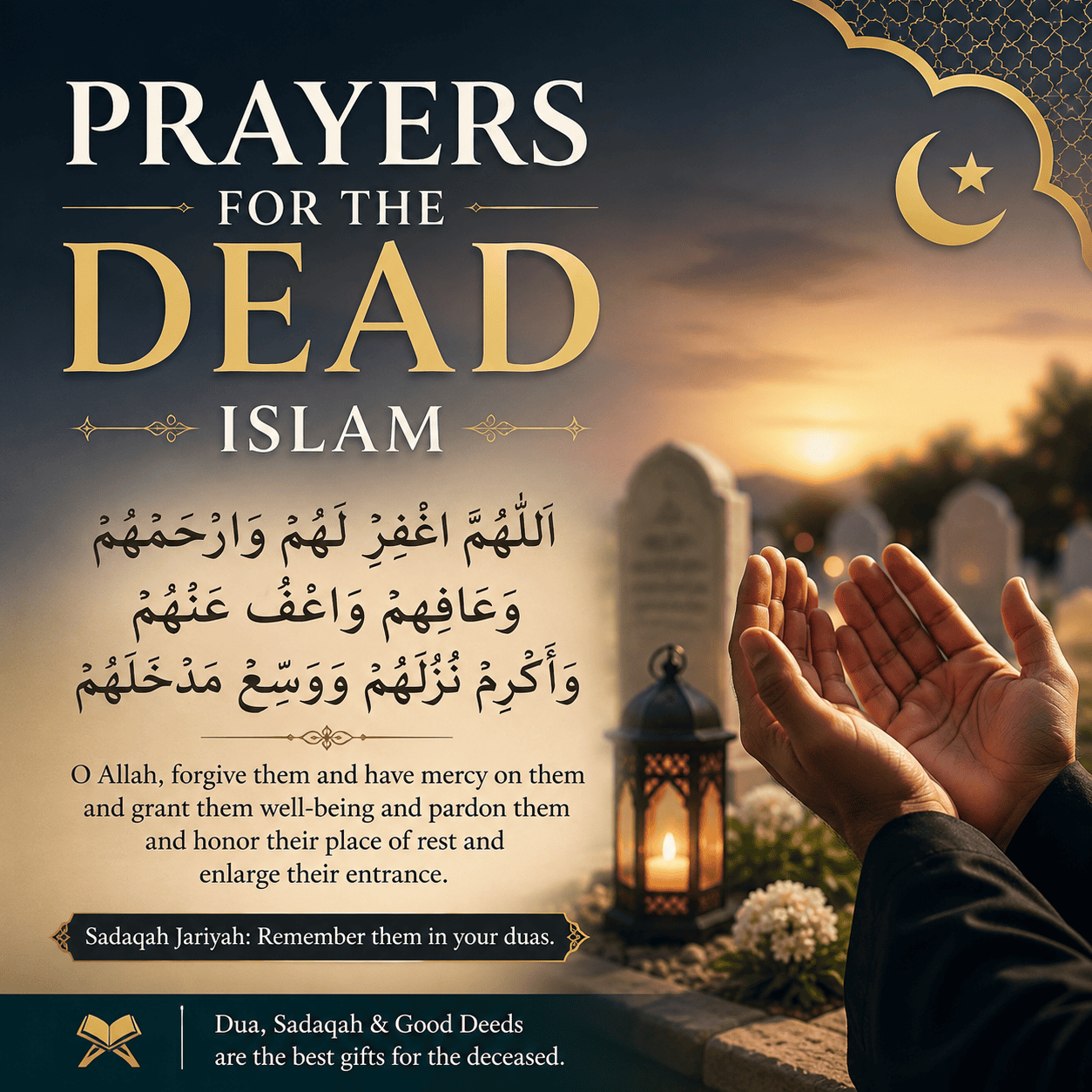
When a Muslim loved one dies, it is natural to wonder what you can still do for them. In Islam, one of the clearest ways to honor a deceased Muslim is to make dua (supplication) asking Allah for forgiveness, mercy, and peace.
The Qur’an itself includes prayers for believers who came before, and authentic hadiths describe supplication for the deceased during the funeral prayer and when visiting graves.
This guide explains prayers for the dead in Islam, including Qur’anic duas, supplications from the Sunnah, what to say when someone dies, what to recite at a graveyard, and how to pray for deceased parents.
What Does Islam Teach About Praying for the Dead?
In Islam, dua for a deceased Muslim means asking Allah to forgive the person, have mercy on them, pardon their shortcomings, and grant them goodness in the Hereafter.
Supplication for the deceased is not presented as a way for people to control a particular outcome; rather, it is an act of worship and a request for Allah’s mercy.
The Qur’an gives an especially direct example in Surah Al-Hashr 59:10, where believers ask Allah to forgive themselves and believers who preceded them in faith.
The Prophet Muhammad ﷺ also taught supplications for the deceased in the Salat al-Janazah (funeral prayer). In Sahih Muslim, a reported supplication asks Allah to forgive the deceased, have mercy on them, pardon them, honor them, and make their grave spacious.
So, if you are looking for a simple answer to “What are prayers for the dead in Islam?”, the central practice is sincere dua for the deceased, particularly asking Allah for forgiveness and mercy.
1. Dua for the Deceased: Forgiveness and Mercy
One of the well-known supplications reported from the Prophet ﷺ during the funeral prayer begins:
Arabic:
اللَّهُمَّ اغْفِرْ لَهُ وَارْحَمْهُ وَعَافِهِ وَاعْفُ عَنْهُ
Transliteration:
Allahumma ighfir lahu warhamhu wa ‘afihi wa‘fu ‘anhu.
Meaning:
O Allah, forgive him, have mercy on him, grant him well-being, and pardon him.
This supplication is particularly concise and focuses on four central requests: forgiveness, mercy, well-being, and pardon.
A longer supplication reported in Sahih Muslim also asks Allah to honor the deceased, make their grave spacious, cleanse them from faults, and protect them from the trial of the grave and the Fire.
For a deceased woman, the Arabic pronouns can be changed from the masculine form to the feminine form, such as lahā and ‘anhā.
A simple English dua
If you are making a personal supplication outside the formal funeral prayer, you can also ask Allah in your own words:
“O Allah, forgive my loved one, have mercy on them, pardon their mistakes, and grant them peace and goodness in the Hereafter.”
This is original devotional wording, not a quotation from the Qur’an or a hadith.
2. Qur’anic Dua for Believers Who Have Passed Before
The Qur’an provides a powerful example of praying for earlier believers in Surah Al-Hashr 59:10:
Transliteration:
Rabbana ighfir lana wa li-ikhwanina alladhina sabaquna bil-iman.
Meaning:
“Our Lord, forgive us and our brothers who preceded us in faith…”
The verse continues by asking Allah to keep resentment away from the hearts of believers and concludes with a reference to Allah’s kindness and mercy.
Because this is a Qur’anic supplication, it is important to distinguish it from a newly written prayer. The wording comes from Qur’an 59:10, rather than being an original prayer created for this article.
3. Dua for Deceased Parents
The Qur’an also teaches believers to ask Allah for mercy upon their parents:
Transliteration:
Rabbi irhamhuma kama rabbayani saghira.
Meaning:
“My Lord, have mercy upon them as they raised me when I was small.”
This supplication appears in Surah Al-Isra 17:24.
Another Qur’anic prayer is found in Surah Ibrahim 14:41:
Transliteration:
Rabbana ighfir li wa liwalidayya wa lil-mu’minina.
Meaning:
“Our Lord, forgive me, my parents, and the believers…”
The verse connects this request with the Day on which the account is established.
These verses can be especially meaningful when remembering a deceased mother or father.
4. Dua During the Janazah Prayer
The Salat al-Janazah is the Islamic funeral prayer. Supplication for the deceased is a central part of it. A narration in Sahih Muslim records the Prophet ﷺ making a detailed dua for a deceased person, asking Allah for forgiveness, mercy, pardon, an honorable reception, and protection from the trials associated with the grave and the Hereafter.
Another narration recorded by Jami` at-Tirmidhi reports a supplication beginning with a request for Allah to forgive the living and deceased, those present and absent, young and old, male and female.
A commonly reported portion is:
Transliteration:
Allahumma ighfir lihayyina wa mayyitina.
Meaning:
“O Allah, forgive our living and our deceased.”
The exact details of the funeral prayer can differ among Islamic legal traditions, so someone attending a Janazah should follow the established practice of the imam or community rather than assuming that every Muslim performs it identically.
5. What to Say When Someone Dies
When Muslims receive news of a death or experience a calamity, the Qur’an teaches the words:
Transliteration:
Inna lillahi wa inna ilayhi raji’un.
Meaning:
“Indeed, we belong to Allah, and indeed to Him we will return.”
This is from Qur’an 2:156.
This statement is not itself a specific funeral dua for the deceased. Rather, it expresses the believer’s recognition that human life belongs to Allah and that all people ultimately return to Him.
After saying it, a person may make sincere dua for the deceased and for the bereaved family.
6. Dua When Visiting a Muslim Graveyard
The Prophet ﷺ taught his companions a greeting and supplication for visiting graves. A narration in Sahih Muslim records:
Transliteration:
As-salamu ‘alaykum ahlad-diyari minal-mu’minina wal-muslimin, wa inna in sha’ Allahu bikum lahiqun, as’alullaha lana wa lakumul-‘afiyah.
Meaning:
“Peace be upon you, inhabitants of these dwellings, among the believers and Muslims. Indeed, if Allah wills, we will join you. We ask Allah for well-being for us and for you.”
This wording is reported in Sahih Muslim 975.
The practice highlights an important point: visiting a grave is not simply about remembering the person. It is also an opportunity to turn to Allah in supplication and reflection.
7. Dua for All Deceased Muslims
You do not have to limit your supplication to a family member. The Qur’an describes believers asking Allah to forgive those who preceded them in faith.
You can make a simple personal dua such as:
“O Allah, forgive the believing men and women who have passed away. Have mercy upon them, pardon their shortcomings, and grant them goodness in the Hereafter.”
This is original devotional wording, not a Qur’anic quotation.
A Qur’anic alternative is the prayer from Surah Al-Hashr 59:10, which specifically asks Allah to forgive believers who came before.
8. Can Dua Benefit the Deceased?
There is direct evidence in the Sunnah that supplication by a righteous child is among the matters specifically mentioned as continuing after a person’s death.
Sahih Muslim 1631 reports that when a person dies, their deeds come to an end except for three matters, including ongoing charity, beneficial knowledge, and a righteous child who prays for them.
This should not be expanded into a promise about a specific outcome for an individual. The Islamic approach is to ask Allah sincerely for mercy and forgiveness while leaving the final judgment and outcome to Him.
The broader Qur’anic pattern also supports praying for believers who preceded us, as shown in Surah Al-Hashr 59:10.
9. What Can You Pray for When Someone Has Died?
When making dua for a deceased Muslim, common themes include:
| What to Ask Allah For | Purpose |
|---|---|
| Forgiveness | Ask Allah to forgive the deceased’s sins |
| Mercy | Ask Allah to show them His mercy |
| Pardon | Ask Allah to overlook their shortcomings |
| Well-being | Ask Allah to grant them safety and goodness |
| An honorable reception | Reflects the prophetic funeral supplication |
| A spacious grave | Included in a reported funeral dua |
| Protection from the Fire | A request found in the prophetic supplication |
| Goodness in the Hereafter | Ask Allah for a favorable final outcome |
These themes are grounded particularly in the supplications reported in Sahih Muslim concerning the deceased.
10. How to Make Dua for a Deceased Loved One
If you are grieving, you do not need complicated wording to begin. A simple approach is:
- Turn to Allah sincerely.
- Mention the deceased by name if you wish.
- Ask Allah to forgive and have mercy on them.
- Ask Allah to pardon their shortcomings.
- Use an established Qur’anic or prophetic dua when you know one.
- You may also make a personal supplication in words you understand, particularly outside the formal prayer.
- Continue making dua rather than feeling that you must find one perfect formula.
The purpose is sincere supplication, not memorizing a particular number of repetitions.
11. Common Mistakes to Avoid
Treating every online dua as a hadith
A prayer found on a website, social media post, or image is not automatically a prophetic supplication. Before calling wording “authentic,” check whether it is actually attributed to the Qur’an or a reliable hadith source.
Presenting original wording as scripture
An English prayer written for personal devotion can be meaningful, but it should not be labeled as Qur’an or Sunnah unless its source is established.
Assuming every Muslim community performs Janazah identically
Details of funeral prayer can vary among Islamic schools and communities. The core purpose—supplicating for the deceased—is well established, while particular procedural details may differ.
Promising a specific spiritual result
It is appropriate to ask Allah for forgiveness, mercy, and goodness. It is not appropriate to guarantee that a particular prayer will produce a specific divine outcome.
Forgetting the bereaved
Praying for the deceased is important, but the living family may also need compassion and support. A simple dua can ask Allah to give the family patience, comfort, and strength during grief.
Frequently Asked Questions
What is the best prayer for the dead in Islam?
A strong starting point is the prophetic supplication reported in Sahih Muslim asking Allah to forgive the deceased, have mercy on them, pardon them, and grant them well-being.
Longer prophetic supplications also ask for an honorable reception, a spacious grave, and protection from the trials of the grave and Fire.
What Quran verse can I read for someone who has died?
Several Qur’anic passages contain supplications for those who came before, including Qur’an 59:10, which asks Allah to forgive believers who preceded us in faith, and Qur’an 14:41, which asks forgiveness for parents and believers.
What should I say when I hear that someone has died?
The Qur’an teaches believers to say:
Inna lillahi wa inna ilayhi raji’un.
It means, “Indeed, we belong to Allah, and indeed to Him we will return.” This is from Qur’an 2:156.
You can then make a sincere dua asking Allah to forgive and have mercy upon the deceased.
What dua should I make for my deceased parents?
You can recite the Qur’anic prayer from Surah Al-Isra 17:24, asking Allah to have mercy upon your parents as they raised you when you were young. You can also use the prayer in Surah Ibrahim 14:41, which asks Allah to forgive one’s parents and the believers.
What should I say when visiting a Muslim grave?
A supplication taught by the Prophet ﷺ begins by greeting the inhabitants of the graves and asking Allah for well-being for them and for the living. This is reported in Sahih Muslim 975.
Final Reflection
Prayers for the dead in Islam center on a simple but profound act: turning to Allah with sincere dua for those who have passed away.
The Qur’an gives believers words for asking forgiveness for earlier believers, while the Sunnah provides specific supplications for the deceased during Janazah and when visiting graves.
You can explore relevant Qur’anic duas for the deceased on Quran.com and authentic supplications reported in the Sunnah through Sunnah.com. If you have lost someone you love, you do not need elaborate language to remember them in prayer.
You can use an established Qur’anic or prophetic supplication, or make a sincere personal dua asking Allah for forgiveness, mercy, and goodness for the deceased. The outcome belongs to Allah, while the act of turning to Him is itself an expression of faith, remembrance, and care.

The Faith & Tradition Research Team helps develop and organize resources relating to religious traditions represented on Prayerium. Our focus is on researching established practices, terminology, historical context, and traditional prayers while presenting different faith traditions with care and respect.