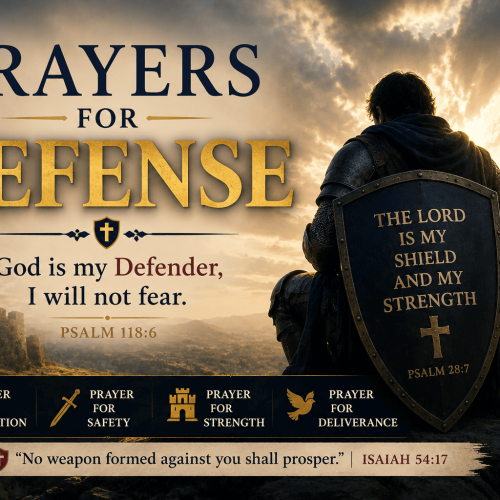

When someone searches for prayers for possession, they may be looking for a Christian prayer for protection, freedom from evil, or guidance during a frightening spiritual experience.
Christian traditions approach these situations carefully, and prayer can be a meaningful way to turn toward God without treating prayer as a guaranteed formula for a particular outcome. In Catholic teaching, a formal exorcism is distinct from ordinary personal prayer.
A major exorcism is reserved for an authorized priest with the required permission of the diocesan bishop, and the Church stresses careful discernment rather than assuming that every troubling experience is demonic possession.
The prayers below are original devotional prayers written for this article. They are not presented as official exorcism rites or as substitutes for pastoral, medical, or mental-health care.
1. A Prayer for Protection From Evil
Heavenly Father,
I turn to You in faith and ask for Your protection. Surround me with Your peace and help me remain grounded in Your love when I feel afraid or troubled.
Give me wisdom to recognize what is good, courage when I feel uncertain, and strength to seek appropriate help when I need it. Keep my heart focused on Christ rather than fear.
Lord Jesus, guide me toward truth, peace, and hope. May Your presence remind me that I do not have to face frightening circumstances alone.
Amen.
This prayer focuses on trust in God rather than attempting to command or confront an evil spirit.
2. A Prayer for Deliverance and Peace
Lord Jesus Christ,
I place my fears and burdens into Your hands. Please bring peace to my mind and heart and help me turn away from fear.
Give me strength to resist what is harmful and wisdom to recognize when I need the support of trusted people. Lead me toward people who can help me safely and compassionately.
May Your love guide me, Your truth steady me, and Your peace remain with me.
Amen.
Christian prayer for deliverance does not need to involve dramatic language. A simple prayer asking God for peace, wisdom, and protection can express sincere faith.
3. A Prayer for Someone Who Feels Spiritually Troubled
Merciful God,
Please be near to the person who feels frightened, confused, or spiritually troubled. Give them peace and surround them with people who will listen without judgment.
Grant wisdom to their family, pastor, priest, or other trusted caregivers as they seek to understand what is happening. Help everyone respond with patience, compassion, and sound judgment.
May fear not control their decisions. Lead them toward truth, safety, and hope.
Amen.
This is especially appropriate when praying for someone else. It asks for support and discernment rather than assuming a particular spiritual explanation.
4. A Short Prayer Against Fear
God of peace,
When I am afraid, help me remember that I can turn to You. Give me a calm heart, a clear mind, and courage to seek help when something is troubling me.
Protect me from fear and guide my thoughts toward what is true, good, and peaceful.
Amen.
A short prayer can be useful when someone is overwhelmed and does not know what words to say.
5. A Prayer With the Name of Jesus
Lord Jesus,
I call upon You with humility and faith. Help me remain close to You and place my fears in Your care.
Give me wisdom rather than panic, peace rather than confusion, and courage rather than fear. Guide the people helping me and lead me toward whatever support I need.
May my attention remain on Your love and mercy.
Amen.
The Christian tradition has a long history of prayer centered on the name of Jesus. The Catechism of the Catholic Church describes invoking Jesus’ name as a longstanding form of Christian prayer.
6. A Prayer for Family and Loved Ones
Heavenly Father,
Watch over my family and those I love. When someone among us is experiencing fear or distress, help us respond with patience instead of panic.
Give us wisdom to know what kind of help is needed. Bring trustworthy spiritual leaders, family members, and qualified professionals into our lives when appropriate.
Help us remain united in compassion and prayer. May Your peace guide our words, choices, and actions.
Amen.
Family members may feel frightened when someone is experiencing unusual or distressing circumstances. A calm, supportive response is more helpful than encouraging fear or making unsupported conclusions.
7. A Prayer for Strength, Wisdom, and Guidance
Lord God,
Give me strength for today and wisdom for what comes next. Help me distinguish between fear, uncertainty, spiritual concerns, and circumstances that require other kinds of care.
Guide me toward people who can help me responsibly. Keep me from making decisions based only on fear or assumptions.
Teach me to trust You while also accepting wise guidance and appropriate care.
May Your peace accompany me through every step.
Amen.
Amen.
What Does the Bible Say About Protection From Evil?
Christian Scripture repeatedly encourages believers to turn toward God in times of fear, temptation, and spiritual struggle.
For example, Ephesians 6:10–18 presents the Christian life using the imagery of the “armor of God,” emphasizing faith, righteousness, truth, salvation, prayer, and perseverance.
The passage is commonly understood as a call to spiritual steadfastness rather than as instructions for performing a personal exorcism.
Jesus also teaches His followers to pray for deliverance from evil in the Lord’s Prayer (Matthew 6:9–13).
These passages can provide a foundation for personal Christian prayer without turning Scripture into a ritual formula.
Is There a Specific Christian Prayer for Possession?
There is no single prayer that all Christians recognize as a universal prayer for possession.
Different Christian traditions have different practices concerning spiritual warfare, deliverance, and exorcism. In the Catholic Church, for example, exorcism is a specific ministry governed by Church rules.
The Catechism of the Catholic Church distinguishes a major exorcism from ordinary prayer and states that a major exorcism can be performed only by a priest with the bishop’s permission.
The Vatican has also specifically warned against unauthorized people attempting to use formal exorcism formulas. At the same time, it emphasizes that this does not prevent Christians from praying, including praying to be delivered from evil.
For that reason, personal prayers such as the ones above should be understood as devotional prayers for protection, peace, faith, and guidance, not as official exorcism rites.
Prayer for Possession vs. Exorcism: What’s the Difference?
| Personal prayer | Formal exorcism |
|---|---|
| Can be a personal expression of faith | A specific ecclesial rite |
| Can ask God for peace and protection | Addresses alleged demonic possession within an authorized Church process |
| Does not require someone to diagnose possession | Requires careful discernment |
| Can be offered privately | In Catholic practice, major exorcism requires an authorized priest |
| Is not a substitute for professional care | Must follow applicable Church requirements |
The distinction matters because prayer and exorcism are not interchangeable terms. Catholic canon law states that an exorcism over a possessed person may be performed legitimately only by someone with special and express permission from the local ordinary, and that permission is granted to a priest meeting the Church’s requirements.
What Should You Do if You Are Worried About Possible Possession?
If you or someone you know is experiencing something frightening, unusual, or difficult to understand, avoid immediately assuming that possession is the explanation.
A Catholic diocesan resource explaining exorcism emphasizes that alleged cases require careful assessment and that medical, psychological, and psychiatric considerations may need to be examined before a case is referred for an exorcist.
A wise response can include:
- Stay calm. Fear can make an already difficult situation feel worse.
- Pray for peace and wisdom. Prayer can be part of a person’s faith response.
- Talk with a trusted adult or family member. You should not have to handle frightening experiences alone.
- Speak with a trusted pastor, priest, or other qualified religious leader if spiritual guidance is important to you.
- Seek appropriate medical or mental-health support when unusual experiences, distress, confusion, or other symptoms are involved.
- Do not attempt an unauthorized exorcism. Formal rites have specific requirements in traditions that practice them.
This approach does not dismiss someone’s faith. Instead, it recognizes that spiritual concerns and health-related concerns should not automatically be treated as the same thing.
Can You Pray the Lord’s Prayer for Protection?
Yes. Christians commonly use the Lord’s Prayer as a central expression of faith and dependence on God. Its closing petition asks for deliverance from evil, making it particularly relevant when someone is praying during a time of fear or spiritual concern.
You can pray Matthew 6:9–13 slowly and reflectively, focusing on God’s holiness, His kingdom, daily provision, forgiveness, and deliverance from evil.
The prayer should be approached as an act of faith rather than as a magical formula.
A Simple Daily Prayer for Protection
If you want something brief to pray each day, you can use this original devotional prayer:
Father in Heaven, guide me today. Protect my heart from fear, give me wisdom in difficult moments, and help me remain close to You. Lead me toward people who can help me when I need support, and fill my heart with Your peace. Through Jesus Christ, Amen.
This prayer is intentionally simple. It focuses on trust, wisdom, peace, and seeking appropriate support rather than attempting to diagnose or confront an unseen cause.
Frequently Asked Questions
What is the best prayer for possession?
There is no universally established “best” prayer for possession. A Christian can pray for God’s protection, peace, wisdom, and deliverance from evil. If someone believes they may be experiencing demonic possession, they should also seek guidance from an appropriate religious leader rather than attempting a formal exorcism themselves.
Can I perform an exorcism prayer myself?
You should not attempt to perform a formal exorcism yourself. In Catholic teaching, major exorcism is reserved to an authorized priest. The Vatican has also cautioned the faithful against using formal exorcism formulas without the proper authority.
Personal prayers asking God for protection and peace are different from performing an exorcism.
Does Christianity teach that every unusual experience is possession?
No. Christian approaches that recognize demonic possession also distinguish it from illness and other conditions. Catholic teaching specifically says that psychological illness is different from demonic possession and emphasizes the importance of careful discernment.
Can I pray for someone who I believe is possessed?
Yes, you can pray for someone by asking God to give them peace, protection, wisdom, strength, and appropriate support. Avoid trying to diagnose the person or conducting a formal rite that is reserved for authorized religious ministers.
What Bible verses can I pray for protection?
Passages commonly used for prayer and reflection include Psalm 23, Psalm 91, Matthew 6:9–13, Ephesians 6:10–18, and James 4:7–8. When using a specific translation, consult that Bible for the exact wording rather than treating a paraphrase as a direct quotation.
Final Thoughts
Searching for prayers for possession often comes from a place of fear or uncertainty. Christian prayer can provide a way to turn toward God for peace, wisdom, courage, and guidance.
At the same time, prayer should not become a substitute for careful discernment or appropriate care. In traditions such as Catholicism, formal exorcism is a specific and regulated ministry rather than something that anyone should attempt.
The Catechism of the Catholic Church explains the Church’s teaching on exorcism and emphasizes the need to distinguish genuine cases from other conditions.
If you are frightened by something you are experiencing, you do not need to face that fear alone. Pray, seek support from trusted people, and allow qualified spiritual and professional caregivers to help you understand what is happening.

The Faith & Tradition Research Team helps develop and organize resources relating to religious traditions represented on Prayerium. Our focus is on researching established practices, terminology, historical context, and traditional prayers while presenting different faith traditions with care and respect.